
LISN (100 Amps) for DO-160, FAA, MIL-STD 461 & CISPR 25/16
Com-Power LI-3100 Line Impedance Stabilization Network (LISN):
-
The LI-3100 operates from 10 kHz to 400 MHz and supports compliance testing for DO-160, FAA, MIL-STD 461F, CISPR 25, and CISPR 16-1-2 standards.
-
It is designed to handle up to 100 amps AC with forced air cooling for reliable performance.
-
The LISN uses air-core inductors to prevent saturation and ensure stable performance over time.
-
It provides defined and stable impedance while isolating the EUT from power source influences, ensuring accurate and repeatable measurements.
-
The system includes a pair of separately housed, single-conductor LISNs for use with single-phase, dual-phase, or DC power systems.
-
Two LI-3100 units can be used together to support three-phase power systems (Wye or Delta configurations).
-
Superior Electric SUPERCON® shrouded sockets are used for mains and EUT connections, with color-coded plugs provided for easy setup.
-
The LISN features an unpainted mounting plate for a secure earth ground connection, which is necessary due to high leakage current.
-
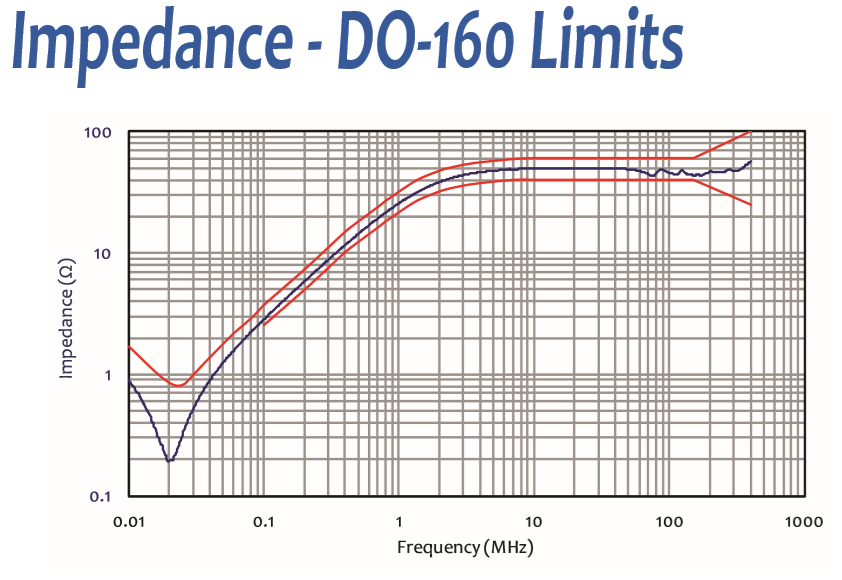
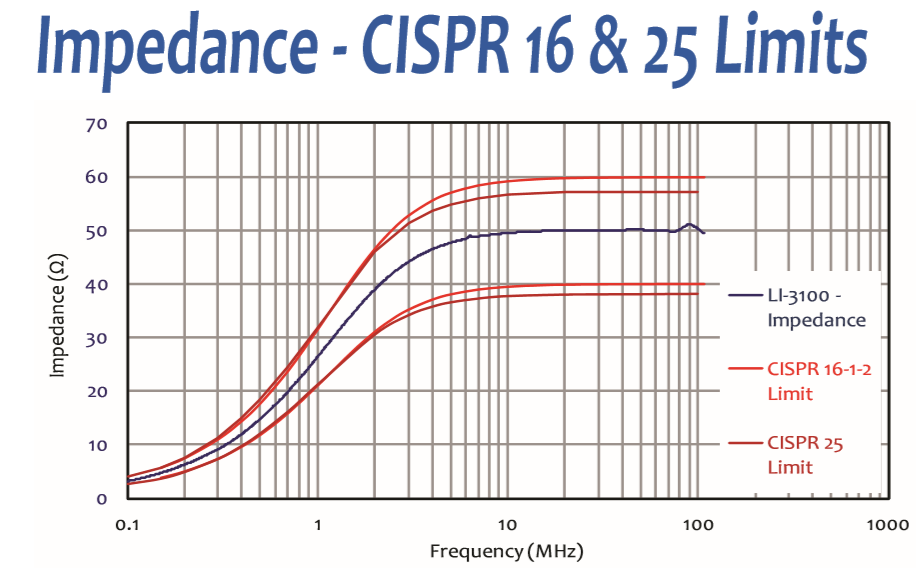
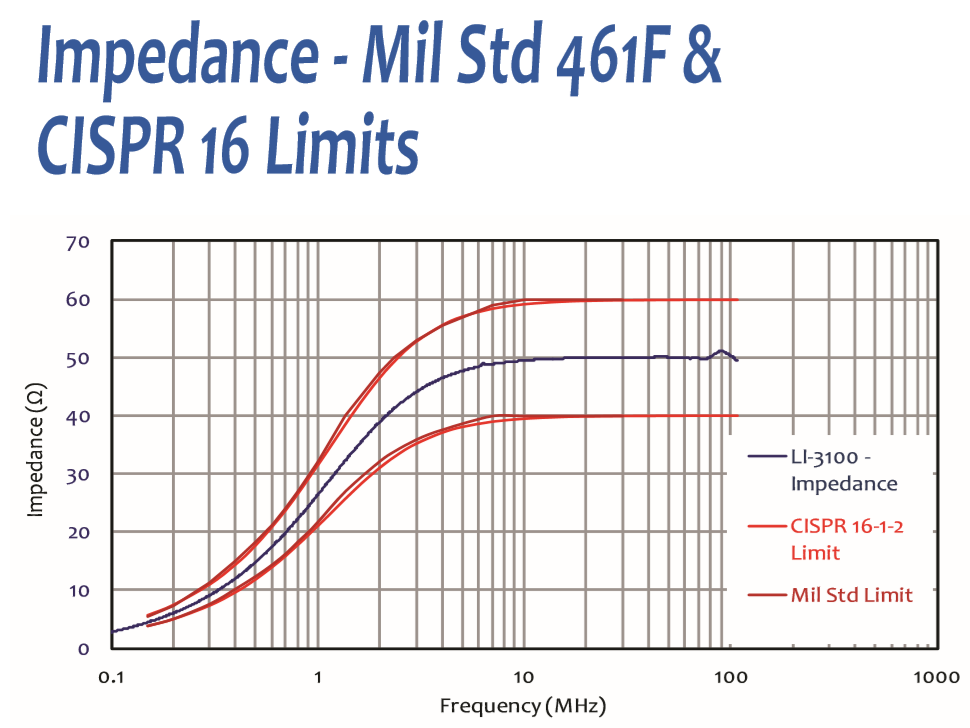
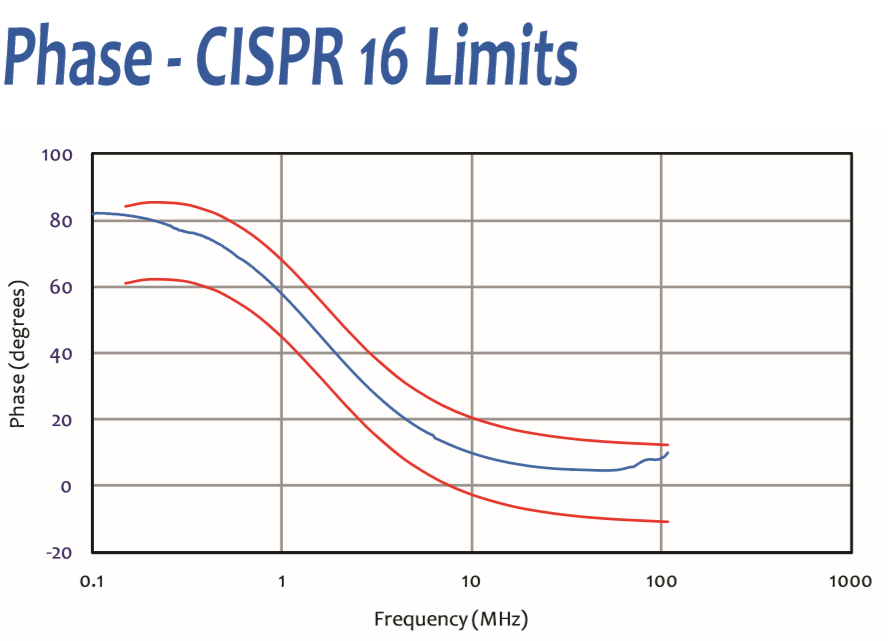
Each LI-3100 is individually calibrated to RTCA DO-160, FAA, MIL-STD 461F, CISPR 25, and CISPR 16-1-2, with impedance, phase, and insertion loss data provided.
-
The device is covered by a three-year standard warranty for long-term reliability and assurance.
Features
- ▸ Highest-current 3x Series 5 µH LISN, 100 A AC/DC with forced-air cooling — the flagship of the 3x Series for full-compliance MIL-STD 461F testing of high-power ground support equipment, aircraft starter-generators, military vehicle drive systems, and EV traction powertrains.
- ▸ Wide 10 kHz to 400 MHz frequency range — covers DO-160 Section 21, FAA conducted emissions, MIL-STD 461F CE101/CE102, CISPR 25 automotive, and CISPR 16 commercial bands in a single LISN.
- ▸ Multi-standard compliance: DO-160 / FAA / MIL-STD 461F / CISPR 25 / CISPR 16 — the 100 A rating supports the highest-current platforms in modern military, aerospace, and electric powertrain testing programs.
- ▸ 5 µH air-core inductor — lower inductance enables accurate high-frequency impedance stabilization to 400 MHz; air-core construction prevents magnetic saturation across all load currents up to the 100 A rating.
- ▸ Insertion loss < 0.5 dB (100 kHz–108 MHz) — minimal signal attenuation across the most-used portion of the LISN passband ensures measured disturbance voltages accurately represent EUT emissions.
- ▸ 100 A AC / 100 A DC current rating without DC derating — matched AC and DC current ratings support full-power testing of high-current AC and DC bus equipment alike.
- ▸ High voltage rating: 480 VAC / 600 VDC — supports 480 V industrial 3-phase systems and 540/600 V high-voltage DC bus configurations on military aircraft, vehicles, and traction powertrains.
- ▸ Forced-air cooling for continuous high-current operation — integrated cooling fans dissipate heat from the air-core inductor and current paths during extended testing of 100 A loads.
- ▸ Superior Electric SUPERCON® shrouded sockets — safe shrouded design rated for 100 A connections; matching color-coded plugs included for high-current mains and EUT wiring.
- ▸ 50 Ω N-type female RF connector — standard interface for direct connection to EMI receivers and spectrum analyzers across the full 10 kHz to 400 MHz range.
- ▸ 3-phase ready — a second LI-3100 pair extends the setup to 3-phase Wye or Delta industrial and military power systems.
- ▸ Individually NIST-traceable calibrated — impedance, phase, isolation, and insertion loss data shipped with each unit. ISO 17025 accredited calibration available on request.
- ▸ Three-year standard warranty — backed by manufacturer support.
Specifications
| Model | LI-3100 |
|---|---|
| Series | 3x Series — Multi-standard 5 µH, single-conductor pair, with forced-air cooling |
| Specification | DO-160 / FAA / MIL-STD 461F / CISPR 25 / CISPR 16 |
| Application | High-power ground support, aircraft starter-generators, military vehicle drives, EV traction |
| Frequency Range | 10 kHz – 400 MHz |
| Inductors | 5 µH (air-core) |
| Current Rating | 100 Amperes AC, 100 Amperes DC (forced-air cooling) |
| Voltage Rating | 480 VAC, 600 VDC |
| Cooling | Forced-air (integrated cooling fans) |
| RF Connector | 50 Ohms N-type (female) |
| Insertion Loss | < 0.5 dB (100 kHz – 108 MHz); see graph for full range |
| Mains & EUT Connections | Superior Electric SUPERCON® shrouded sockets |
| Calibration | Individual, NIST-traceable; ISO 17025 accredited available on request |
| Warranty | Three-year standard warranty |
All values are typical, unless specified. Ships as a pair of separately housed networks. All specifications subject to change without notice.
🔍 Not Sure This Is The Right LISN?
Compare all 25 Com-Power LISN models side-by-side with our interactive selection tool. Filter by current, voltage, frequency, and standards to find your perfect match.
Compare All LISN Models →LI-3100 DO-160 / MIL-STD-461F / CISPR 25 / CISPR 16-1-2 Single-Phase LISN FAQs
What is the LI-3100 and what makes it unique among Com-Power single-phase LISNs?
The LI-3100 is a single-conductor, 50Ω, 5 μH Line Impedance Stabilization Network (LISN) rated at 100 A AC with forced-air cooling, covering 10 kHz to 400 MHz. It is the only Com-Power single-phase LISN compliant with four major standards simultaneously: RTCA DO-160, MIL-STD-461F, CISPR 25, and CISPR 16-1-2. This multi-standard compliance in a single high-current instrument makes the LI-3100 the most versatile single-phase LISN in the Com-Power lineup, serving aerospace avionics, military equipment, automotive electronics, and high-power commercial products requiring multi-standard certification.
What four standards does the LI-3100 comply with and why is multi-standard compliance significant?
The LI-3100 is fully compliant with RTCA DO-160, MIL-STD-461F, CISPR 25, and CISPR 16-1-2. Multi-standard compliance matters because modern aerospace and defense platforms incorporate COTS electronics that must satisfy both military and commercial emissions standards simultaneously. Automotive suppliers producing equipment for both commercial EV platforms (CISPR 25) and military vehicle variants (MIL-STD-461) benefit equally. A single LI-3100 handles all four standards, eliminating the need for multiple LISNs in multi-standard certification programs.
What is the frequency range of the LI-3100 and what measurement significance does 10 kHz to 400 MHz have?
The LI-3100 covers 10 kHz to 400 MHz. This wide range is required because DO-160 Section 20 extends to 400 MHz — far beyond the 30 MHz upper limit of commercial CISPR 16-1-2 LISNs. The extension to 400 MHz is critical for avionics because conducted emissions above 30 MHz can couple into VHF and UHF communication and navigation systems on aircraft. MIL-STD-461F CE102 (10 kHz–10 MHz), CISPR 25 (150 kHz–108 MHz), and CISPR 16-1-2 (150 kHz–30 MHz) are all contained within the LI-3100’s single operating range.
What is the current rating of the LI-3100 and what class of equipment does it support?
The LI-3100 is rated at 100 A AC continuous with forced-air cooling. This covers aircraft main bus power conversion equipment, shipboard single-phase power distribution components, high-power military vehicle onboard power systems, large avionics power supply units, industrial motor drives requiring CISPR 16-1-2 compliance, and high-power EV and hybrid vehicle power electronics requiring CISPR 25 compliance.
What is the voltage rating of the LI-3100 and what power systems does it support?
The LI-3100 is rated at 480 VAC line to ground and 600 VDC. The 480 VAC rating covers industrial 50–60 Hz single-phase power and aircraft/shipboard 400 Hz bus voltages. The 600 VDC rating supports 540 VDC military aircraft bus standards, 600 VDC industrial DC distribution, and high-voltage battery bus systems in military and commercial electric vehicles.
Why does the LI-3100 use a 5 μH inductor rather than the 50 μH used in CISPR 16-1-2 / ANSI C63.4 commercial LISNs?
The 5 μH inductor is specified by DO-160, MIL-STD-461F, and CISPR 25 for their LISN network types. The 5 μH network produces an impedance characteristic that rises steeply with frequency, reaching the required 50 Ω target and maintaining it through 400 MHz — where a 50 μH inductor would produce excessively high impedance not representative of real aerospace power bus conditions. CISPR 16-1-2 also specifies the 5 μH network as a valid configuration per its Table 5 requirements.
Why does the LI-3100 require forced-air cooling and how does the cooling system operate?
At 100 A, resistive losses generate substantial heat that passive convection cannot manage during extended compliance test sequences. The LI-3100 includes internal forced-air cooling fans. Cooling fans must be activated before energizing the EUT and maintained throughout testing. Operating at or near 100 A without cooling risks overheating the air-core inductor insulation, degrading inductance accuracy, and causing permanent damage.
The LI-3100 is sold as a pair of networks. Why is a pair required and how are they connected?
Single-phase AC and DC power systems have two current-carrying conductors (Line/Neutral or positive/negative DC bus), and compliance testing requires a LISN in series with each conductor simultaneously. One LI-3100 is installed in the Line conductor and one in the Neutral. Measurements are performed one conductor at a time with the inactive RF port terminated at 50 Ω. For three-phase systems, a second LI-3100 pair accommodates the additional phase conductors.
What type of connectors does the LI-3100 use at the mains and EUT ports?
The LI-3100 uses Superior Electric SUPERCON® shrouded sockets at both mains and EUT ports. At 100 A, the shrouded design is critical — accidental contact with live conductors at this current level is life-threatening. Color-coded plugs for mains and EUT wiring are included, rated for the full 100 A current capacity.
Why is the mounting plate of the LI-3100 left unpainted and what grounding is required?
The unpainted mounting plate enables a low-impedance metal-to-metal bond to the test ground or bonding plane. At 100 A, leakage currents through internal LISN capacitors are substantial and must return to earth ground. In MIL-STD-461 setups, a direct metal-to-metal bond to the bonding plane is required before power is connected. In CISPR setups, the bond goes to the reference ground plane per CISPR 16-1-2.
What RF connector does the LI-3100 use and what should be connected to the RF measurement port?
The LI-3100 uses a 50 Ω N-type female RF connector. This connects via 50 Ω coaxial cable to an EMI receiver or spectrum analyzer configured for the applicable standard’s frequency range and detector. The inactive LISN RF port must be terminated at 50 Ω. A Transient Limiter between the RF port and receiver is recommended, especially for high-power aerospace and industrial EUTs that generate significant power line transients.
What insertion loss does the LI-3100 provide and how is it applied in test data post-processing?
The LI-3100 provides insertion loss below 0.65 dB from 100 kHz to 108 MHz. The individual calibration data sheet supplies insertion loss values across the full 10 kHz to 400 MHz range. In compliance post-processing, the insertion loss correction from calibration data is added to raw EMI receiver readings at each frequency point to obtain the actual disturbance voltage, which is then compared against the applicable DO-160, MIL-STD-461F, CISPR 25, or CISPR 16-1-2 limit line.
How is the LI-3100 individually calibrated and what calibration data is supplied?
Every LI-3100 is individually calibrated per RTCA DO-160, MIL-STD-461F, CISPR 25, and CISPR 16-1-2. Impedance, phase, and insertion loss data across the full 10 kHz to 400 MHz range are supplied with each unit along with a certificate of calibration. Individual calibration verifies the impedance characteristic of the specific unit against all four applicable standard limits.
What is the warranty coverage for the LI-3100?
The LI-3100 carries a three-year warranty from Com-Power Corporation. As a passive instrument, its service life is long under normal laboratory conditions. Periodic recalibration on a one- or two-year interval is recommended to maintain measurement traceability across all four supported standards.
What are the physical dimensions and weight of the LI-3100?
Each LI-3100 network measures 10 x 10 x 21 inches (25.4 x 25.4 x 53.3 cm) and weighs 13 lbs (5.9 kg). A complete single-phase installation requires floor or heavy bench space for both units on the appropriate ground plane, high-current wiring rated for 100 A, cooling fan power connections, and a coaxial cable from the active RF port to the EMI receiver.
How does the LI-3100 compare to other Com-Power 5 μH single-phase LISNs such as the LI-325C, LI-350, and LI-550C?
All four models use 5 μH air-core inductors but differ in current rating, frequency range, and standards compliance. The LI-325C (25 A) and LI-350 (50 A) are lower-current counterparts for DO-160 and MIL-STD-461 testing. The LI-550C (50 A) covers CISPR 25 and CISPR 16-1-2 but not DO-160 or MIL-STD-461, and only to 108 MHz. The LI-3100 is unique in combining all four standards, the widest 10 kHz–400 MHz range, and the highest 100 A current rating in a single 5 μH single-phase LISN.
What types of equipment cannot be tested with the LI-3100 and what alternatives exist?
The LI-3100 is not suitable for: standard commercial FCC Part 15 or EN 55032 testing requiring the CISPR 16-1-2 50 μH V-network (use LI-125C, LI-150C, or LI-1100C); MIL-STD-461 50 μH CE102 testing (use LI-400C at 25 A or LI-4100 at 100 A); or three-phase equipment without a second pair (use two LI-3100 pairs or a LI-3P series LISN).
How is the LI-3100 used when performing DO-160 Section 20 conducted emissions testing on an aircraft avionics power supply unit?
Aircraft avionics power supply units (PSUs) converting 115 VAC 400 Hz aircraft bus power to regulated DC outputs can draw up to 100 A at full avionics rack load. The LI-3100 pair is installed between the 115 VAC 400 Hz test power source and the PSU input terminals, with the PSU operated at rated output into representative avionics loads. CE sweeps from 10 kHz to 400 MHz on both Line and Neutral capture the full DO-160 range. The LI-3100’s 480 VAC rating accommodates aircraft bus voltages, its 100 A rating supports full-load testing, and its 400 MHz upper limit ensures compliance with the VHF and UHF portion of the DO-160 Section 20 frequency range critical for aviation RF system coexistence.
How is the LI-3100 applied in CISPR 25 conducted emissions testing of a high-power EV traction inverter power supply?
High-power EV traction inverter auxiliary power supplies drawing up to 100 A from the vehicle’s high-voltage DC bus require CISPR 25 CE testing to ensure they do not interfere with in-vehicle AM, FM, DAB, and cellular receivers. The LI-3100 pair connects between the vehicle DC bus simulator and the auxiliary power supply input, operated at maximum rated current into representative loads. CISPR 25 CE measurements are performed from 150 kHz to 108 MHz on both positive and negative bus conductors. The LI-3100’s 600 VDC rating accommodates high-voltage vehicle bus levels, supporting full-load testing and ensuring worst-case emissions are captured against CISPR 25 Class 5 limits.
What does a MIL-STD-461F CE102 test setup look like using the LI-3100 for a high-power military vehicle single-phase power converter?
The LI-3100 pair is bonded to the MIL-STD-461 reference bonding plane via unpainted mounting plates. The military power supply connects to the LI-3100 mains inputs using 100 A rated color-coded connectors. A 50 Ω N-type cable runs from the active RF port to the EMI receiver configured for a 10 kHz to 10 MHz CE102 sweep. Cooling fans are activated first, then the EUT is brought to rated load. Line and Neutral are measured sequentially with the inactive RF port at 50 Ω. Calibration insertion loss corrections are applied to produce CE102 disturbance voltage values for comparison against MIL-STD-461F limits.
How is the LI-3100 used in a combined DO-160 and CISPR 25 qualification program for an aerospace-grade power converter used on both civil aircraft and military UAV platforms?
A power conversion unit intended for both civil aircraft (DO-160 Section 20) and military UAV applications (CISPR 25 and MIL-STD-461F CE102) benefits directly from the LI-3100’s multi-standard capability. The LI-3100 pair is set up once with the EUT at rated load. The DO-160 sweep from 10 kHz to 400 MHz is performed first, followed by CISPR 25 from 150 kHz to 108 MHz and CE102 from 10 kHz to 10 MHz — all without changing the LISN hardware. This eliminates test setup reconfiguration time, reduces variability between measurements under different standards, and produces a comprehensive multi-standard conducted emissions dataset from a single test session.


Quote Request
Other EMC Test Equipment
- Absorbing Clamps
- Antenna Kits
- Antenna Masts - Automated and Manual
- Antennas
- Bulk Current Injection probes
- CDNs - Coupling Decoupling Network
- Comb Generators
- Conducted Immunity Test Systems
- Current Monitor Probes
- Current Probe Calibration Fixtures
- EM Clamps
- Feed Through Capacitor
- ISNs - Impedance Stabilization Network
- LISNs - Single Phase
- LISNs - TEMPEST
- LISNs - Three Phase
- Magnetic Field Generator
- Near Field Probes
- Power Amplifiers
- Pre-compliance Emissions Test Systems
- Preamplifiers
- Spectrum Analyzers
- Surge Generators
- System Controllers
- Transient Limiters
- Tripods For EMC
- Turntables