
AC-220 Hybrid Combilog Antenna
AC-220 CombiLog Antenna:
-
Frequency Range: 20 MHz–2 GHz (emissions), 80 MHz–2 GHz (immunity)
-
Hybrid Design: Combines log periodic and biconical (bow-tie) elements
-
Polarization: Linearly polarized with good cross-polarization performance
-
Calibration: Individually calibrated to ANSI C63.5 with NIST traceability
-
Power Handling: Up to 500 Watts for immunity testing
-
Applications: EMI testing, immunity tests, shielding tests, site surveys
-
Compliance: Meets ANSI C63.5 and CISPR 16-1-4 balance/symmetry specs
-
Mounting: 1/4” x 20 thread; compatible with AT-812 Tripod, AM-400 Mast
-
Warranty: Standard 3-year warranty
-
Advantage: Replaces up to 4 separate antennas with a single hybrid unit
Features
- ▸ Single-antenna replacement for four conventional antennas — covers 20 MHz to 2 GHz as a receiving antenna and 80 MHz to 2 GHz as a transmitting antenna, eliminating the need to swap between biconicals, log-periodics, and other narrowband antennas.
- ▸ Hybrid log-periodic / biconical design — combines a log-periodic structure with low-frequency “bow-tie” elements integrated into the feed lines, providing the bandwidth advantages of both antenna types in one assembly.
- ▸ Common-mode chokes installed — suppress common-mode currents flowing on the outer conductor of the coaxial feed/receive cable, reducing measurement uncertainty caused by cable-borne pickup.
- ▸ High power handling for immunity testing — rated for up to 500 Watts continuous, allowing it to generate the high field strengths required for radiated immunity tests when driven by an RF power amplifier.
- ▸ Tight balance/symmetry per CISPR 16-1-4 — antenna symmetry held to better than ±1 dB across 30 MHz to 2 GHz, complying with the balance requirements of ANSI C63.5 and CISPR 16-1-4.
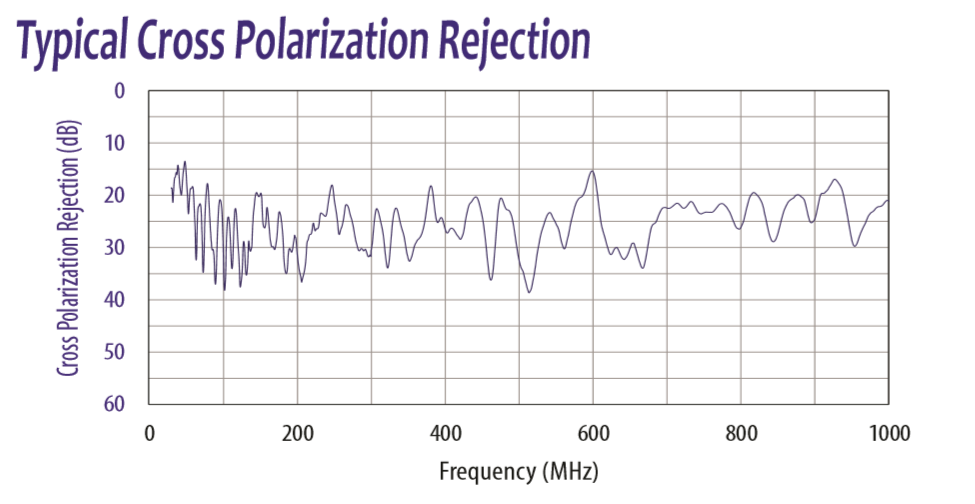
- ▸ Good cross-polarization performance — high cross-polarization rejection minimizes measurement error caused by orthogonal-polarization field components.
- ▸ Transmit and receive capability — functions as a receiving antenna for emissions testing and as a transmitting antenna for radiated immunity testing with the same hardware.
- ▸ Hinged polarization-change mount — integrated hinge mechanism allows the operator to switch between horizontal and vertical polarization quickly, without re-mounting the antenna.
- ▸ Standard 1/4"-20 mounting — mounting assembly includes a standard 1/4"-20 threaded hole for use with tripods, antenna masts, or custom mounting structures; recommended supports are the Com-Power AT-812 Tripod and AM-400 Antenna Mast.
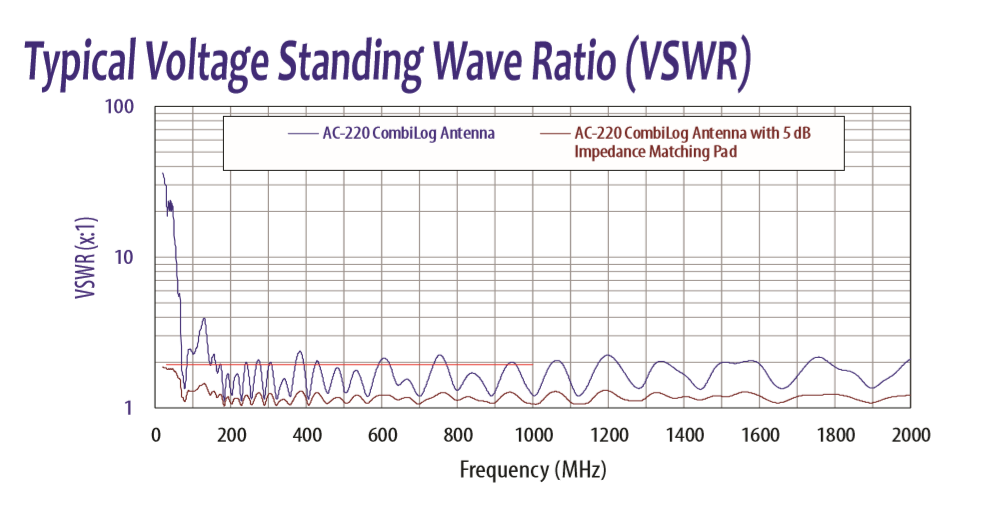
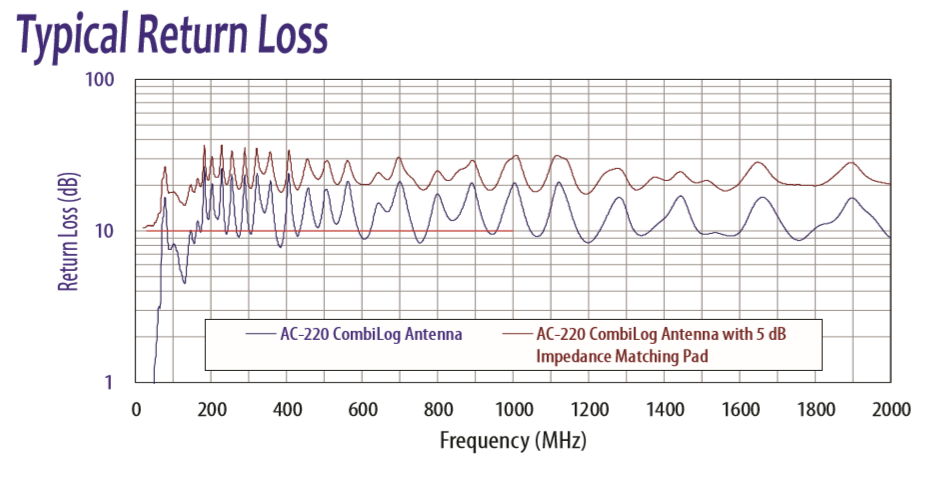
- ▸ Optional 5 dB impedance-matching pad — available to flatten VSWR and improve return loss for compliance with CISPR 16-1-4 measurement requirements.
- ▸ Regulatory compliance applications — suitable for qualification-level measurements per FCC, CISPR, EN, ETSI, and other major commercial EMC standards.
- ▸ General-purpose RF utility — useful for shielding effectiveness testing, site comparisons, field monitoring, and site surveys beyond formal compliance work.
- ▸ Individually calibrated, NIST-traceable — calibrated per ANSI C63.5; calibration data and certificate ship with each unit; ISO 17025 accredited calibration available on request.
- ▸ Three-year standard warranty — backed by manufacturer support.
Specifications
| Product Name | CombiLog Antenna |
|---|---|
| Frequency Range | 20 MHz to 2 GHz (receive / emissions); 80 MHz to 2 GHz (transmit / immunity) |
| Polarization | Linear |
| Antenna Symmetry (Balance) | < ±1 dB (30 MHz to 2 GHz) |
| Cross-Polarization Rejection | See typical cross-polarization rejection graph |
| Nominal Impedance | 50 Ω |
| Power Handling (CW) | 500 Watts (continuous) |
| Connector | N-type (female) |
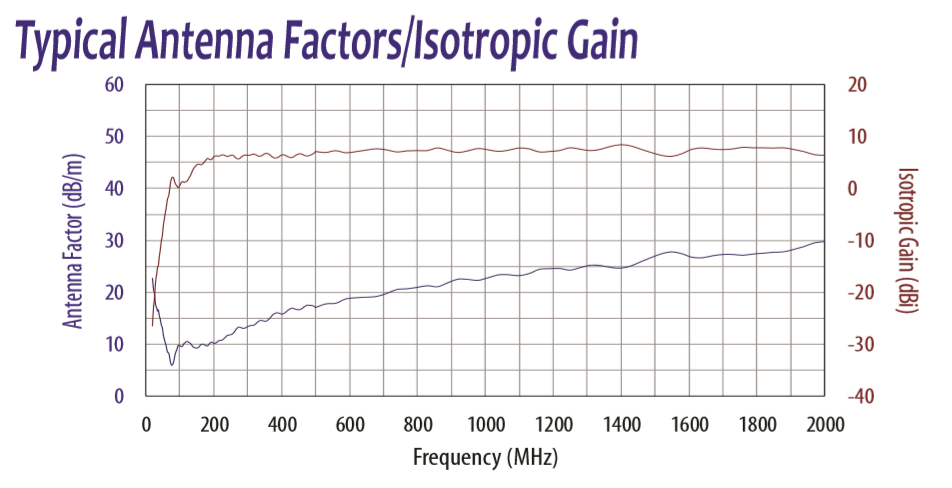
| Antenna Factor | See typical antenna factor graph |
| Isotropic Gain | See typical isotropic gain graph |
| VSWR / Return Loss | See typical VSWR / return loss graphs (with and without 5 dB matching pad) |
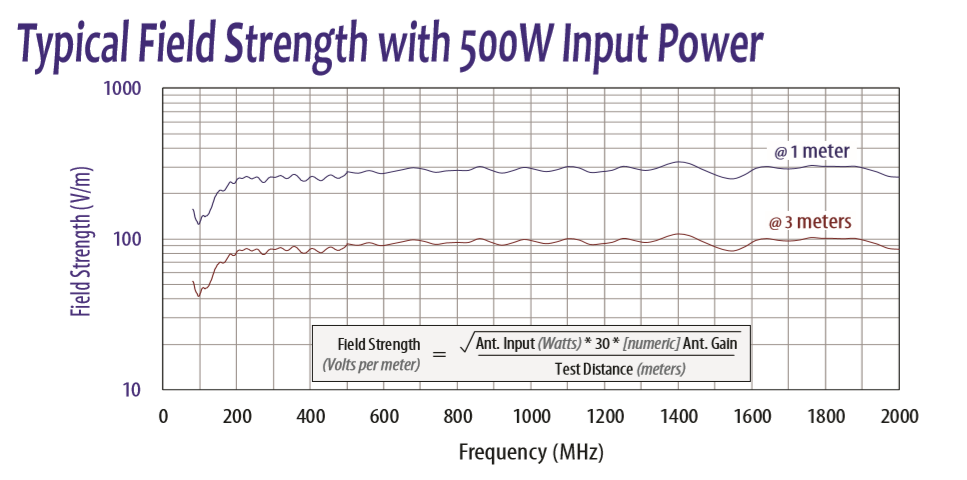
| Maximum Radiated Field | See typical field strength graph (with 500 W input power) |
| Applicable Standards | FCC, CISPR, EN, ETSI, etc. |
| Calibration | Individually calibrated per ANSI C63.5, NIST traceable |
| Dimensions (H × W × D) | 50" × 27.6" × 38" [127 × 70.1 × 96.5 cm] |
| Weight | 10.5 lbs [4.8 kg] |
All values are typical, unless specified. All specifications are subject to change without notice.
🔍 Not Sure Which Antenna You Need?
Compare all Com-Power antenna models side-by-side with our interactive selection tool. Filter by frequency range, antenna category, application, polarization, and power handling to find your perfect match.
Compare All Antenna Models →AC-220 CombiLog Hybrid Antenna – Frequently Asked Questions
1. What is the AC-220 CombiLog hybrid antenna and what is it designed to do?
The AC-220 CombiLog hybrid antenna is a broadband EMC hybrid antenna that combines biconical (bow-tie) elements and a log periodic array into a single structure. It is designed to cover 20 MHz to 2 GHz as a receiving antenna for radiated emissions measurements and 80 MHz to 2 GHz as a transmitting antenna for radiated immunity testing. One AC-220 covers what would traditionally require up to four separate antennas across the same band, which directly translates into faster sweeps, fewer cable reconnections, fewer height-adjustment cycles, and more consistent measurement geometry from one frequency to the next. For compliance laboratories, pre-compliance labs, and engineering teams whose work focuses on sub-2 GHz radiated testing, the AC-220 is a strong everyday-workhorse choice.
2. Why is 20 MHz to 2 GHz coverage well-matched to most commercial EMC compliance work?
A very large share of radiated EMC compliance work falls inside the AC-220's coverage band. Standards such as FCC Part 15, CISPR 22 / 32 (ITE and multimedia), CISPR 11 (ISM), CISPR 25 (automotive), MIL-STD-461 RS103, and IEC 61000-4-3 either start at 30 MHz or extend through the low-to-mid GHz range — territory the AC-220 covers completely from a single mount. The 20 MHz lower end also provides useful headroom below the standard 30 MHz start of most commercial radiated standards, which is helpful for pre-compliance scanning, troubleshooting, and applications that look at HF behavior just below the standard limits. For labs whose product mix does not push into modern wireless bands above 2 GHz (WiFi 5/6 GHz, 5G Sub-6 GHz), the AC-220's range covers essentially the full radiated EMC test program in one antenna.
3. How does the AC-220 differ from the ACL-6000 CombiLog antenna?
The AC-220 and ACL-6000 share the same CombiLog design philosophy: linear polarization, 50 Ω nominal impedance, N-type female connector, ±1 dB symmetry per ANSI C63.5 and CISPR 16-1-4, individual ANSI C63.5 calibration with NIST traceability, and a three-year warranty. The differences come down to frequency range and how immunity power delivery is structured:
- The AC-220 covers 20 MHz to 2 GHz for emissions and 80 MHz to 2 GHz for immunity, with a flat 500 W CW continuous rating across the entire band.
- The ACL-6000 covers 30 MHz to 6 GHz for emissions and 80 MHz to 6 GHz for immunity, with a frequency-shaped power capability of up to 1250 W CW.
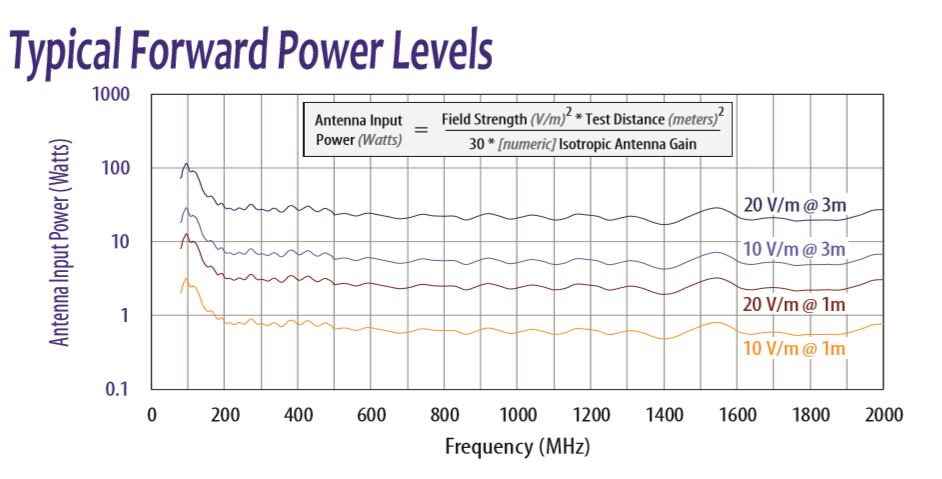
The AC-220's flat 500 W rating is one of its strongest practical features. Because the antenna will accept and deliver the same continuous power at every frequency in its band, amplifier sizing becomes predictable — the lab knows exactly how much power is available at any test frequency without having to consult a power curve. That predictability is especially valuable for automotive immunity (ISO 11451), where stronger CW field generation across the band is often required, and it gives comfortable headroom for IEC 61000-4-3 immunity at the common field strengths (3 V/m, 10 V/m, up to 20 V/m at 3 m per the datasheet curves).
In practical selection terms: the AC-220 is the cost-effective, operationally simple choice for traditional compliance work below 2 GHz — automotive, industrial, consumer electronics, traditional wireless (WiFi 2.4 GHz, Bluetooth). The ACL-6000 is the right pick when the test profile reaches into modern wireless bands (WiFi 5/6 GHz, WiFi 6E, 5G Sub-6 GHz, UWB) or any standard above 2 GHz.
4. How does the AC-220 compare with biconical antennas like the AB-300M and AB-900A?
The AC-220 and dedicated biconical antennas serve different but complementary roles. The AB-300M and AB-900A cover 25 MHz to 300 MHz — specialized for the low-frequency portion of the EMC spectrum, both 50 W rated. The AB-300M uses a traditional center-fed design; the AB-900A uses a gamma-match feed (potentially better VSWR at the band edges). The AC-220 integrates biconical-style elements alongside a log-periodic array to cover 20 MHz to 2 GHz from a single mount, with dual-mode (emissions and immunity) capability.
Biconical antennas have a specialized standards-recognized role in NSA (Normalized Site Attenuation) site validation per ANSI C63.4 and CISPR 16-1-4. Their physical dimensions conform to ANSI C63.5 Figure G.1, which allows the use of published Geometric Site Calibration Factor (GSCF) values rather than custom NSA antenna calibration. That gives a matched biconical pair a unique role for periodic site qualification of OATS and semi-anechoic chambers. The AC-220, by contrast, is engineered for the much broader day-to-day workflow of a lab: radiated emissions sweeps across the full 20 MHz to 2 GHz range from one mount, radiated immunity campaigns up to 500 W CW, shielding effectiveness measurements, field monitoring, and general site investigation work. Many labs use both: an AC-220 for everyday compliance work, and a biconical pair on hand for the periodic NSA site validation procedure.
5. Which Com-Power antenna should I choose — AC-220, ACL-6000, AB-300M, or AB-900A?
A simplified selection guide based on the lab's primary workflow:
- Choose the AC-220 if testing primarily stays below 2 GHz — FCC Part 15, CISPR 22 / 32, CISPR 25 automotive, IEC 61000-4-3 at standard levels — and the lab wants a single antenna to cover 20 MHz to 2 GHz emissions and 80 MHz to 2 GHz immunity from one mount. The flat 500 W CW power handling is a particularly good fit for automotive immunity (ISO 11451).
- Choose the ACL-6000 if products being tested include WiFi 5 GHz / 6 GHz, WiFi 6E, 5G Sub-6 GHz, UWB, or any device with emissions or immunity requirements above 2 GHz, and the lab wants one platform to span 30 MHz to 6 GHz.
- Choose the AB-300M or AB-900A when the lab is performing NSA site validation per ANSI C63.4 / CISPR 16-1-4 and wants to use published GSCF values, or when an ANSI C63.5-dimensioned biconical is specifically called out for 30–300 MHz commercial emissions work. The AB-300M is center-fed; the AB-900A uses a gamma-match feed; performance is otherwise interchangeable.
The most common real-world configuration in well-equipped labs is a CombiLog (AC-220 or ACL-6000) for routine compliance sweeps and engineering work, paired with a matched biconical set (AB-300M or AB-900A) reserved for formal NSA site qualification. The CombiLog drives daily test throughput; the biconicals handle the standards-mandated site validation procedure.
6. What are the biggest real-world workflow advantages of the AC-220?
The AC-220 simplifies radiated testing in practical, time-saving ways. One antenna covers what would otherwise require multiple separate antennas (biconical plus one or more log-periodics) across 20 MHz to 2 GHz, which means fewer swaps, fewer cable reconnections, fewer height-adjustment cycles, fewer software reconfigurations of antenna factor, and a much lower chance of setup error during long test campaigns. The integrated hinged polarization-change mount also lets the operator switch between horizontal and vertical polarization with a single physical motion rather than dismounting and re-mounting the antenna. In production labs, certification labs, design validation teams, and troubleshooting environments where measurements are repeated frequently, these workflow gains directly translate into faster turnaround and more reproducible data.
7. What standards and measurement frameworks is the AC-220 intended to support?
The AC-220 datasheet identifies it as suitable for FCC, CISPR, EN, ETSI and similar regulatory frameworks. In practice, that covers a broad set of specific standards, including:
- FCC Part 15 — unintentional radiators (digital devices, IT equipment, consumer electronics)
- FCC Part 18 — ISM equipment
- CISPR 11 / EN 55011 — industrial, scientific, and medical equipment
- CISPR 22 / 32 (EN 55022 / EN 55032) — ITE and multimedia equipment
- CISPR 25 — automotive components and wiring harness emissions (well matched to this standard since most CISPR 25 antenna-based bands lie below 2 GHz)
- CISPR 16-1-4 — antenna and measurement apparatus requirements
- ANSI C63.4 / C63.5 — US emissions measurement methods and antenna calibration
- MIL-STD-461 RS103 — military radiated susceptibility (within the AC-220's 80 MHz to 2 GHz transmit range)
- IEC 61000-4-3 — radiated immunity (the AC-220's 80 MHz to 2 GHz transmit range covers the original IEC 61000-4-3 frequency band)
- ISO 11451 — automotive immunity (the flat 500 W CW rating is particularly well matched to the higher continuous power demands of this standard)
The AC-220 also meets the ±1 dB antenna symmetry and balance requirements of ANSI C63.5 and CISPR 16-1-4 over 30 MHz to 2 GHz, which is what positions it for both emissions compliance and immunity work in OATS, semi-anechoic chambers, and shielded rooms.
8. How is the AC-220 used for radiated emissions measurements?
In receive mode, the AC-220 acts as a broadband EMI EMC antenna that captures electromagnetic energy emitted by the equipment under test (EUT). The captured signal is routed through cable (and an optional preamplifier) to an EMI receiver or spectrum analyzer, and the receiver reading is converted into field strength by applying the calibrated antenna factor, cable loss, and any preamp gain in the measurement software. Because the antenna spans 20 MHz to 2 GHz in one structure, the lab can perform full-frequency sweeps without an antenna change — particularly valuable in pre-compliance scans, troubleshooting sessions, and formal qualification testing where consistent geometry across the band is important for repeatability.
9. How is the AC-220 used for radiated immunity and RF susceptibility testing, and why is the 500 W power handling significant?
In transmit mode, the AC-220 is driven by an RF power amplifier to generate controlled fields around the EUT across 80 MHz to 2 GHz. This is the standard configuration for IEC 61000-4-3 radiated immunity, automotive immunity under ISO 11451, MIL-STD-461 RS103, and broader RF stress evaluations. The 500 W flat CW continuous rating is a defining strength of the AC-220 for immunity work: the antenna will accept and deliver the same continuous power at every frequency in its band, which makes amplifier chain sizing predictable and provides comfortable headroom for the common immunity field strengths. The datasheet's typical forward power curves show that 500 W input is more than sufficient to reach 10 V/m and 20 V/m at 1 m and 3 m across the band — with plenty of margin for the additional power required by 80% AM modulation. For automotive immunity testing under ISO 11451, where higher continuous power is often required across the band, the AC-220's flat power profile is a particularly clean match.
10. Why is linear polarization important on the AC-220?
The AC-220 is a linearly polarized antenna, which matters because EMC measurements depend strongly on antenna orientation. Radiated emissions can vary with EUT orientation, cable routing, and chassis geometry, and immunity standards generally call for testing in both horizontal and vertical polarizations. Linear polarization gives the test engineer clean, deterministic control over orientation, supporting the disciplined H-and-V polarization sweeps that compliance work requires. The integrated hinged polarization-change mount makes those orientation changes a quick physical motion, which keeps operator workflow efficient when many polarization switches are needed during a test campaign.
11. Why is antenna symmetry and balance important, and how does the AC-220 perform?
Antenna symmetry, sometimes called balance, describes how closely the two halves of a balanced antenna behave identically. A well-balanced antenna delivers consistent response when rotated between vertical and horizontal polarization, reduces common-mode currents on the feed cable, and produces lower measurement uncertainty across frequency. The AC-220 is built to hold antenna symmetry within ±1 dB across 30 MHz to 2 GHz, meeting the requirements of ANSI C63.5 and CISPR 16-1-4 — the symmetry threshold that compliance-grade measurement antennas are expected to satisfy. Common-mode chokes installed on the feed structure further reduce common-mode currents flowing on the outer conductor of the coax, which keeps cable-borne pickup from contaminating the measurement.
12. What does high cross-polarization rejection mean, and why does it matter on the AC-220?
High cross-polarization rejection means the antenna strongly favors its intended polarization and discriminates against orthogonal polarization components. In measurement terms, this improves measurement purity: when the antenna is set up for horizontal polarization, it responds primarily to horizontal fields rather than also picking up vertical components, and the same is true in reverse. For emissions testing this produces cleaner readings; for immunity testing it produces a more cleanly polarized illumination field at the EUT. The AC-220 datasheet calls out good cross-polarization performance as one of its design features, which is one of the markers of an antenna built for serious compliance and engineering measurement work.
13. What kinds of real-world products are good candidates for testing with the AC-220?
The AC-220 is well suited to consumer electronics, industrial electronics, automotive systems, IT equipment, and medical devices — essentially any product whose radiated EMC profile stays within the 20 MHz to 2 GHz range. Real-world examples include devices with switching power supplies, digital clocks, microcontrollers, control boards, displays, embedded radios (Bluetooth, WiFi 2.4 GHz, Zigbee, traditional cellular), cable interfaces, and power conversion hardware that produce broadband emissions across this range. The combination of broad single-antenna coverage and 500 W CW immunity capability also makes the AC-220 a natural fit for laboratories that run both emissions sweeps and immunity testing on the same product line from the same antenna mount.
14. Can the AC-220 be used for shielding effectiveness testing, site surveys, and chamber characterization?
Yes. The datasheet explicitly identifies the AC-220 as suitable for test site comparisons, shielding effectiveness tests of large enclosures, field monitoring, and site surveys. The wide single-antenna bandwidth makes it efficient for chamber investigations, enclosure evaluations, and field diagnostics where engineers want to characterize behavior across a broad band without repeatedly changing the source or receive antenna. For the specific case of formal NSA site validation under ANSI C63.4 / CISPR 16-1-4 using published GSCF values, a matched ANSI C63.5-dimensioned biconical pair (AB-300M or AB-900A) is the standards-recognized tool for that particular procedure — complementary to the broader role the AC-220 plays in the rest of the lab's chamber and product-test workflow.
15. Why do ANSI C63.5 calibration and NIST traceability matter for the AC-220?
The AC-220 is individually calibrated per ANSI C63.5 with NIST traceability, and optional ISO 17025 accredited calibration is available upon request. This matters because broadband antennas need reliable, traceable antenna factor data to be used for compliance work — the calibrated antenna factor is what converts the EMI receiver reading (in dBµV) into a meaningful field strength value (in dBµV/m). NIST traceability strengthens confidence in the calibration chain, while ISO 17025 accreditation supports formal quality system requirements and accredited lab workflows. In other words, the calibration package isn't paperwork — it is what makes the measurement traceable, defensible, and accepted in regulated environments.
16. What mechanical, mounting, and RF interface details matter for the AC-220 in daily use?
The AC-220 uses a 50 ohm nominal impedance and an N-type female connector, both standard and convenient for EMC labs. Per the datasheet, the antenna measures 50″ × 27.6″ × 38″ (127 × 70.1 × 96.5 cm, H × W × D) and weighs only 10.5 lbs (4.8 kg) — light enough for a single technician to handle without unusual lifting equipment. Several mechanical features make day-to-day use efficient:
- Hinged polarization-change mount — switch between horizontal and vertical polarization with a single physical motion, no dismounting required.
- Standard 1/4″-20 mounting thread — compatible with the Com-Power AT-812 tripod, the AM-400 antenna mast, and most third-party EMC supports.
- Optional 5 dB impedance-matching pad — available to flatten VSWR and improve return loss for tighter compliance with CISPR 16-1-4 measurement requirements where needed.
- Common-mode chokes on the feed structure — reduce common-mode currents on the outer conductor of the coax to keep cable-borne pickup from contaminating measurements.
17. Which Com-Power preamplifiers work well with the AC-220?
The AC-220 datasheet lists the PAM-103 preamplifier (1 MHz to 1 GHz) as a related item; this covers the AC-220's lower emissions band (20 MHz to 1 GHz). For the upper portion of the AC-220's emissions range (1 GHz to 2 GHz), Com-Power's PAM-6000 preamplifier (1 GHz to 6 GHz) is a natural choice. A preamp lifts low-level emissions above the noise floor of the EMI receiver or spectrum analyzer — particularly valuable at higher frequencies where antenna factor numerically rises and emissions from modern products tend to be smaller, and during pre-compliance and troubleshooting work where small differences in emission level often determine whether a design passes or fails. When integrating a preamp, the preamp gain correction is applied in the measurement software alongside the antenna factor and cable loss, and it is good practice to include a transient limiter between the antenna and the preamp to protect the preamp input from EUT power-on transients. A typical receive signal chain looks like:
AC-220 → coaxial cable → transient limiter → preamp (PAM-103 or PAM-6000) → EMI receiver / spectrum analyzer
18. When is the AC-220 the right antenna for the lab?
The AC-220 fits labs whose radiated test program lives primarily within 20 MHz to 2 GHz and that value workflow simplicity, predictable amplifier sizing, and a single antenna platform for both emissions and immunity work. It is especially well matched to laboratories doing FCC and CISPR product compliance, CISPR 25 automotive emissions, ISO 11451 automotive immunity (where the flat 500 W CW rating is a particularly clean fit), IEC 61000-4-3 immunity at standard levels, and engineering and pre-compliance work across the sub-2 GHz spectrum. For specialized cases at the very high end of the band — for example, when a project occasionally needs to look above 2 GHz — complementary antennas can be added alongside the AC-220, but for the central day-to-day EMC workflow of most commercial compliance labs, the AC-220 offers a strong balance of bandwidth, dual-mode capability, and standards-oriented performance from a single platform.
19. Why would an EMC lab choose the AC-220 as a long-term antenna investment?
An EMC lab may choose the AC-220 because it brings together broad sub-2 GHz frequency coverage, dual receive/transmit capability, flat 500 W CW power handling, standards-oriented symmetry performance (±1 dB per ANSI C63.5 and CISPR 16-1-4), linear polarization with a hinged quick-change mount, good cross-polarization rejection, ANSI C63.5 calibration with NIST traceability, an optional ISO 17025 accreditation path, a three-year standard warranty, and practical day-to-day usefulness across many EMC applications. For the large share of commercial compliance work that stays inside its frequency range, the AC-220 is a cost-effective, workflow-efficient antenna platform that consolidates what would otherwise be a multi-antenna setup into a single, well-calibrated, dual-mode unit — a strong long-term choice for labs whose product mix is well matched to the sub-2 GHz EMC spectrum.
Application Notes (PDF)
- AN-107 — What is Antenna Factor?
- AN-106 — Use of Antenna Factor for EMC Measurements
- Selecting the Right EMI Antenna
- Considerations when Selecting an Antenna for RF Immunity Testing
- EMC Antenna Calibration Requirements, Methodologies, and Best Practices
- NIST Antenna Calibration Services — Com-Power Capabilities and Traceability
- Com-Power EMC Antenna Product Line — Complete Specifications
- Accounting for Ambient Noise
Interactive Tools
- Antenna Finder Wizard
- Com-Power Antenna & Field Strength Calculator
- Com-Power EMC Compliance Limits Calculator
- Com-Power Cable Loss & Attenuation Calculator
- Com-Power VSWR / Return Loss / Mismatch Loss Calculator
- Com-Power Free Space Path Loss & Link Budget Calculator
Industry Applications
- EMC Considerations for IoT and Smart Home Devices
- Automotive EMC Testing — ISO 11452 / CISPR 25
- 5G Equipment EMC Testing — New Challenges in EMC Compliance
- Medical Device EMC Compliance — IEC 60601-1-2 Essentials
- EV Charging Systems — EMC Requirements and Compliance
Blog Articles


Quote Request
Other EMC Test Equipment
- Absorbing Clamps
- Antenna Kits
- Antenna Masts - Automated and Manual
- Antennas
- Bulk Current Injection probes
- CDNs - Coupling Decoupling Network
- Comb Generators
- Conducted Immunity Test Systems
- Current Monitor Probes
- Current Probe Calibration Fixtures
- EM Clamps
- Feed Through Capacitor
- ISNs - Impedance Stabilization Network
- LISNs - Single Phase
- LISNs - TEMPEST
- LISNs - Three Phase
- Magnetic Field Generator
- Near Field Probes
- Power Amplifiers
- Pre-compliance Emissions Test Systems
- Preamplifiers
- Spectrum Analyzers
- Surge Generators
- System Controllers
- Transient Limiters
- Tripods For EMC
- Turntables