
ABM-6000 Microwave Biconical Antenna
The ABM-6000 Microwave Biconical antenna is specifically designed to be the transmit source antenna for test site validations above 1 GHz per the CISPR 16-1-4 Site Voltage Standing Wave Ratio (SVSWR) procedure.
Features
- ▸ Microwave coverage 1 GHz to 6 GHz — covers the lower microwave band where above-1 GHz site validation and amplifier harmonic measurements are performed.
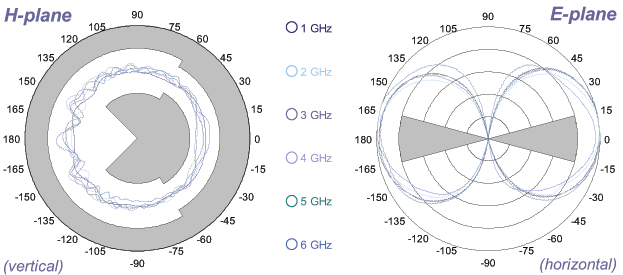
- ▸ CISPR 16-1-4 compliant radiation pattern — specifically designed to meet the radiation pattern specifications detailed in CISPR 16-1-4 (section 8.2.2.1), making it the appropriate transmit source antenna for site validations above 1 GHz.
- ▸ True dipole-like radiation pattern — uniform pattern effectively illuminates the entire test volume during SVSWR (site voltage standing-wave ratio) procedures, ensuring reflections are not masked during validation.
- ▸ Traditional perpendicular feed-line geometry — feed line is perpendicular to the elements (rather than “in-line” through the elements), preserving E-plane symmetry and avoiding the ripples and side lobes that compromise some competing mini-biconicals during site validation.
- ▸ High cross-polarization rejection — better than 20 dB cross-polarization rejection for accurate orthogonal-polarization isolation during measurements.
- ▸ Excellent inversion symmetry — less than 1 dB symmetry/balance, important for reproducible site validation results.
- ▸ Transmit and receive capability — works as a transmit source antenna for site validations or as a receive antenna for emissions and field measurements.
- ▸ Compact and lightweight — only 20.5" long and 13 oz (0.368 kg), making it easy to maneuver into the multiple positions and orientations required by the SVSWR procedure within a test volume.
- ▸ Stainless steel and brass construction — stainless steel housing with brass elements provides durability for transport between sites and use in varied environments.
- ▸ Textured handle and mounting clamp — powder-coated textured handle section combined with a supplied mounting clamp allows easy mounting on any tripod or antenna mast (non-conductive tripods available from Com-Power).
- ▸ Versatile measurement applications — suitable for SVSWR site validation per CISPR 16-1-4, amplifier harmonic measurements per IEC 61000-4-3, field surveys, and measurements of high-level signals where minimum field disruption is critical.
- ▸ Individually calibrated, NIST-traceable — calibrated per ANSI C63.5:2006 at 3 meters distance; calibration data and certificate ship with each unit.
- ▸ Protective carrying case included — supplied with carrying case, mounting clamp, user’s manual, and calibration documentation.
- ▸ Three-year standard warranty — backed by manufacturer support.
Specifications
| Antenna Type | Microwave Biconical (mini-biconical dipole) |
|---|---|
| Frequency Range | 1 GHz to 6 GHz |
| Polarization | Linear |
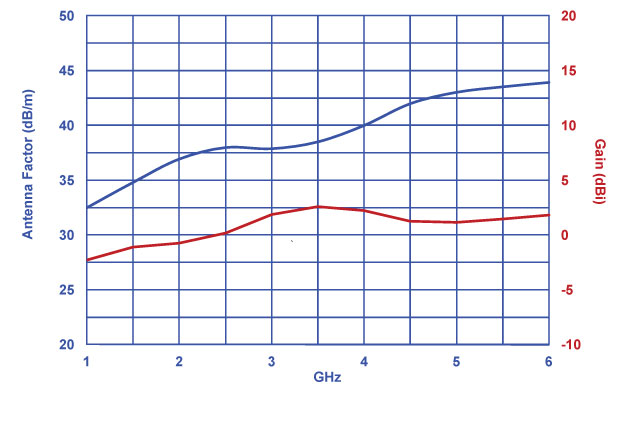
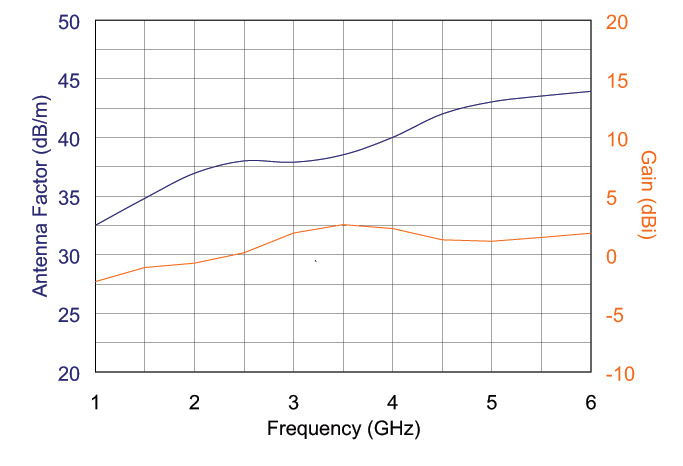
| Antenna Factor | 32 to 46 dB/m |
| Isotropic Gain | -3 to 4.5 dBi |
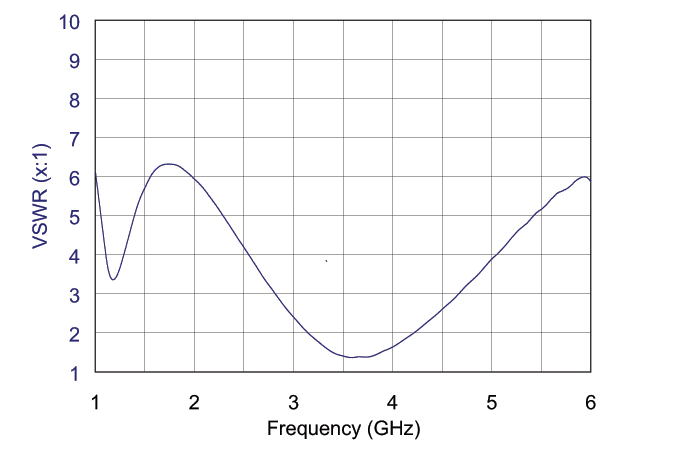
| VSWR | 3 : 1 (average) |
| 3 dB Beamwidth | 75° to 95° |
| Impedance | 50 Ω |
| Inversion Symmetry | < 1 dB |
| Cross-Polarization | > 20 dB rejection |
| Maximum Input Power | 50 Watts |
| Connector Type | N-type (female) |
| Construction | Stainless steel housing with brass elements |
| Calibration | Individually calibrated per ANSI C63.5:2006 at 3 m distance |
| Overall Length | 20.5" (52 cm) |
| Maximum Width (elements) | 2.5" (6.35 cm) |
| Weight | 13 oz (0.368 kg) |
All values are typical, unless specified. All specifications are subject to change without notice.
| Title | Link |
|---|---|
| Datasheet | View PDF |
🔍 Not Sure Which Antenna You Need?
Compare all Com-Power antenna models side-by-side with our interactive selection tool. Filter by frequency range, antenna category, application, polarization, and power handling to find your perfect match.
Compare All Antenna Models →ABM-6000 Microwave Biconical Antenna – Technical FAQs
1. What is the ABM-6000 antenna and what is it used for?
The ABM-6000 is a microwave biconical antenna designed for 1 GHz to 6 GHz EMC testing, primarily used for site validation using the CISPR 16-1-4 SVSWR method.
2. What is SVSWR and why is this antenna important?
SVSWR (Site Voltage Standing Wave Ratio) is used to validate EMC test sites above 1 GHz. The ABM-6000 is specifically designed as the transmit antenna for this procedure.
3. What real-world applications use this antenna?
Used in: - EMC chamber validation - Automotive radar testing - 5G and wireless device testing - Aerospace EMC setups
4. How is this different from standard biconical antennas?
Unlike low-frequency biconical antennas, this is designed for microwave frequencies and SVSWR validation above 1 GHz.
5. When should you use this instead of a horn antenna?
Use ABM-6000 when: - SVSWR compliance is required - Dipole-like radiation pattern is needed Use horn antennas for high-gain directional testing.
6. What standards require this antenna?
CISPR 16-1-4 (SVSWR), IEC 61000-4-3, and other high-frequency EMC standards.
7. What are typical EMC lab use cases?
- Chamber validation - Field uniformity testing - Amplifier harmonic measurements - Field surveys
8. Why is dipole-like radiation pattern important?
It ensures consistent field distribution required for SVSWR validation.
9. What industries use this antenna?
Telecom, automotive, aerospace, defense, and wireless device manufacturers.
10. Can this antenna be used for emissions testing?
Yes, it can be used as a receiving antenna, though it is optimized for validation and transmit applications.
11. How does it compare to log periodic antennas?
Log periodic antennas are used for emissions measurements, while ABM-6000 is optimized for validation and uniform field generation.
12. What is antenna factor range and why important?
The antenna factor (32–46 dB/m) ensures accurate conversion of measured voltage to field strength.
13. What are real-world measurement challenges it solves?
- High-frequency site validation - Field uniformity issues - Measurement uncertainty reduction
14. What is cross-polarization rejection and why important?
It ensures minimal interference from unwanted polarization, improving measurement accuracy.
15. How does size and weight help engineers?
Lightweight design allows easy positioning and repeatable measurements in test chambers.
16. Can it be used for pre-compliance testing?
Yes, especially for high-frequency emissions and field studies.
17. Why choose ABM-6000?
It is purpose-built for SVSWR validation, offers accurate field generation, and supports high-frequency EMC testing.
Application Notes (PDF)
- AN-107 — What is Antenna Factor?
- AN-106 — Use of Antenna Factor for EMC Measurements
- Selecting the Right EMI Antenna
- Considerations when Selecting an Antenna for RF Immunity Testing
- EMC Antenna Calibration Requirements, Methodologies, and Best Practices
- NIST Antenna Calibration Services — Com-Power Capabilities and Traceability
- Com-Power EMC Antenna Product Line — Complete Specifications
- Accounting for Ambient Noise
Interactive Tools
- Antenna Finder Wizard
- Com-Power Antenna & Field Strength Calculator
- Com-Power EMC Compliance Limits Calculator
- Com-Power Cable Loss & Attenuation Calculator
- Com-Power VSWR / Return Loss / Mismatch Loss Calculator
- Com-Power Free Space Path Loss & Link Budget Calculator
Industry Applications
- EMC Considerations for IoT and Smart Home Devices
- Automotive EMC Testing — ISO 11452 / CISPR 25
- 5G Equipment EMC Testing — New Challenges in EMC Compliance
- Medical Device EMC Compliance — IEC 60601-1-2 Essentials
- EV Charging Systems — EMC Requirements and Compliance
Blog Articles

Quote Request
Other EMC Test Equipment
- Absorbing Clamps
- Antenna Kits
- Antenna Masts - Automated and Manual
- Antennas
- Bulk Current Injection probes
- CDNs - Coupling Decoupling Network
- Comb Generators
- Conducted Immunity Test Systems
- Current Monitor Probes
- Current Probe Calibration Fixtures
- EM Clamps
- Feed Through Capacitor
- ISNs - Impedance Stabilization Network
- LISNs - Single Phase
- LISNs - TEMPEST
- LISNs - Three Phase
- Magnetic Field Generator
- Near Field Probes
- Power Amplifiers
- Pre-compliance Emissions Test Systems
- Preamplifiers
- Spectrum Analyzers
- Surge Generators
- System Controllers
- Transient Limiters
- Tripods For EMC
- Turntables