
Audio and Low-Frequency EMI/EMC Preamplifier
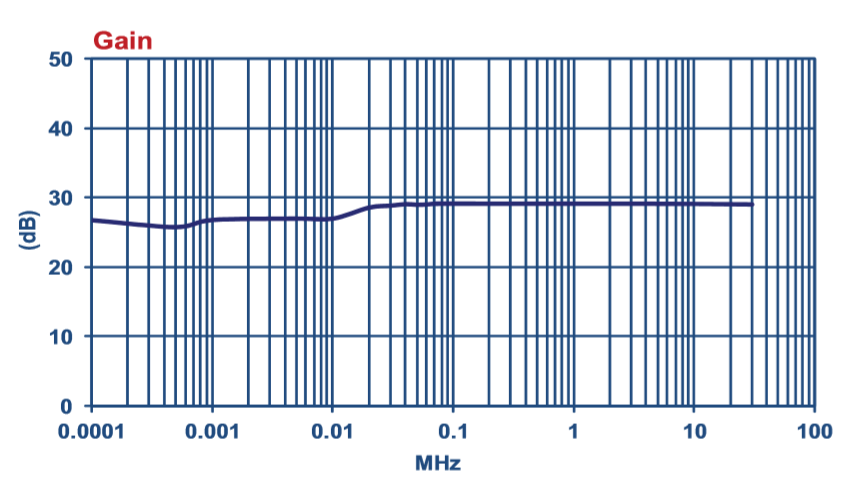
- The PAL-010 is a battery-powered audio and low-frequency EMC preamplifier covering 100 Hz to 30 MHz with 28 dB gain — the only Com-Power preamplifier that reaches down into the audio band.
- Low noise figure < 1.9 dB with ±2.5 dB gain flatness; the gain materially improves system sensitivity without raising the receiver noise floor.
- Covers the full CISPR conducted emissions band (150 kHz to 30 MHz) plus extends well below into MIL-STD-461 CE101 / CE102 territory and audio-frequency investigative work.
- FCC Part 15, CISPR 11/14/22/32, EN 55011/14/22/32, MIL-STD-461, FAA RTCA DO-160 conducted emissions test support — insert between LISN RF output (or transient limiter) and EMI receiver.
- Ideal for switch-mode power supplies, EV chargers, LED drivers, motor drives, UPS systems, solar inverters, and other products with strong low-frequency switching emissions.
- Near-field probe amplification — boosts weak H-field and E-field signals by 30–50 dB during PCB-level EMI debug on switching regulators, clock lines, and power-management ICs.
- Internal NiMH rechargeable battery eliminates AC ground-loop noise from coupling into sensitive low-frequency measurements; external 15 VDC adapter for bench operation. 50Ω BNC female I/O.
- Individually NIST-traceable calibrated; ISO 17025 calibration available on request. Three-year warranty.
Features
- ▸ Audio and low-frequency EMI/EMC preamplifier — purpose-built for the conducted-emissions band and below, where general-purpose RF preamps cannot reach.
- ▸ Wide frequency range: 100 Hz to 30 MHz — covers FCC Part 15, CISPR 11/14/22/32, EN 55011/14/22/32, and MIL-STD-461 CE101/CE102 conducted-emissions bands.
- ▸ 28 dB gain with low noise figure — gain flatness of ±2.5 dB and noise figure below 1.9 dB; the gain materially improves system sensitivity without raising the noise floor.
- ▸ Reduces EMI receiver noise floor — raises weak conducted-emissions signals from switch-mode power supplies, DC-DC converters, motor drives, and clock harmonics above the noise floor of typical EMI receivers and spectrum analyzers.
- ▸ Provides input isolation — protects EMI receivers and spectrum analyzers from transient inputs that may appear at the LISN RF output, especially during power-up of large EUTs.
- ▸ Battery operation eliminates ground loops — internal NiMH battery pack allows operation near the LISN reference ground plane without introducing AC-mains-derived hum or ground-loop noise into sensitive low-frequency measurements.
- ▸ Pairs with near-field probes for PCB-level debug — the high gain and low noise figure are especially useful when probing low-frequency clocks, switching regulators, and power-management ICs at the board level, where signals can be 30–50 dB below far-field antenna levels.
- ▸ 50Ω BNC (female) input/output — standard interface for direct connection to LISNs, transient limiters, EMI receivers, and spectrum analyzers in commercial EMC test setups.
- ▸ Compact bench-top form factor — 7.5″ × 5″ × 3″ (19 × 13 × 7.6 cm), 3.3 lbs (1.5 kg); easy to position next to LISNs and chamber walls.
- ▸ Individually calibrated, NIST-traceable — each unit ships with its own gain-versus-frequency calibration data and certificate; ISO 17025 accredited calibration available on request.
- ▸ Three-year standard warranty — backed by manufacturer support.
Specifications
| Model | PAL-010 |
|---|---|
| Application | EMI / EMC Measurements (audio and low-frequency band) |
| Frequency Range | 100 Hz to 30 MHz |
| Gain | 28 dB |
| Gain Flatness | ± 2.5 dB |
| Noise Figure | < 1.9 dB |
| Input/Output Impedance | 50 Ω |
| Connector Type | BNC (female) |
| Power Source | 15 VDC, 500 mA external adapter, or internal battery pack |
| Battery Pack | 2 × 6 V NiMH (rechargeable) |
| Dimensions (L × W × H) | 7.5″ × 5″ × 3″ (19 × 13 × 7.6 cm) |
| Weight | 3.3 lbs (1.5 kg) |
| Calibration | Individually calibrated, NIST traceable; ISO 17025 accredited available on request |
| Warranty | Three-year standard warranty |
All values are typical, unless specified. All specifications are subject to change without notice.
🔍 Not Sure Which Preamplifier You Need?
Find the perfect Com-Power preamplifier for your EMC testing needs with our interactive finder wizard. Filter by frequency range, gain, noise figure, and application to match your exact requirements.
Find Your Preamplifier →PAL-010 Audio and Low Frequency Preamplifier – Frequently Asked Questions
1. What is the PAL-010 preamplifier and what is it designed for?
The PAL-010 is a general-purpose, broadband, high-gain benchtop preamplifier designed specifically for low-frequency EMI and EMC emissions measurements. It covers 100 Hz to 30 MHz with 28 dB of gain and is used to reduce the noise floor of an EMI receiver or spectrum analyzer and increase overall system sensitivity to low-level signals. At these lower frequencies, DUT emissions from switching supplies, clock lines, motor drives, and power-converter harmonics can be very weak at the antenna or LISN output, and a dedicated low-frequency preamplifier like the PAL-010 makes them easier to resolve above the receiver noise floor.
2. Why is the 100 Hz to 30 MHz range important in EMC testing?
This range covers some of the most challenging portions of the EMC spectrum. CISPR conducted emissions run from 150 kHz to 30 MHz, MIL-STD-461 CE101 and CE102 extend down into the 30 Hz to 10 kHz region and up through 10 MHz, and FCC conducted emissions start at 150 kHz. A preamplifier that cleanly covers audio and low-RF frequencies is valuable because many EMI receivers have reduced sensitivity below a few hundred kilohertz, and low-frequency signals from switch-mode power supplies, DC-DC converters, and magnetic field sources are often right at the edge of measurable amplitude.
3. How does the PAL-010 differ from the PAM-103 and other Com-Power preamplifiers?
The PAL-010 and PAM-103 overlap at 1–30 MHz but are designed for different jobs. The PAL-010 starts at 100 Hz, extending well below what the PAM-103 (1 MHz to 1 GHz) can reach, making it the correct choice for audio-band and low-frequency power-related EMI work. The PAM-103, in contrast, is better above 30 MHz where the PAL-010 rolls off. At the top end, the PAM-6000, PAM-118A, PAM-118H, PAM-840A, and PAM-840H are the right choices for microwave work. For labs that need continuous coverage from the audio band up, a PAL-010 paired with a PAM-103 or PAM-118A is a common combination.
4. How does the PAL-010 compare with general-purpose RF preamplifiers?
Many general-purpose RF preamplifiers start at 10 MHz or higher because they are optimized for communications work. The PAL-010 is different in that it is built around the needs of EMC low-frequency emissions: flat response from the audio band, low noise figure below 2 dB, individual calibration data supplied with the unit, and a robust input to survive the kinds of transients typical of conducted emissions testing on LISNs. A communications preamplifier may have higher gain or a lower noise figure over a narrow band, but it rarely covers from 100 Hz with the flatness the PAL-010 provides.
5. What are the real-world workflow advantages of using the PAL-010?
The PAL-010 reduces the need to compensate for receiver noise floor with longer integration times and narrower resolution bandwidths, both of which slow down a test. At 9 kHz RBW — the CISPR 16 standard RBW for 150 kHz to 30 MHz conducted emissions — a preamplifier with 28 dB of gain can make the difference between a marginal signal being visible or being lost in the noise. For labs doing repeat scans during design debug or compliance verification, it saves hours per day by keeping scans short and readings clean.
6. What standards can the PAL-010 support?
The PAL-010 is suitable for measurements under FCC Part 15, CISPR 11, CISPR 14, CISPR 22 / 32, EN 55011, EN 55014, EN 55022 / 32, MIL-STD-461 (CE101, CE102), and FAA RTCA DO-160 conducted emissions tests. It also supports VLF and ELF investigative work when labs need to look at harmonic content from variable-speed drives, power-electronics test benches, or low-frequency magnetic field sources. Because each unit ships with individual calibration data, the gain correction can be applied in any EMI receiver or spectrum analyzer software that accepts external correction tables.
7. How is the PAL-010 used in a typical conducted emissions setup?
In a conducted emissions test, the PAL-010 is inserted between the LISN RF output port (or a transient limiter following the LISN) and the EMI receiver input. It amplifies the signal coming off the LISN before any long coax run to the receiver, improving the signal-to-noise ratio of the measurement. Its individual calibration data is subtracted from the measured reading inside the receiver or post-processing software so that the reported amplitude represents the signal at the LISN port, not at the receiver input.
8. Can the PAL-010 be used with near-field probes?
Yes. The PAL-010's high gain and low noise figure make it very useful for near-field probing on printed circuit boards, where signal levels from H-field and E-field probes can be 30 to 50 dB below what a far-field antenna would pick up. It is especially helpful when tracking down radiated or coupled noise from low-frequency clocks, switching regulators, power management ICs, and digital buses on a PCB.
9. Why does noise figure matter on a low-frequency preamplifier?
The noise figure sets a floor on how much the preamplifier degrades the overall system sensitivity. A high-gain preamplifier with a poor noise figure just amplifies its own noise along with the signal and provides little real benefit. The PAL-010 has a noise figure of less than 1.9 dB, which means it adds very little noise while providing 28 dB of gain — the combination is what actually improves weak-signal visibility rather than just making the display look busier.
10. How does the PAL-010 help with long cable runs?
Even at low frequencies, long coaxial cables between the LISN and receiver add loss and pick up ambient electrical noise from fluorescent lighting, motor drives, and nearby instruments. Placing the PAL-010 near the LISN rather than near the receiver means the signal is amplified before it travels the cable, so cable loss and ambient pickup degrade an already-boosted signal rather than the original weak one. This is the same front-end amplification principle used at higher frequencies but with different cable-loss considerations.
11. What kinds of real-world products benefit from PAL-010 testing?
Products with significant low-frequency emissions content benefit most: switch-mode power supplies, LED drivers, variable-frequency motor drives, EV charging equipment, solar inverters, UPS systems, power-over-Ethernet equipment, industrial process controllers, motor-driven appliances, and medical electrosurgical equipment. All of these commonly have fundamental switching frequencies, harmonics, or control-loop emissions that fall in the PAL-010's range and can be difficult to see without front-end amplification.
12. Can the PAL-010 be used for site surveys or ambient monitoring?
Yes. For low-frequency ambient noise surveys — checking a test site for local AM broadcast interference, power-line harmonics, or switching-supply byproducts from nearby buildings — the PAL-010 boosts receiver sensitivity so weak ambient signals become visible. This is useful during site qualification, when investigating mysterious compliance failures, or when diagnosing noise that is only intermittent and difficult to trigger on.
13. Why do individual calibration and NIST traceability matter for the PAL-010?
Each PAL-010 is individually calibrated and ships with its own gain-versus-frequency data, which is traceable to NIST through the SI. This matters because no two amplifiers are identical — a nominal 28 dB unit might be 27.6 dB at 1 MHz and 28.3 dB at 10 MHz. Without per-unit calibration, a 0.5 dB error applied across every measurement in a compliance scan can push a pass into a fail or vice versa. Com-Power also offers ISO/IEC 17025 accredited calibration for labs whose quality systems require accredited calibration data on all measurement-contributing instruments.
14. What mechanical and RF interface details matter for daily use of the PAL-010?
The PAL-010 has a 50 ohm nominal impedance, BNC female connectors, and a compact form factor approximately 7.5" x 5" x 3" weighing about 3.3 lbs (1.5 kg). It is powered by a 15 VDC, 500 mA external adapter or from its internal NiMH battery pack, which is helpful when the preamp must sit next to a LISN on the reference ground plane and AC power would introduce ground-loop noise. The battery also allows ad-hoc measurements outside the main test bay without running power cables across clean chamber floors.
15. When is the PAL-010 a better choice than a wideband RF preamplifier?
The PAL-010 is the better choice when your testing is concentrated in the conducted emissions band and below, or when you need to see low-frequency content down to 100 Hz. A wideband microwave preamp covering 1 MHz to 18 GHz will not reach that low, and its noise figure above 1 GHz is not helping you when your measurement problem is at 500 kHz. For labs focused on power electronics, consumer appliances, industrial equipment, and medical devices that have prominent low-frequency EMI signatures, the PAL-010 is a purpose-built tool rather than a compromise.
16. Why would an EMC lab choose the PAL-010 as a long-term investment?
The PAL-010 covers a frequency range that most general-purpose RF preamplifiers simply do not reach, and it does so with the calibration rigor, low noise figure, and standards-oriented design that EMC labs need. It also pairs directly with Com-Power LISNs, transient limiters, and EMI receivers as part of a matched measurement chain. For a lab that does conducted emissions work regularly — which is most EMC labs — having a dedicated low-frequency preamplifier on the bench rather than stretching a higher-frequency unit below its specified range is a foundational quality decision. A three-year warranty, rechargeable battery operation, and individual calibration make it a reliable part of the test chain for many years.


Quote Request
Other EMC Test Equipment
- Absorbing Clamps
- Antenna Kits
- Antenna Masts - Automated and Manual
- Antennas
- Bulk Current Injection probes
- CDNs - Coupling Decoupling Network
- Comb Generators
- Conducted Immunity Test Systems
- Current Monitor Probes
- Current Probe Calibration Fixtures
- EM Clamps
- Feed Through Capacitor
- ISNs - Impedance Stabilization Network
- LISNs - Single Phase
- LISNs - TEMPEST
- LISNs - Three Phase
- Magnetic Field Generator
- Near Field Probes
- Power Amplifiers
- Pre-compliance Emissions Test Systems
- Preamplifiers
- Spectrum Analyzers
- Surge Generators
- System Controllers
- Transient Limiters
- Tripods For EMC
- Turntables