Three-Phase Line Impedance Stabilization Networks (LISNs)
Com-Power’s three-phase LISN portfolio provides a complete range of four-conductor Line Impedance Stabilization Networks for conducted emissions testing of three-phase equipment. With twelve models spanning three series—LI-3P-1X, LI-3P-2X, and LI-3P-4X—these LISNs cover commercial (CISPR 16-1-2, ANSI C63.4) and military (MIL-STD-461) standards at current ratings from 16 A to 100 A per phase. All models support both Delta and Wye power configurations, feature remote fiber optic line switching via the RLI V2.0 interface, built-in transient limiters, and air-core inductors that eliminate magnetic saturation.
How a Three-Phase LISN Works
A Line Impedance Stabilization Network (LISN), also called an Artificial Mains Network (AMN), is a measurement device placed in series between the AC power source and the Equipment Under Test (EUT) during conducted emissions testing. In a three-phase setup, the LISN contains four independent stabilization networks—one for each of the three phase conductors (L1, L2, L3) and one for the neutral (N). Each network performs three critical functions simultaneously:
1. Provides a defined, stable impedance to the EUT. The real-world impedance of a power grid varies unpredictably based on wiring length, connected loads, and time of day. A LISN replaces this unknown impedance with a precisely controlled 50Ω impedance across the measurement frequency range. This ensures that conducted emissions measurements are repeatable and comparable regardless of the power source or facility. The 50 μH inductor in the network simulates the typical inductance of approximately 50 meters of building supply wiring.
2. Isolates the EUT from external noise. The power grid carries RF noise from other equipment connected to the same supply. The LISN’s inductor presents high impedance at RF frequencies, blocking this external noise from reaching the EUT measurement point. This ensures that only the emissions generated by the EUT itself are measured, not interference from the power grid.
3. Couples disturbance voltages to the measurement port. The LISN provides a 50Ω RF output port (N-type connector) that extracts the conducted emissions from each power line and delivers them to the EMI receiver or spectrum analyzer. A coupling capacitor blocks the low-frequency AC power voltage while passing the higher-frequency RF emissions to the measurement instrument.
In a three-phase LISN, one line is measured at a time. The selected line is routed to the 50Ω measurement port, while the remaining lines are internally terminated into 50Ω loads. This maintains the correct impedance on all lines simultaneously, which is essential because conducted emissions on one phase can be affected by the termination on the other phases.
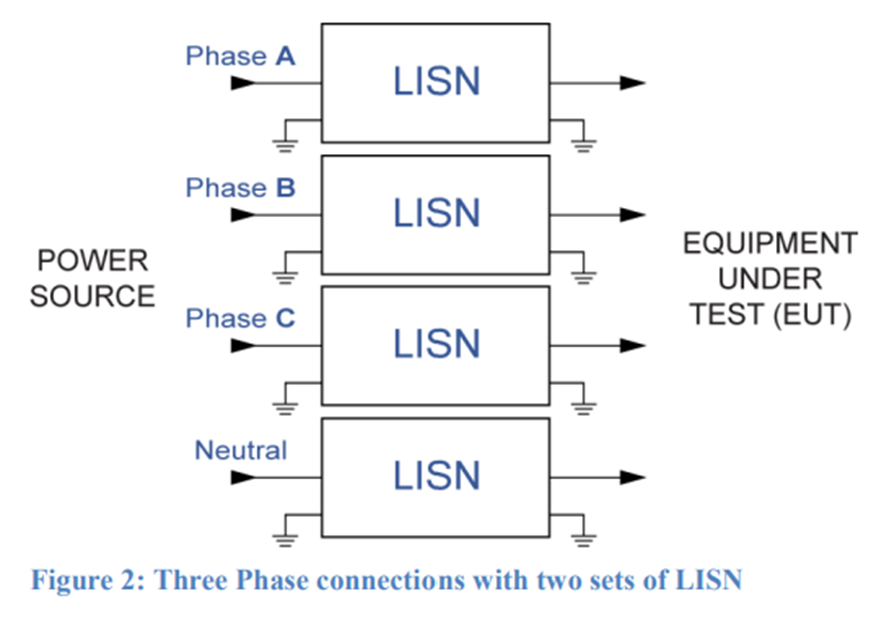
Three-Phase LISN Configuration – The LISN is placed between the power source and EUT, with each phase conductor (L1, L2, L3) and neutral (N) passing through an independent 50Ω/50 μH stabilization network. The selected line is routed to the RF measurement port while unselected lines are terminated into 50Ω.
Three Series for Every Standard
Choosing the correct series depends on the applicable test standard. Each series uses a different LISN network topology and frequency range as required by the relevant standard. The three series are not interchangeable.
| LI-3P-1X Series |
LI-3P-2X Series |
LI-3P-4X Series |
|
Commercial conducted emissions testing per CISPR 16-1-2 and ANSI C63.4 in the traditional 150 kHz to 30 MHz range.
Network: 50Ω, 50 μH
Range: 150 kHz – 30 MHz
Standard: CISPR 16-1-2 / ANSI C63.4
Models: 16A, 32A, 63A, 100A
|
Extended-range commercial testing per CISPR 16-1-2 and ANSI C63.4 starting from 9 kHz using the V-AMN topology.
Network: 50Ω, 50/250 μH +5Ω
Range: 9 kHz – 30 MHz
Standard: CISPR 16-1-2 / ANSI C63.4
Models: 16A, 32A, 63A, 100A
|
Military CE102 conducted emissions testing per MIL-STD-461D/E/F/G, with support for 400 Hz and 800 Hz AC power.
Network: 50Ω, 50 μH
Range: 10 kHz – 10 MHz
Standard: MIL-STD-461D/E/F/G
Models: 16A, 32A, 63A, 100A
|
Series Comparison
| Parameter |
LI-3P-1X |
LI-3P-2X |
LI-3P-4X |
| Standard |
CISPR 16-1-2 / ANSI C63.4 |
CISPR 16-1-2 / ANSI C63.4 |
MIL-STD-461D/E/F/G |
| Application |
Commercial CE (FCC, CE, etc.) |
Commercial CE (FCC, CE, etc.) |
Military CE102 |
| LISN Type |
50Ω, 50 μH |
50Ω, 50/250 μH +5Ω (V-AMN) |
50Ω, 50 μH |
| Frequency Range |
150 kHz – 30 MHz |
9 kHz – 30 MHz |
10 kHz – 10 MHz |
| Current Ratings |
16, 32, 63, 100 A |
16, 32, 63, 100 A |
16, 32, 63, 100 A |
| Max AC Voltage (L-L) |
865 Vrms |
865 Vrms |
865 Vrms |
| 400 Hz / 800 Hz Support |
No |
No |
Yes |
| Transient Limiter |
Built-in |
Built-in, bypassable, dual 5 dB pads |
Built-in |
| Insertion Loss (in-band) |
< 11 dB |
< 11 dB (above 150 kHz) |
< 21 dB (above 150 kHz) |
| Isolation (in-band) |
> 40 dB |
> 40 dB (above 50 kHz) |
— |
| Remote Interface |
RLI V2.0 (fiber optic) |
RLI V2.0 (fiber optic) |
RLI V2.0 (fiber optic) |
| Power Configurations |
Delta & Wye |
Delta & Wye |
Delta & Wye |
Typical Three-Phase Equipment Tested
Three-phase LISNs are required whenever the EUT draws power from a three-phase supply. Common categories of three-phase equipment that require conducted emissions testing include:
| Equipment Category |
Examples |
Recommended Series |
| Industrial Motor Drives & VFDs |
Variable frequency drives, servo drives, conveyor motors |
LI-3P-1X or LI-3P-2X (commercial) / LI-3P-4X (military) |
| HVAC & Refrigeration |
Compressors, chillers, air handling units, cooling towers |
LI-3P-1X or LI-3P-2X |
| Renewable Energy |
Solar inverters, wind turbine converters, battery storage systems |
LI-3P-1X or LI-3P-2X |
| EV Charging |
Level 2 and Level 3 AC/DC charging stations |
LI-3P-1X or LI-3P-2X |
| Manufacturing Equipment |
CNC machines, welders, industrial robots, packaging lines |
LI-3P-1X or LI-3P-2X |
| Military Shipboard & Aircraft |
Propulsion drives, weapons systems, avionics, ground support |
LI-3P-4X |
| Data Centers |
UPS systems, PDUs, server power supplies |
LI-3P-1X or LI-3P-2X |
| Medical Equipment |
Large imaging systems (MRI, CT), sterilization equipment |
LI-3P-1X or LI-3P-2X |
Common Features Across All Series
Regardless of the series selected, every Com-Power three-phase LISN includes:
| Feature |
Description |
| Four-Conductor Design |
Independent stabilization networks for L1, L2, L3, and Neutral, supporting both Delta (3-wire) and Wye (4-wire) configurations. |
| Air-Core Inductors |
Eliminate magnetic saturation and permeability variation, ensuring accurate impedance at all current levels. |
| Built-In Transient Limiter |
Protects the RF input of the measuring instrument from damaging voltage transients and reduces out-of-band emissions. |
| RLI V2.0 Remote Interface |
Fiber optic–controlled line switching (L1, L2, L3, N) via USB-connected interface unit, enabling automated test sequences. |
| Local Line Selection |
Front-panel buttons or push-buttons for manual line selection without the remote interface. |
| 50Ω N-Type RF Port |
Standard measurement port for direct connection to any EMI receiver or spectrum analyzer. |
| Individual Calibration |
Each unit ships with calibration data. ISO 17025 accredited calibration available upon request. |
| Three-Year Warranty |
Standard warranty coverage on all models. |
Contact Us
Get a Quote


