
Preamplifier for Sniffer Probes
- The PAP-501 is a compact preamplifier for near-field probes covering 10 MHz to 1000 MHz with 21 dB gain — purpose-built for board-level EMI troubleshooting with H-field and E-field sniffer probes.
- Small form factor just 83 × 42 × 25 mm (3.27″ × 1.65″ × 0.985″), 1 lb (0.45 kg) — the most compact preamp in the Com-Power lineup, designed to clip directly to a near-field probe handle without strain on the BNC connection.
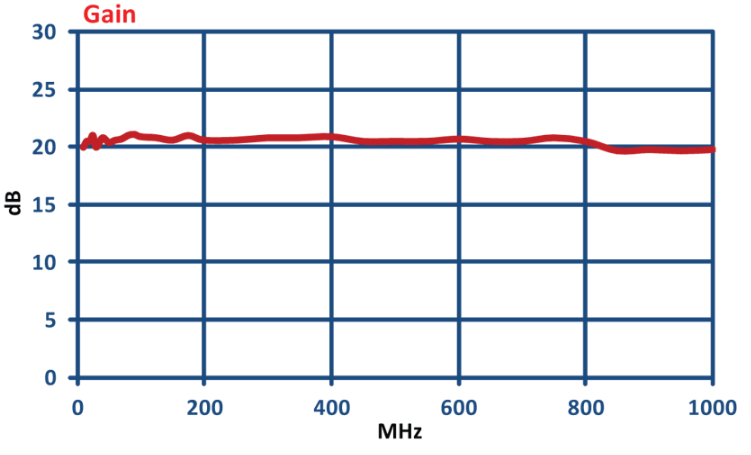
- Boosts weak near-field probe signals by up to 30–50 dB above what the EMI receiver alone can resolve; flat gain ±2 dB over the full 10–1000 MHz band with +10 dBm at 1 dB compression for excellent linearity.
- Pairs with Com-Power PS-300, PS-400, PS-500 near-field probe sets and other H-field / E-field sniffer probes for tracking down emission sources at the PCB and component level.
- Locates EMI noise sources on switching regulators, clock lines, DC-DC converters, motor drivers, oscillators, and high-speed digital buses during R&D, design debug, and pre-compliance investigations.
- Supports troubleshooting of products under FCC Part 15, CISPR 22 / CISPR 32 / EN 55032, MIL-STD-461 RE102, and automotive emissions standards before formal compliance testing.
- 50Ω BNC connectors for direct probe-to-preamp-to-receiver connection; powered by external 6 VDC, 0.5 A adapter for clean bench operation in lab and prototype debug environments.
- Individually calibrated for accurate gain correction in EMI receivers and spectrum analyzer software. Three-year warranty.
Features
- ▸ Compact preamplifier purpose-built for near-field probes (sniffer probes) — the smallest preamp in the Com-Power lineup, designed for circuit-level EMI/EMC troubleshooting and debug.
- ▸ Frequency range: 10 MHz to 1000 MHz — covers the principal radiated emissions band where most digital clocks, switching converters, and digital interfaces produce harmonic content.
- ▸ 21 dB gain with ±2 dB flatness — moderate gain that boosts weak near-field probe signals without overdriving the receiver mixer when the probe is positioned over hot spots on a PCB.
- ▸ +10 dBm output @ 1 dB compression — supports linear amplification of localized signals captured by H-field and E-field probes.
- ▸ Extremely portable, small form factor — 83 × 42 × 25 mm (3.27″ × 1.65″ × 0.985″); fits in a pocket or probe kit, easy to bring to the bench during EMI debug sessions.
- ▸ Pairs with Com-Power near-field probe sets (PS-400, PS-500) — ideal companion for H-field magnetic loop and E-field probes during PCB-level EMI source localization.
- ▸ Locates emission sources during product development — identifies which trace, IC, connector, or seam is the actual emitter when a board fails CISPR 22 / 32 / EN 55032 radiated emissions limits.
- ▸ Verifies shielding and gasket effectiveness — sweep along enclosure seams, slot apertures, and cable feedthroughs to find leakage paths during shielding development.
- ▸ 50Ω BNC input/output — standard interface for direct connection to spectrum analyzers, EMI receivers, and the BNC outputs of typical near-field probe sets.
- ▸ External 6 VDC power adapter — simple desktop operation; adapter included with the unit.
- ▸ Lightweight at 1 lb (0.45 kg) — sits comfortably on the bench next to the EUT or hangs from probe cables without straining the test setup.
- ▸ Maximum input rating: +10 dBm, 2 VDC — protects the unit when accidentally connected to active circuit nodes during board-level probing.
- ▸ Individually calibrated, NIST-traceable — calibration data and certificate ship with each unit; ISO 17025 accredited calibration available on request.
- ▸ Three-year standard warranty — backed by manufacturer support.
Specifications
| Model | PAP-501 |
|---|---|
| Application | EMI / EMC Measurements (near-field probe / sniffer probe) |
| Frequency Range | 10 MHz to 1000 MHz |
| Gain | 21 dB |
| Gain Flatness | ± 2 dB |
| P1dB (Output Power @ 1 dB Compression) | +10 dBm |
| Maximum Input | 2 VDC, +10 dBm |
| Impedance | 50 Ω |
| Connector Type | BNC |
| Power | 6 VDC, 0.5 A (external adapter) |
| Dimensions | 83 × 42 × 25 mm (3.27″ × 1.65″ × 0.985″) |
| Weight | 1 lb (0.45 kg) |
| Calibration | Individually calibrated, NIST traceable; ISO 17025 accredited available on request |
| Warranty | Three-year standard warranty |
All values are typical, unless specified. All specifications are subject to change without notice.
| Title | Link |
|---|---|
| Manual | View PDF |
🔍 Not Sure Which Preamplifier You Need?
Find the perfect Com-Power preamplifier for your EMC testing needs with our interactive finder wizard. Filter by frequency range, gain, noise figure, and application to match your exact requirements.
Find Your Preamplifier →PAP-501 Compact Near-Field Probe Preamplifier – Frequently Asked Questions
1. What is the PAP-501 preamplifier and what is it designed for?
The PAP-501 is a compact, small-form-factor preamplifier designed specifically for use with near-field probes and sniffer probes during EMI troubleshooting and debug work. It covers 10 MHz to 1000 MHz with 21 dB of gain. Its role is to boost the very weak signals captured by near-field H-field and E-field probes so they can be seen clearly on a spectrum analyzer or EMI receiver during PCB-level diagnostic work. Its small size makes it easy to hold or attach near the probe, minimizing cable loss and keeping both hands free for probing.
2. Why is the 10 MHz to 1000 MHz range important for near-field probe work?
This range covers the frequencies where most PCB-level EMI problems originate: digital clock fundamentals and harmonics, switch-mode power supply switching frequencies and their harmonics, microcontroller oscillator leakage, bus line crosstalk, and radiated emissions coupling from traces and connectors. Most commercial compliance failures between 30 MHz and 1 GHz can be traced to energy generated inside this range. A preamp matched to this range is essential for locating the specific circuit elements, traces, or components that are the source of compliance-band emissions.
3. How does the PAP-501 differ from the PAM-103 and PAL-010?
All three overlap in the 10–30 MHz or 1 MHz–1 GHz range, but they target different use cases. The PAM-103 is a larger benchtop unit with 33 dB gain and is optimized for receive-antenna and LISN-based compliance measurements. The PAL-010 extends down to 100 Hz for low-frequency conducted work. The PAP-501 is the compact, portable unit specifically sized for handheld near-field troubleshooting where you need amplification right at the probe, not at the receiver. The 21 dB gain is deliberately lower than the larger preamps because near-field probes produce stronger raw signals than antennas do — too much gain would compress on hot spots.
4. How does the PAP-501 compare with using a full-size preamp for near-field work?
A large benchtop preamp (like the PAM-103) can certainly be used with near-field probes, and it gives higher gain and longer battery life. But the PAP-501's advantages are portability, ease of handling, and close probe coupling. A handheld probe connected through a short 6-inch cable to a pocket-sized preamp, then out to the analyzer through a longer cable, is a much more ergonomic setup than probe-to-long-cable-to-benchtop-amp. The small form factor means the preamp can ride on the operator's wrist, clip to a bench, or rest next to the DUT — wherever is most convenient for the work being done.
5. What are the real-world workflow advantages of the PAP-501?
The PAP-501 makes EMI debug fast and ergonomic. For design engineers tracking down a specific failing frequency, the workflow is: move probe around the PCB, watch the analyzer, identify the hot location, investigate the underlying circuit element, apply a fix, verify. A compact preamp keeps this loop tight because the operator is not constantly repositioning a large benchtop unit along with the probe. The 21 dB gain is enough to lift typical near-field probe output above the analyzer noise floor without being so high that the preamp compresses on hot probe locations.
6. What standards and testing frameworks does the PAP-501 support?
The PAP-501 is a diagnostic tool rather than a compliance measurement tool. It is used to identify the sources of emissions that might cause compliance failures under FCC Part 15, CISPR 11, CISPR 22/32, EN 55011, EN 55022/32, MIL-STD-461 RE102, RTCA DO-160, and CISPR 25, but the PAP-501 itself is not used in the formal compliance measurement chain. It supports the engineering workflow that prevents compliance failures: finding noise sources, verifying mitigation effectiveness, and pre-checking designs before formal testing. Calibration traceable to NIST through the SI is provided.
7. How is the PAP-501 used with near-field probes?
In typical use, a near-field probe kit (like the Com-Power PS-500) is connected to the PAP-501's input, and the output goes to a spectrum analyzer or EMI receiver. The operator moves the probe across the DUT looking for peaks at the frequencies of interest. H-field probes respond to currents in traces and components; E-field probes respond to voltage on nodes. With the PAP-501 amplifying the probe output by 21 dB, even weak sources become clearly visible against the analyzer noise floor, and the operator can zero in on the exact component or trace responsible.
8. Can the PAP-501 be used for applications beyond near-field probing?
Yes. The PAP-501 is also useful as a general-purpose portable preamp for field measurements, site surveys, and low-cost pre-compliance work. It can feed from a portable antenna (biconical, log-periodic, or simple whip) for quick radiated emissions investigations outside a formal chamber. It is useful for interference hunting in buildings, troubleshooting reception problems, and investigating the source of ambient signals. Anywhere a small, battery-operated preamp is useful, the PAP-501 fits.
9. Why is a 21 dB gain level the right choice for a near-field probe preamp?
Near-field probes, especially when placed directly on a hot trace or component, can produce output levels of -20 to 0 dBm at the fundamental. Amplifying by 30–40 dB would immediately drive most spectrum analyzer input mixers into compression and produce spurious intermodulation that looks like emissions. A 21 dB gain is a well-chosen compromise: high enough to lift weak sources above the noise floor during careful debug, low enough to keep strong sources within the analyzer's linear range when the probe is right on top of them. For more sensitivity on very weak sources, operators can narrow the RBW rather than stacking up gain.
10. Can the PAP-501 be used for both H-field and E-field probes?
Yes. The PAP-501 is a general-purpose RF amplifier with a 50-ohm input and output, so it works equally well with both H-field magnetic-loop probes and E-field electric-field probes. Typical probe kits include both types plus various sizes, and the PAP-501 amplifies the output of any of them. For best results, the same probe-to-preamp cable should be used consistently across a troubleshooting session so that amplitude comparisons between probe locations remain meaningful.
11. What kinds of real-world products are good candidates for PAP-501 investigation?
Any product with EMI concerns in the 10 MHz to 1 GHz range can be investigated with the PAP-501: consumer electronics, IoT devices, industrial controllers, automotive modules, medical devices, computing equipment, networking hardware, home appliances, LED lighting, motor drives, and wireless products. The PAP-501 is particularly valuable during design validation when a product is approaching a compliance test and the design team needs to identify and fix emissions sources before the formal test. It is also useful post-compliance when investigating customer reports of interference in specific environments.
12. Can the PAP-501 be used to verify EMI fixes?
Yes, and this is one of its most valuable uses. After applying an EMI fix (better grounding, added filter capacitor, shield can, improved layout on a revised PCB), the engineer can re-probe the same location with the PAP-501 in the chain and directly compare before-and-after amplitudes at the frequency of concern. This A/B comparison workflow is how most practical EMC debug work happens, and the PAP-501 makes it accessible with a portable, easy-to-handle setup.
13. Why does NIST-traceable calibration matter for a near-field probe preamp?
Even though the PAP-501 is a diagnostic tool rather than a compliance measurement tool, having known, calibrated gain matters for meaningful A/B comparisons and for combining probe output with calibrated probes to estimate field strength. Each PAP-501 ships with NIST-traceable calibration documenting its actual gain versus frequency. This allows users to correctly interpret amplitude readings and, when combined with calibrated probe data, estimate actual field strengths at the probe location — useful for correlating near-field findings with far-field compliance measurements.
14. What mechanical and RF interface details matter for daily use of the PAP-501?
The PAP-501 is built around a small form factor that makes it genuinely portable. It uses 50-ohm SMA or BNC connectors (depending on the variant) that match common near-field probe outputs. It is powered by an external DC adapter, keeping the body small while still providing stable gain. Because it is handled frequently during debug work, users should keep it away from solder splatter and hot surfaces, and should avoid mechanical shock to the connectors. Maintenance is minimal, but periodic visual inspection of the connectors for contamination is good practice.
15. When is the PAP-501 a better choice than a full-size benchtop preamp?
The PAP-501 is the better choice when the workflow is handheld, mobile, or close-quarters: PCB debug, component-level investigation, cable-harness probing, enclosure leakage hunting, and quick field measurements. A full-size benchtop preamp like the PAM-103 is the better choice when the measurement is fixed and formal: antenna-based radiated emissions, LISN-based conducted emissions, and compliance scans. The two are complementary; many labs have both, using the PAP-501 for day-to-day debug and the PAM-103 for formal measurements.
16. Why would an EMC lab or design team choose the PAP-501 as a long-term investment?
The PAP-501 is the tool that makes near-field probing genuinely practical. A near-field probe kit is only as useful as the front-end amplification behind it, and attempting probe work without a preamp often means weak sources are lost in analyzer noise. The PAP-501 is purpose-built for this role: compact, ergonomic, and appropriately gained for probe-level signals. For design engineers, EMC consultants, product development teams, and compliance labs that routinely investigate emissions sources at the circuit level, the PAP-501 is a modest-cost, high-value piece of equipment that pays for itself quickly by making debug faster and more effective.

Quote Request
Other EMC Test Equipment
- Absorbing Clamps
- Antenna Kits
- Antenna Masts - Automated and Manual
- Antennas
- Bulk Current Injection probes
- CDNs - Coupling Decoupling Network
- Comb Generators
- Conducted Immunity Test Systems
- Current Monitor Probes
- Current Probe Calibration Fixtures
- EM Clamps
- Feed Through Capacitor
- ISNs - Impedance Stabilization Network
- LISNs - Single Phase
- LISNs - TEMPEST
- LISNs - Three Phase
- Magnetic Field Generator
- Near Field Probes
- Power Amplifiers
- Pre-compliance Emissions Test Systems
- Preamplifiers
- Spectrum Analyzers
- Surge Generators
- System Controllers
- Transient Limiters
- Tripods For EMC
- Turntables