
Tempest Line Impedance Stabilization Network
-
The Com-Power LIP-120 PLISN is engineered specifically for TEMPEST conducted emissions testing, delivering reliable performance across the 5 kHz to 1 MHz frequency range.
-
It provides a controlled and stable 50Ω impedance, ensuring accurate and repeatable test results in government, military, and compliance labs.
-
The LISN isolates the Equipment Under Test (EUT) and the measurement circuit from the power source, minimizing external interference during TEMPEST evaluations.
-
Its compliance with TEMPEST standards makes it suitable for sensitive applications where secure and standardized EMI performance verification is required.
-
The 50 Ω N-type connectors allow direct connection to EMI receivers or spectrum analyzers for reliable conducted noise measurements.
-
Designed for both AC and DC input power, the unit supports up to 270 VAC / 380 VDC and currents of 10 amps, making it versatile for multiple test setups.
-
Its compact, durable design (11.8 × 8 × 5.1 inches, 9 lb) allows easy integration into laboratory environments and portable test systems.
-
Each LIP-120 is supplied with calibration data traceable to NIST, with optional ISO-17025 calibration available for high-assurance compliance testing.
-
Backed by a three-year warranty, the LIP-120 provides long-term reliability for critical TEMPEST and EMC/EMI compliance testing needs.
Features
- ▸ Low-frequency TEMPEST LISN, 5 kHz to 1 MHz — engineered to capture compromising emanations in the band where digital clock harmonics, switching power supply signatures, and data bus leakage signals are most prominent.
- ▸ 1.37 mH high-inductance air-core network — provides the high impedance required to capture conducted emanations on power lines at lower frequencies; air-core construction eliminates magnetic saturation across the full current range.
- ▸ 50 Ω defined impedance — presents a calibrated impedance to the EUT, making security assessments repeatable and directly comparable across test sessions and laboratories.
- ▸ Dual-conductor design (Line and Neutral) — covers both AC power conductors simultaneously, enabling detection of differential-mode and common-mode compromising signals on both leads.
- ▸ 10 A continuous current rating — supports the full range of equipment found in classified processing environments, from secure workstations and printers to communications terminals.
- ▸ 270 VAC (50/60 Hz) / 380 VDC voltage rating — supports worldwide AC mains voltages and high-voltage DC bus systems found in military and government installations.
- ▸ 50 Ω N-type (female) RF measurement port — standard interface for direct connection to TEMPEST-grade EMI receivers and spectrum analyzers.
- ▸ Universal three-pin AC EUT receptacle — accommodates a wide range of AC plug types found on classified equipment without requiring custom adapters.
- ▸ Compact form factor — 5.1 × 8.0 × 11.8 in (13 × 20.5 × 30 cm), 9 lbs (4.05 kg); suitable for portable deployment in field assessments at SCIFs, military installations, and diplomatic facilities.
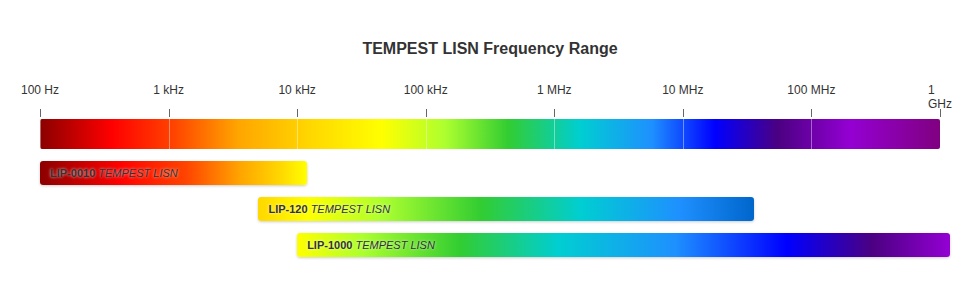
- ▸ Complementary to LIP-0010 and LIP-1000 — together the three TEMPEST LISNs deliver uninterrupted 100 Hz to 1 GHz coverage; common 10 A / 380 VDC ratings allow seamless transitions between units without EUT rewiring.
- ▸ Individually NIST-traceable calibrated — impedance, insertion loss, and isolation data shipped with each unit. ISO 17025 accredited calibration available on request for high-assurance compliance documentation.
- ▸ Three-year standard warranty — backed by manufacturer support.
Specifications
| Model | LIP-120 |
|---|---|
| Product Type | TEMPEST Power Line LISN, dual-conductor (Line & Neutral) |
| Standard | TEMPEST |
| Application | Low-frequency TEMPEST conducted emissions tests |
| Frequency Range | 5 kHz – 1 MHz |
| Inductance | 1.37 mH (air-core) |
| Impedance | 50 Ω |
| Number of Lines | 2 (Line & Neutral) |
| Max Voltage | 270 VAC (50/60 Hz) / 380 VDC |
| Max Current | 10 A continuous |
| RF Measurement Port | N-type (female), 50 Ω |
| EUT Power Output | Universal three-pin AC receptacle |
| Dimensions (H × W × D) | 5.1 × 8.0 × 11.8 in (13 × 20.5 × 30 cm) |
| Weight | 9 lbs (4.05 kg) |
| Operating Temperature | 5 °C to 40 °C |
| Calibration | Individual, NIST-traceable; ISO 17025 accredited available on request |
| Warranty | Three-year standard warranty |
All values are typical, unless specified. All specifications subject to change without notice.


🔍 Not Sure This Is The Right LISN?
Compare all 25 Com-Power LISN models side-by-side with our interactive selection tool. Filter by current, voltage, frequency, and standards to find your perfect match.
Compare All LISN Models →LIP-120 TEMPEST Line Impedance Stabilization Network FAQs
What is the LIP-120 and what TEMPEST testing application is it designed for?
The LIP-120 is a dual-conductor, 50Ω, 1.37 mH Line Impedance Stabilization Network (LISN) designed specifically for TEMPEST testing. It covers 5 kHz to 1 MHz and provides the measurement platform for performing power line conducted emissions compliance testing across this range. It provides a defined, stable impedance reference for the EUT, isolates the EUT from the power source, provides isolation between power lines to minimize cross-coupling, and couples disturbance voltages to the coaxial measurement ports for connection to a TEMPEST measurement receiver or spectrum analyzer.
Why does the LIP-120 cover 5 kHz to 1 MHz and how does this fit within the broader TEMPEST conducted emissions spectrum?
The 5 kHz to 1 MHz range represents the mid-frequency TEMPEST conducted emissions band, bridging the LIP-0010 (100 Hz to 10 kHz) and the LIP-1000 (1 MHz to 1 GHz). The 5 kHz lower limit captures conducted emissions from switching power supplies, keyboard scan circuits, display refresh harmonics, and digital subsystem clocking sources. The 1 MHz upper limit marks the transition into the RF TEMPEST band. Overlapping frequency coverage with the LIP-0010 (5 kHz to 10 kHz) and LIP-1000 (at 1 MHz) allows spectral continuity to be verified at the handover points between instruments.
What is the significance of the 1.37 mH inductance in the LIP-120?
The LIP-120 uses a 1.37 mH inductance, intermediate between the 2.8 mH of the LIP-0010 and the 23 μH of the LIP-1000. At 5 kHz, 1.37 mH presents approximately 43 Ω of inductive reactance, approaching the target 50Ω impedance. At 1 MHz, the reactance is approximately 8.6 kΩ, ensuring the 50Ω resistive termination within the LISN dominates the measurement impedance. The impedance profile transitions from approximately 45 Ω at 5 kHz to a stable 50Ω through the mid-band before remaining above 50Ω toward 1 MHz as inductive reactance increases.
What power system types can the LIP-120 be used with and what are its voltage and current ratings?
The LIP-120 is rated for both AC and DC operation and accommodates DC, single-phase, split-phase, and three-phase AC systems. Maximum AC voltage is 270 V RMS line-to-ground at 50-60 Hz; maximum DC voltage is 380 V DC; maximum current is 10 A continuous per line. For three-phase AC systems, two LIP-120 LISNs are used together, one per phase pair. This multi-power-system compatibility makes the LIP-120 suitable for TEMPEST evaluation of equipment powered from a wide range of AC and DC sources.
How does the LIP-120 achieve isolation between its two power conductors and why does this matter for TEMPEST measurements?
The LIP-120 provides greater than 30 dB of line-to-line isolation at 5 kHz, increasing to greater than 55 dB at 1 MHz. This rising isolation characteristic ensures that disturbance signals on one power conductor cannot corrupt the measurement of the other conductor across the full TEMPEST band. In a TEMPEST context, where individual conductors are measured separately to assess information-bearing signals, high line-to-line isolation is essential. The increasing isolation with frequency ensures the most sensitive high-frequency portion of the band receives the greatest cross-conductor isolation.
What mains port to EUT port isolation does the LIP-120 provide and why is this important?
The LIP-120 provides mains-to-EUT port isolation of greater than 20 dB at 5 kHz, increasing to greater than 40 dB at 1 MHz. This isolation prevents the conducted emissions environment of the facility power source from contaminating TEMPEST measurements of the EUT's power lead emissions. Without adequate mains isolation, background conducted noise from the facility supply would appear at the measurement port and could mask or be confused with genuine TEMPEST emissions, leading to false passes or false failures in the evaluation.
What insertion loss does the LIP-120 introduce and how is it accounted for in TEMPEST test results?
The LIP-120 provides insertion loss of less than 2 dB across the full 5 kHz to 1 MHz range, decreasing from approximately 2 dB at 5 kHz toward zero as frequency approaches 1 MHz. The individual unit calibration data supplied with each LIP-120 provides the precise LISN factor correction versus frequency for the specific unit, allowing accurate TEMPEST compliance assessments that account for any variation from the typical curve.
What connectors does the LIP-120 use on the mains input, EUT power output port, and RF measurement ports?
The mains power input uses an IEC C13 receptacle. The EUT power output port is a universal, multi-configuration receptacle accommodating almost any EUT plug without adapters. Both RF measurement ports use N-Type female connectors for connection to the TEMPEST measurement receiver or spectrum analyzer — the same connector type used across all three LIP-series TEMPEST LISNs.
Why does the LIP-120 use air-core inductors?
Air-core inductors prevent magnetic core saturation and inductance variation under DC bias or high AC current. At up to 10 A, a ferromagnetic core would experience significant DC bias saturation, reducing its inductance from the specified 1.37 mH and distorting the LISN impedance characteristic. Air-core inductors maintain constant 1.37 mH inductance regardless of current, ensuring reproducible impedance across all EUT operating current levels and making TEMPEST evaluation results independent of the EUT's instantaneous current draw.
How does the LIP-120 relate to the LIP-0010 and LIP-1000 in building a complete TEMPEST conducted emissions measurement capability?
The LIP-120 occupies the mid-frequency position in the three-model Com-Power TEMPEST LISN series: LIP-0010 (100 Hz to 10 kHz), LIP-120 (5 kHz to 1 MHz), LIP-1000 (1 MHz to 1 GHz). Used sequentially, the three instruments produce a complete 100 Hz to 1 GHz conducted emissions profile. The LIP-120 is the most broadly applicable of the three because its range captures the majority of information-bearing emanations from digital processing equipment including clock harmonics, bus activity signatures, and video synchronization artifacts.
What types of equipment are most commonly evaluated using the LIP-120?
Common EUT types include desktop and laptop computers, secure workstations, network servers, cryptographic processing modules, secure video display units, classified data storage systems, satellite communications ground terminals, tactical data link processors, and any AC or DC-powered electronic device processing information subject to TEMPEST controls. The 5 kHz to 1 MHz range is directly relevant to these devices because switching power supplies, processor clock harmonics, bus transaction signatures, and display drive signals generate their primary conducted power lead emissions in this band.
How is the LIP-120 connected and used in a typical TEMPEST conducted emissions test session?
The LIP-120 is positioned on the grounded test surface with its mounting plate bonded to the facility earth. The facility power source connects to the IEC C13 mains input; the EUT connects to the universal EUT output receptacle. A 50Ω coaxial cable connects one N-Type measurement port to the TEMPEST measurement receiver configured for 5 kHz to 1 MHz. The second N-Type port is terminated into 50Ω when not in use. The EUT is operated in its representative mission configuration while the receiver sweeps each power conductor recording peak or quasi-peak emission levels.
How are two LIP-120 LISNs used together for three-phase AC TEMPEST testing?
For three-phase AC TEMPEST testing, two LIP-120 LISNs are used simultaneously: one for Phase A and Phase B, the second for Phase C and Neutral/Ground. The AC power source connects to the mains ports of both LISNs; the EUT three-phase input connects to the EUT output ports of both. TEMPEST conducted emissions measurements are then taken from each of the four measurement ports sequentially, covering all three phase conductors and neutral. Both LIP-120 units must have their individual insertion loss corrections applied to measurements from each unit.
What are the physical dimensions and weight of the LIP-120?
The LIP-120 measures 5.1″ H × 8″ W × 11.8″ D (130 × 204 × 300 mm) and weighs 8.5 lbs (3.9 kg). It is smaller and lighter than the LIP-0010 (27.5 lbs) because 1.37 mH requires less wire and core geometry than 2.8 mH. It is slightly larger than the LIP-1000 (5.5 lbs) because 1.37 mH requires more inductor material than the 23 μH of the LIP-1000. Operating temperature is 40°F to 104°F (5°C to 40°C).
Why must the LIP-120 mounting plate be connected to earth ground and what safety precautions apply?
The unpainted mounting plate must make direct metal-to-metal contact with the facility earth reference before power is applied. Leakage currents through the internal network create a shock hazard and a floating measurement reference without this bond. All connections must be made securely before the supply is energized, and all connections must be de-energized before any connectors are removed. Inserting or removing power connectors while the supply is live can result in electrical shock at up to 270 V AC or 380 V DC.
How is the LIP-120 calibrated and what calibration documentation is supplied?
Every LIP-120 is individually calibrated per its relevant TEMPEST LISN requirements. Impedance, insertion loss (LISN factor), mains-to-EUT port isolation, and line-to-line isolation data are supplied with each unit along with a certificate of calibration. ISO 17025 accredited calibration is available upon request for TEMPEST test facilities operating under formal quality management programs or government accreditation frameworks.
How is the LIP-120 used during TEMPEST evaluation of a secure workstation at a government-accredited TEMPEST test facility?
At a government-accredited TEMPEST test facility, the LIP-120 is connected between the facility single-phase supply and the workstation's power input. The workstation operates in a representative classified workload configuration including keyboard input, display output, network activity, and processor-intensive tasks. The TEMPEST measurement receiver sweeps from 5 kHz to 1 MHz on each power conductor, and the LIP-120 individual calibration data is applied as a correction factor to convert raw receiver readings into true disturbance voltage measurements.
What is a typical real-world scenario where the LIP-120 is used to test a classified satellite communications ground terminal before SCIF installation?
Before a classified satellite communications ground terminal can be installed in a sensitive compartmented information facility (SCIF), the LIP-120 measures its single-phase or split-phase AC power input emissions from 5 kHz to 1 MHz. The terminal is operated while processing representative encrypted traffic including uplink modulation, downlink demodulation, and key management operations. If any frequencies exceed the permissible TEMPEST level, the facility security officer requires a classified power line filter on the AC input before accepting the terminal for SCIF installation.
How do defense electronics manufacturers use the LIP-120 during product development to predict TEMPEST compliance?
Defense electronics manufacturers incorporate LIP-120 testing into their product development cycle, measuring power lead conducted emissions at each design revision from 5 kHz to 1 MHz. If a revision unexpectedly increases emissions at specific frequencies, the LIP-120 data allows the engineer to correlate emission peaks with specific circuit design changes and implement targeted countermeasures such as improved power supply filtering, PCB layout revisions, or shielding enhancements. This development-phase TEMPEST assessment significantly reduces the probability of first-attempt failure in the formal government TEMPEST evaluation.
How is the LIP-120 used in a field TEMPEST assessment after maintenance of a deployed classified communications system?
When a deployed classified system undergoes maintenance involving replacement of power supply components or circuit board modifications, a field TEMPEST assessment with the LIP-120 verifies that the maintenance has not degraded the system's conducted emissions TEMPEST posture. A portable setup — LIP-120, portable measurement receiver, and calibrated reference source — is brought to the installation location. 5 kHz to 1 MHz sweeps are compared against pre-maintenance baseline measurements, and any new emission peaks are evaluated against the applicable TEMPEST limit to determine whether the system remains within its approved TEMPEST zone.
What is a typical scenario where the LIP-120 is used alongside the LIP-0010 and LIP-1000 to produce a complete TEMPEST conducted emissions test report?
A complete TEMPEST report requires measurements from 100 Hz to 1 GHz. The sequence begins with the LIP-0010 (100 Hz to 10 kHz), followed by the LIP-120 (5 kHz to 1 MHz), with the 5 kHz to 10 kHz overlap confirming instrument agreement, then the LIP-1000 (1 MHz to 1 GHz) with the 1 MHz handover verified for spectral continuity. All three data sets, corrected using each instrument's individual calibration data, are assembled into the final report. The LIP-120 data set typically contains the most content because switching power supply harmonics, processor bus emissions, and display drive signals produce the highest concentration of TEMPEST-relevant power lead emissions in the 5 kHz to 1 MHz band.

Quote Request
Other EMC Test Equipment
- Absorbing Clamps
- Antenna Kits
- Antenna Masts - Automated and Manual
- Antennas
- Bulk Current Injection probes
- CDNs - Coupling Decoupling Network
- Comb Generators
- Conducted Immunity Test Systems
- Current Monitor Probes
- Current Probe Calibration Fixtures
- EM Clamps
- Feed Through Capacitor
- ISNs - Impedance Stabilization Network
- LISNs - Single Phase
- LISNs - TEMPEST
- LISNs - Three Phase
- Magnetic Field Generator
- Near Field Probes
- Power Amplifiers
- Pre-compliance Emissions Test Systems
- Preamplifiers
- Spectrum Analyzers
- Surge Generators
- System Controllers
- Transient Limiters
- Tripods For EMC
- Turntables