
LISN 100 Amps CISPR 16 & ANSI C63.4
LI-1100C
50μH inductor
Used for FCC, CISPR, EN, ANSI
Frequency 150 kHz – 30 MHz
- The LI-1100 Line Impedance Stabilization Network (LISN) provides the necessary measurement platform for performing power line conducted emissions compliance testing as required by most worldwide standards for commercial products.
- The LI-1100 is compliant with both CISPR 16-1-2 and ANSI C63.4.
- The LISN provides defined stable impedance and isolates the EUT from power source influences, thereby providing accurate and repeatable results.
- The LI-1100 includes one pair of, separately housed, single-conductor networks, to be installed in series with each current-carrying conductor in a single- phase, dual-phase or DC power system. A second LI-1100 pair can be used to accommodate 3-phase power systems (Wye or Delta configurations).
- The LI-1100 is equipped with Superior Electric SUPERCON® shrouded sockets at the mains (power input) and EUT (power output) ports. The matching color-coded plugs for connection to the mains and EUT wiring are included.
- This LISN uses air-core inductors to prevent saturation and permeability variation. The mounting plate of the LI-1100 is left unpainted in order to facilitate connection to earth ground in its installation, which is essential due to high leakage current.
- Use of a Transient Limiter for impedance matching, reduction of out-of-band emissions and transient protection for your measurement instrument is highly recommended and available from Com- Power.
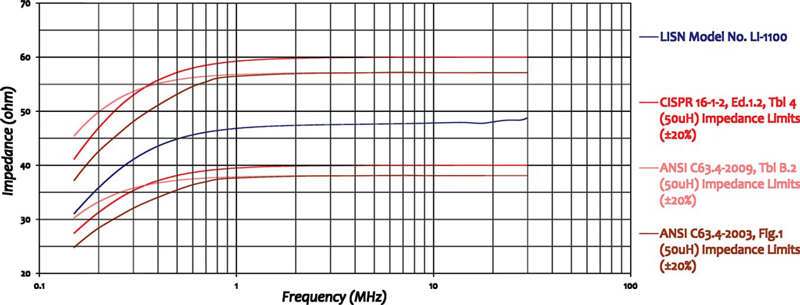
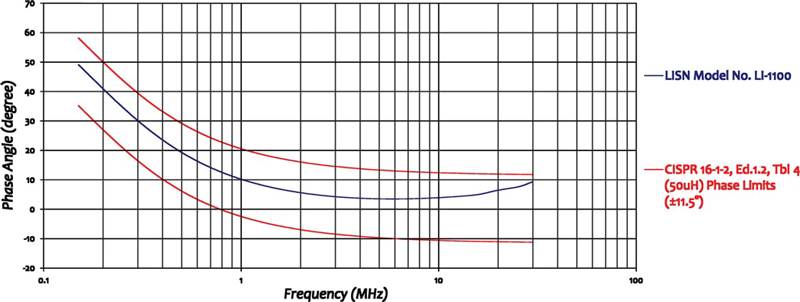
- All Com-Power LISNs are individually calibrated in compliance with the relevant requirements of CISPR 16-1-2 and ANSI C63.4. Impedance, Phase, Isolation, and Insertion Loss data is supplied with each unit, along with the calibration certificate.
- Frequency range of 150 kHz to 30 MHz
- 100 Amp(AC) (forced air cooling)
- Fully compliant with CISPR 16-1-2 / ANSI C63.4
- “Air-core” inductors to prevent saturation
- Individual Calibration Included
- Three-Year Warranty
- Product Name: Line Impedance Stabilization Network (LISN)
- Specification: CISPR 16-1-2 / ANSI C63.4
- Application: Power Line conducted emission tests
- Frequency Range: 150KHz - 30 MHz
- RF Connector: 50 Ohms N-type (female)
- Current Rating: 100 Ampere AC, 70 Ampere DC
- Voltage Rating: 440 VAC (Line to Ground), 620 VDC
- Inductors: 50 microhenry (air-core)
- Mains & EUT Connections: Superior Electric SUPERCON shrouded connectors
- Dimensions (each network): 10 x 10 x 21 inches / 25.4 x 25.4 x 53.3 cm
- Weight (each network): 17 lbs / 7.7 kg
- Insertion Loss: <0.5 dB (150 kHz - 30 MHz)
- Isolation: > 40 dB (150 kHz - 30 MHz)
🔍 Not Sure This Is The Right LISN?
Compare all 25 Com-Power LISN models side-by-side with our interactive selection tool. Filter by current, voltage, frequency, and standards to find your perfect match.
Compare All LISN Models →LI-1100C CISPR 16-1-2 / ANSI C63.4 High-Current Single-Phase LISN FAQs
What is the LI-1100C and what type of testing is it designed for?
The LI-1100C is a single-conductor, 50Ω, 50 μH Line Impedance Stabilization Network (LISN) designed for power-line conducted emissions compliance testing per CISPR 16-1-2 and ANSI C63.4 at currents up to 100 A AC with forced-air cooling. It is the highest-current model in the Com-Power single-phase CISPR 16-1-2 / ANSI C63.4 LISN range, designed for the most demanding commercial and industrial products including high-power motor drives, large UPS systems, high-power EV charging infrastructure, industrial welding equipment, large photovoltaic inverters, and any commercial product drawing up to 100 A.
What standards does the LI-1100C comply with?
The LI-1100C is fully compliant with CISPR 16-1-2 (specifying LISN electrical characteristics for conducted emissions measurements) and ANSI C63.4 (the American National Standard for FCC compliance testing). It is accepted by accredited EMC test laboratories worldwide for commercial product conducted emissions certification including CE marking under EN 55032, FCC Part 15, and other national standards derived from CISPR 16-1-2.
What is the frequency range of the LI-1100C?
The LI-1100C covers 150 kHz to 30 MHz — the same range as the LI-125C (25 A) and LI-150C (50 A). All three models share identical frequency coverage, RF connector type, 50 μH inductor value, and compliance standards. The only differences are maximum current rating and physical size required for the larger inductors and conductors at 100 A.
What is the current rating of the LI-1100C and what class of high-power products does it support?
The LI-1100C is rated at 100 A AC and 70 A DC — the highest in the Com-Power single-phase CISPR 16-1-2 range. This supports large industrial motor drives, high-power EV Level 2 and Level 3 charging stations, large UPS systems for data centers, industrial welding systems, large photovoltaic inverters and energy storage systems, high-power commercial HVAC systems, and high-power data center PDUs drawing up to 100 A single-phase.
What is the voltage rating of the LI-1100C and what power systems does it support?
The LI-1100C is rated at 440 VAC line-to-ground at 50–60 Hz and 620 VDC. The elevated 440 VAC rating (compared to 270 VAC for LI-125C/LI-150C) supports 277 VAC single-phase from 480 VAC North American industrial three-phase Wye systems, 380–415 VAC single-phase from European 400 VAC industrial three-phase Wye systems, and 620 VDC for EV battery storage, industrial DC bus, and high-voltage power conversion equipment.
Why does the LI-1100C require forced-air cooling and how does the system operate?
At 100 A, resistive losses in the air-core inductors generate substantial heat that passive convection cannot manage during extended compliance test sequences. The LI-1100C includes a fan powered by a dedicated adapter (120/230 VAC input, 6 VDC / 0.5 A output). The cooling fan must be running before the EUT is energized at or near full rated current, and must continue throughout the test. Operating at 100 A without the fan risks overheating the inductor insulation, damaging the unit and potentially altering inductance values.
How does the LI-1100C achieve its defined impedance and why are air-core inductors used at 100 A?
A 50 μH air-core inductor in series with the power line conductor, combined with capacitor and resistor networks, produces the defined 50 Ω CISPR impedance. Air-core inductors are essential at 100 A — any ferromagnetic core would saturate, causing inductance to collapse below 50 μH and invalidating the LISN impedance profile. Air-core inductors maintain a constant 50 μH at all currents up to the 100 A rating.
The LI-1100C is sold as a pair. Why is a pair required?
CISPR 16-1-2 and ANSI C63.4 require a LISN in series with each current-carrying conductor simultaneously (Line and Neutral). One LI-1100C is installed in the Line conductor and one in the Neutral. Measurements are performed one conductor at a time; the inactive RF port is terminated at 50 Ω. For three-phase systems, a second LI-1100C pair accommodates Phase B, Phase C, and Neutral.
What connectors does the LI-1100C use?
The LI-1100C uses Superior Electric SUPERCON® shrouded sockets at both mains and EUT ports, with color-coded plugs included. At 100 A and up to 440 VAC / 620 VDC, the shrouded connector design is critical for personnel safety. All power cables must be appropriately sized and rated for 100 A continuous operation.
Why is the mounting plate of the LI-1100C left unpainted and what grounding is required?
The unpainted mounting plate enables a low-impedance metal-to-metal bond to the test setup ground plane. At 100 A and up to 440 VAC, leakage currents through internal capacitors are potentially life-threatening if the earth bond is absent. The mounting plate must be bonded with a verified, direct low-impedance connection before any power connections are made. The test facility ground infrastructure must be verified as adequate for expected leakage current levels.
What RF connector does the LI-1100C use?
The LI-1100C uses a 50 Ω N-type female RF connector, connecting via 50 Ω coaxial cable to an EMI receiver or spectrum analyzer. The inactive LISN RF port must be terminated at 50 Ω. Com-Power recommends a Transient Limiter — at 100 A, large motor drives and industrial power converters generate much larger transient energy than lower-power products, making receiver protection especially important.
What insertion loss and isolation does the LI-1100C provide?
The LI-1100C provides insertion loss below 0.5 dB and isolation above 40 dB across 150 kHz to 30 MHz — identical to the LI-125C and LI-150C. Low insertion loss ensures measured voltages accurately represent actual EUT emissions. High isolation prevents facility power line noise from contaminating EUT measurement results at the RF port.
How is the LI-1100C individually calibrated and what calibration data is supplied?
Every LI-1100C is individually calibrated per CISPR 16-1-2 and ANSI C63.4. Impedance, phase, isolation, and insertion loss data for the specific unit are supplied with a certificate of calibration, providing precise insertion loss corrections for compliance testing and accounting for unit-to-unit component variations.
What is the warranty coverage for the LI-1100C?
The LI-1100C carries a three-year warranty from Com-Power Corporation. In addition to periodic recalibration on a one- or two-year interval, periodic inspection of the cooling fan to ensure it remains functional and that airflow is not obstructed is recommended.
What are the physical dimensions and weight of the LI-1100C?
Each LI-1100C network measures 10 x 10 x 21 inches (25.4 x 25.4 x 53.3 cm) and weighs 17 lbs (7.7 kg). The LI-1100C is substantially larger and heavier than the LI-125C and LI-150C. A complete single-phase installation requires significant floor or heavy bench space, 100 A-rated high-current wiring to the mains and EUT ports, and a powered cooling fan adapter running before EUT energization.
What is a Transient Limiter and why does Com-Power recommend one with the LI-1100C?
A Transient Limiter between the LI-1100C RF port and the EMI receiver provides impedance matching, attenuates out-of-band emissions below 150 kHz and above 30 MHz, and clamps voltage transients. At 100 A, large motor drives, UPS systems, and industrial power converters generate substantially larger transient energy than lower-power products, making the Transient Limiter especially important.
How does the LI-1100C complete the Com-Power single-phase CISPR 16-1-2 / ANSI C63.4 LISN range?
The LI-125C (25 A AC), LI-150C (50 A AC), and LI-1100C (100 A AC, forced-air) form the complete single-conductor CISPR 16-1-2 / ANSI C63.4 range, all sharing 150 kHz to 30 MHz, 50 Ω N-type RF, 50 μH air-core inductors, and individual calibration. Select the lowest-rated model accommodating the EUT current. The LI-1100C is required only when the EUT draws more than 50 A. Using a lower-current model at excessive current risks thermal damage and invalid measurements.
What types of equipment cannot be tested with the LI-1100C?
The LI-1100C is not suitable for: DO-160 or MIL-STD-461 testing (which require different network topologies); automotive CISPR 25 testing (use LI-550C); DC bus voltages exceeding 620 VDC; or three-phase systems without a second pair. At 100 A and up to 440 VAC, strict high-current and high-voltage safety procedures are mandatory — verified earth bonding, appropriately rated PPE, confirmed ground fault protection, and facility safety protocol compliance.
How is the LI-1100C used in conducted emissions compliance testing of a large industrial motor drive?
Large industrial motor drives drawing up to 100 A from single-phase 240 VAC or 277 VAC are installed through the LI-1100C pair between the AC mains and the drive’s AC input, with the drive output connected to the motor at representative load. Cooling fans are started first, then the drive is energized to rated input current. CE measurements from 150 kHz to 30 MHz on both Line and Neutral are compared against EN 55011 Class A industrial limits. The 100 A continuous rating with forced cooling allows full-rated-current testing throughout the entire CE scan duration — which may be 30+ minutes for a complete quasi-peak and average sweep — without thermally derating the LISN.
What does a conducted emissions test setup look like using the LI-1100C for a high-power EV charging station?
High-power Level 2 EV charging stations can draw up to 100 A from single-phase or split-phase 240 VAC. The LI-1100C pair connects between the regulated AC supply and the charger’s AC input; the charger output connects to an EV battery simulator at full rated charging current. Cooling fans are activated before the charger is energized. CE measurements from 150 kHz to 30 MHz capture switching frequency harmonics and rectifier noise that could interfere with nearby AM and FM receivers. The 440 VAC and 100 A ratings enable full-rated-current testing at both 120 VAC and 240 VAC charger configurations without changing the LISN.
How does an accredited EMC laboratory use the LI-1100C for third-party EN 55032 compliance testing of a high-power industrial power supply?
The laboratory confirms rated input current is up to 100 A, sets up the LI-1100C pair on the calibrated ground plane per EN 55032 / CISPR 16-1-2, and activates the cooling fans before energizing the supply at rated input current via a calibrated electronic load. Line and Neutral CE measurements from 150 kHz to 30 MHz are recorded with CISPR quasi-peak and average detectors. The LI-1100C’s individual calibration insertion loss correction is applied, and corrected results are compared against EN 55032 Class A or Class B limits. The LI-1100C’s calibration certificate, current rating, and CISPR 16-1-2 compliance are all documented in the formal test report.
How is the LI-1100C applied in conducted emissions testing of a large photovoltaic inverter for grid connection compliance?
Grid-tied PV inverters for commercial and industrial solar installations may output up to 100 A at single-phase 240 VAC. The LI-1100C pair is installed between the inverter AC output and a grid simulator or bidirectional power supply configured to absorb full rated output power. CE measurements from 150 kHz to 30 MHz at full rated output power per EN 55011 or FCC Part 15 capture switching frequency harmonics and intermodulation products generated by the DC-to-AC conversion stage that could appear on the utility grid and interfere with grid communication systems and other grid-connected equipment.


Quote Request
Other EMC Test Equipment
- Absorbing Clamps
- Antenna Kits
- Antenna Masts - Automated and Manual
- Antennas
- Bulk Current Injection probes
- CDNs - Coupling Decoupling Network
- Comb Generators
- Conducted Immunity Test Systems
- Current Monitor Probes
- Current Probe Calibration Fixtures
- EM Clamps
- Feed Through Capacitor
- ISNs - Impedance Stabilization Network
- LISNs - Single Phase
- LISNs - TEMPEST
- LISNs - Three Phase
- Magnetic Field Generator
- Near Field Probes
- Power Amplifiers
- Pre-compliance Emissions Test Systems
- Preamplifiers
- Spectrum Analyzers
- Surge Generators
- System Controllers
- Transient Limiters
- Tripods For EMC
- Turntables