
Tempest DC Power LISN for 100 Hz to 10 kHz Conducted Emissions Testing
- Provides a defined 50 Ω / 2.8 mH impedance network for controlled DC conducted emissions measurements from 100 Hz to 10 kHz.
- Supports up to 380 VDC and 10 A continuous current per line, making it suitable for higher-power DC-powered equipment.
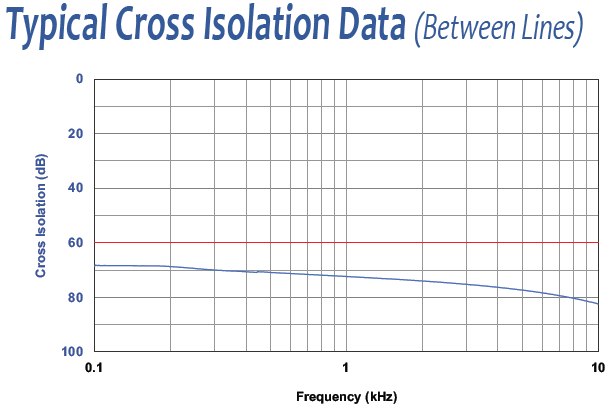
- Delivers < 1 dB to < 0.5 dB insertion loss with > 60 dB line-to-line isolation for accurate TEMPEST measurement performance.
- Isolates the equipment under test (EUT) from the DC source to reduce external supply influence during emissions testing.
- Couples disturbance voltages to the N-type RF measurement ports for direct connection to EMI receivers or spectrum analyzers.
- Improves repeatability in TEMPEST labs by maintaining a stable impedance environment independent of source variations.
- Helps evaluate secure communication devices, defense electronics, control systems, and other DC-powered equipment under realistic compliance conditions.
- Uses air-core inductors to prevent magnetic saturation and preserve impedance stability across the measurement band.
- Simplifies setup with a universal multi-configuration EUT receptacle and IEC C13 input for flexible lab integration.
- Supplied with individual calibration data and optional ISO 17025 accredited calibration to support high-assurance TEMPEST workflows.
Features
- ▸ Purpose-built TEMPEST DC LISN — engineered for security emanations testing of DC-powered classified equipment; the only Com-Power LISN that operates entirely below 10 kHz, addressing a frequency band that conventional commercial LISNs cannot reach.
- ▸ 100 Hz to 10 kHz frequency range — captures low-frequency compromising emanations from battery-backed systems, DC bus architectures, UPS systems, and portable secure devices that would propagate undetected on standard 150 kHz–30 MHz LISNs.
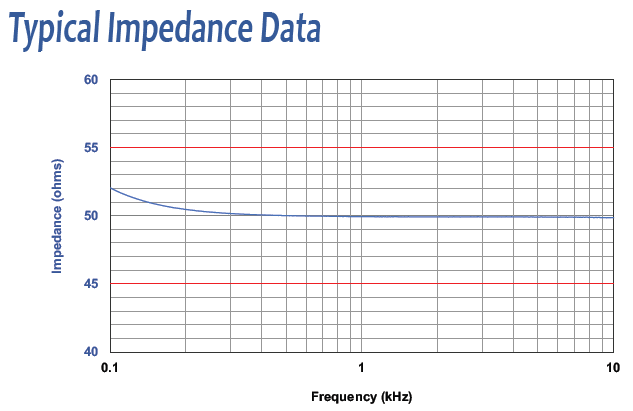
- ▸ 2.8 mH air-core inductors with 50 Ω (±10%) impedance — the high-inductance air-core network presents a stable, defined impedance below 10 kHz; air-core construction prevents permeability variation under DC load.
- ▸ Dual-conductor architecture with two independent N-type RF measurement ports — both DC power lines are measured simultaneously without cable swapping; each line has its own dedicated 50 Ω female N-type measurement port.
- ▸ 10 A DC continuous current, 380 VDC voltage rating — supports the full range of DC-powered classified equipment found in SCIFs, military installations, and diplomatic facilities.
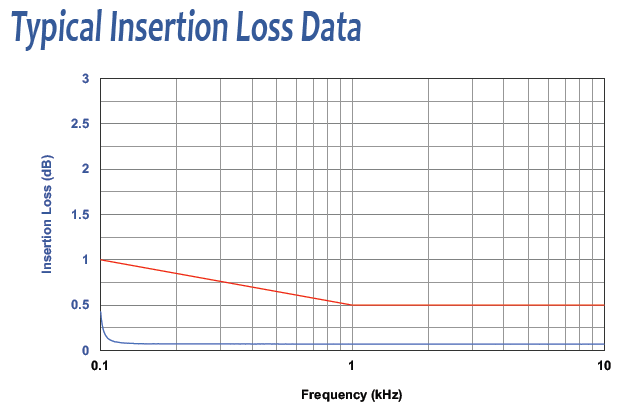
- ▸ Insertion loss < 1 dB (100 Hz–1 kHz) and < 0.5 dB (1 kHz–10 kHz) — minimal signal attenuation across the operating band ensures even very low-level compromising signals reach the EMI receiver intact.
- ▸ Line-to-line isolation > 60 dB — substantially better isolation between the two DC power lines than commercial LISNs typically deliver; ensures compromising signals on one line are not masked by emissions or noise from the other line.
- ▸ Universal multi-configuration EUT receptacle — accommodates the widest range of DC-powered equipment plug types without custom adapters; IEC C13 mains input on the supply side.
- ▸ Unpainted mounting plate for low-impedance ground bond — metal-to-metal bonding to the test setup ground plane is essential due to the high leakage current characteristics inherent to DC LISN operation.
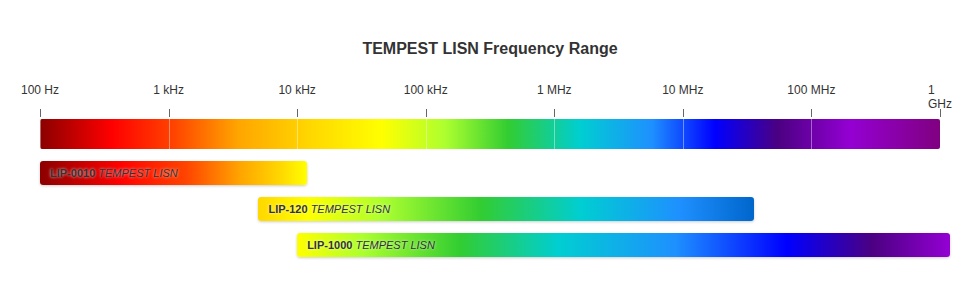
- ▸ Complementary to LIP-120 and LIP-1000 — together the three TEMPEST LISNs deliver uninterrupted 100 Hz to 1 GHz coverage; common 10 A / 380 VDC ratings allow seamless transitions between units without EUT rewiring.
- ▸ Individually NIST-traceable calibrated — impedance, insertion loss, and isolation data shipped with each unit. ISO 17025 accredited calibration available on request for high-assurance compliance documentation.
- ▸ Three-year standard warranty — backed by manufacturer support.
Specifications
| Model | LIP-0010 |
|---|---|
| Product Type | TEMPEST DC Power LISN, dual-conductor |
| Standard | TEMPEST |
| Application | DC power line conducted emissions tests |
| Network Type | 50 Ω / 2.8 mH (air-core) |
| Frequency Range | 100 Hz – 10 kHz |
| Impedance | 50 Ω (±10%) |
| Insertion Loss | < 1 dB to < 0.5 dB (100 Hz – 1 kHz); < 0.5 dB (1 kHz – 10 kHz) |
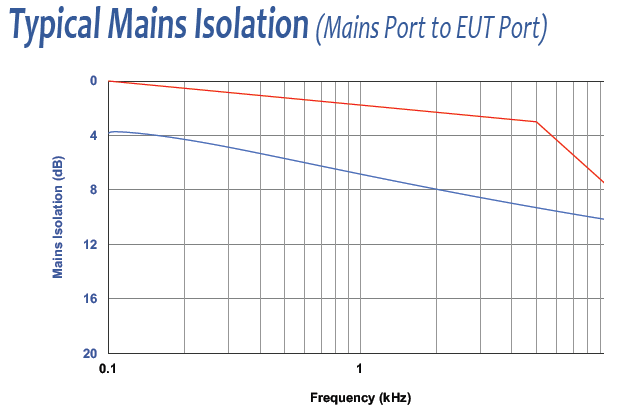
| Isolation (Mains to EUT) | 0 dB to > 3 dB (100 Hz – 5 kHz); > 3 dB to > 7 dB (5 kHz – 10 kHz) |
| Isolation (Line to Line) | > 60 dB |
| Number of Lines | 2 (Line 1 & Line 2 / Neutral) |
| Max DC Voltage | 380 VDC |
| Max DC Current | 10 A DC continuous (per line) |
| RF Measurement Ports | 2 × N-type (female), 50 Ω |
| Mains Input | IEC C13 receptacle |
| EUT Power Output | Universal multi-configuration receptacle |
| Dimensions (H × W × D) | 6.75 × 11.25 × 15 in (171 × 286 × 381 mm) |
| Weight | 27.5 lbs (12.5 kg) |
| Operating Temperature | 5 °C to 40 °C |
| Calibration | Individual, NIST-traceable; ISO 17025 accredited available on request |
| Warranty | Three-year standard warranty |
All values are typical, unless specified. All specifications subject to change without notice.
| Title | Link |
|---|---|
| LIP-0010 Datasheet_Rev-D030326 | View PDF |
🔍 Not Sure This Is The Right LISN?
Compare all 25 Com-Power LISN models side-by-side with our interactive selection tool. Filter by current, voltage, frequency, and standards to find your perfect match.
Compare All LISN Models →LIP-0010 TEMPEST DC Line Impedance Stabilization Network FAQs
What is the LIP-0010 and what testing application is it designed for?
The LIP-0010 is a dual-conductor, 50Ω, 2.8 mH Line Impedance Stabilization Network (LISN) designed specifically for TEMPEST testing of DC-powered devices over the frequency range of 100 Hz to 10 kHz. It provides the defined, stable impedance reference required for DC power line conducted emissions compliance measurements, isolates the EUT from the DC power source, provides isolation between the power lines to minimize cross-coupling, and couples disturbance voltages to the coaxial measurement port for connection to a measuring instrument.
What is TEMPEST testing and why does it require a specialized LISN like the LIP-0010?
TEMPEST is a U.S. government and NATO designation for investigations of compromising emanations from information-processing equipment — evaluating whether classified or sensitive information can be reconstructed from unintentional emissions on a device's power leads or through radiated fields. The frequency range for TEMPEST power lead emissions extends as low as 100 Hz, far below the 150 kHz lower limit of commercial EMC LISNs. The LIP-0010 is specifically designed with a 2.8 mH network to provide the defined TEMPEST impedance characteristic from 100 Hz to 10 kHz, which commercial or military EMC LISNs with smaller inductance values cannot achieve.
Why does the LIP-0010 cover 100 Hz to 10 kHz specifically, and why does this range matter for TEMPEST?
The 100 Hz to 10 kHz range corresponds to where low-frequency emanations from DC-powered processing equipment appear on power leads. Equipment such as display controllers, keyboard interfaces, and digital devices processing sensitive information can modulate their DC supply current at audio and sub-audio frequencies that carry information-bearing signals. The 100 Hz lower limit captures fundamental power supply ripple and slow modulation frequencies. The 10 kHz upper limit marks the transition where the LIP-120 takes over. Together with the LIP-120 and LIP-1000, the series covers the complete TEMPEST conducted emissions spectrum from 100 Hz to 1 GHz.
What is the significance of the 2.8 mH inductance in the LIP-0010 network and how does it differ from standard EMC LISNs?
The LIP-0010 uses a 2.8 mH inductance — far larger than the 50 μH used in commercial CISPR 16-1-2 LISNs and the 1.37 mH in the LIP-120. A 50 μH inductor presents less than 32 mΩ of reactance at 100 Hz, making it entirely ineffective as a measurement reference at low TEMPEST frequencies. The LIP-0010's 2.8 mH inductor presents approximately 1.76 Ω at 100 Hz, rising to 176 Ω at 10 kHz, providing the impedance characteristic the TEMPEST measurement standard requires at these frequencies.
What DC voltage and current ratings does the LIP-0010 support?
The LIP-0010 supports a maximum DC voltage of 380 V and a maximum continuous DC current of 10 A per line. These ratings accommodate a wide range of DC-powered TEMPEST-evaluated equipment including laptop and desktop computers, secure communications terminals, cryptographic equipment, and information display systems — operating on low-voltage DC supplies from 5 V to 48 V as well as higher-voltage DC systems up to 380 V.
How does the LIP-0010 achieve isolation between the DC power lines to prevent cross-coupling?
The LIP-0010 provides greater than 60 dB of line-to-line isolation across the full 100 Hz to 10 kHz range. This prevents disturbance signals on one power conductor from coupling into the measurement port of the other conductor, which would corrupt the conducted emissions measurement. In a TEMPEST context this is particularly important because the positive and negative DC conductors may carry different emission signatures, and contamination of one measurement channel by the other would make it impossible to correctly characterize individual conductor emissions.
What insertion loss does the LIP-0010 provide and how does this affect TEMPEST measurements?
Insertion loss decreases linearly with the logarithm of frequency from less than 1 dB at 100 Hz to less than 0.5 dB at 1 kHz, remaining below 0.5 dB through 10 kHz. This very low insertion loss minimizes attenuation of the EUT's disturbance voltages before they reach the measurement port — important because TEMPEST emissions on DC power leads can be extremely low-level signals. Mains-to-EUT port isolation grows from 0 dB at 100 Hz to greater than 3 dB at 5 kHz, and from greater than 3 dB to greater than 7 dB between 5 kHz and 10 kHz.
What connectors does the LIP-0010 use on the mains input, EUT power port, and RF measurement ports?
The mains power input port uses an IEC C13 receptacle. The EUT power output port uses a universal multi-configuration receptacle accommodating a wide range of EUT power plug types without adapters. Both RF measurement ports use 50Ω N-type female connectors for connection to the measuring instrument — the standard connector type across all three LIP-series TEMPEST LISNs for consistency of measurement port connections.
Why are air-core inductors used in the LIP-0010 and what measurement benefit do they provide?
Air-core inductors prevent magnetic saturation and permeability variation across the 100 Hz to 10 kHz range. At DC currents up to 10 A, a ferromagnetic core would saturate and its inductance would collapse from the specified 2.8 mH value, destroying the defined impedance characteristic. Air-core inductors maintain constant 2.8 mH inductance regardless of DC bias current, ensuring the LISN presents the correct 50Ω impedance profile at every DC operating point from zero to maximum rated current.
Why must the LIP-0010 mounting plate be connected to earth ground before applying power?
The unpainted mounting plate must make direct metal-to-metal contact with the facility earth reference before power is applied. The LISN carries leakage currents from the DC supply through its internal network to the chassis, and without an earth bond these create a shock hazard and a floating measurement reference. The ground bond also establishes the reference potential for disturbance voltage measurements. The earth ground connection must be the first connection made and the last removed.
How is the LIP-0010 calibrated and what documentation is provided?
Every LIP-0010 is individually calibrated per its relevant TEMPEST LISN requirements. Impedance, insertion loss, mains-to-EUT port isolation, and line-to-line isolation data are supplied with each unit along with a certificate of calibration. ISO 17025 accredited calibration is available upon request for TEMPEST test facilities operating under formal quality management programs or accreditation frameworks.
How does the LIP-0010 fit into the complete Com-Power TEMPEST LISN series?
The LIP-series covers the complete TEMPEST conducted emissions spectrum: the LIP-0010 covers 100 Hz to 10 kHz (2.8 mH network) for the lowest-frequency DC TEMPEST measurements; the LIP-120 covers 5 kHz to 1 MHz (1.37 mH network) for the mid-frequency range; and the LIP-1000 covers 1 MHz to 1 GHz (23 μH network) for the high-frequency RF range. A complete TEMPEST characterization from 100 Hz to 1 GHz requires all three LISNs. The LIP-0010 is specifically required when the evaluation includes the 100 Hz to 10 kHz sub-band, which standard military or commercial EMC LISNs cannot cover.
What types of DC-powered equipment are most commonly evaluated using the LIP-0010?
The LIP-0010 is most commonly used to evaluate DC-powered information-processing and communications equipment including laptops and desktops processing classified information, secure terminal units, cryptographic key fill devices, satellite communications terminals, tactical radio frequency generators, digital signal processing modules in secure intelligence systems, biometric processing units, and DC-powered network switching equipment in classified facilities.
How does a typical TEMPEST conducted emissions test setup with the LIP-0010 look in a secure test facility?
The LIP-0010 is positioned on the grounded test surface with its mounting plate bonded to the facility earth reference. The DC power source connects to the IEC C13 mains input; the EUT connects to the universal EUT power receptacle. A 50Ω coaxial cable connects one N-type measurement port to the TEMPEST measurement receiver configured for 100 Hz to 10 kHz. The second N-type port is terminated into 50Ω when not in use. The EUT is operated in its representative mission configuration and the receiver sweeps the 100 Hz to 10 kHz range to capture conducted emissions on the measured power conductor.
What are the physical dimensions and weight of the LIP-0010?
The LIP-0010 measures 6.75″ H × 11.25″ W × 15″ D (171 × 286 × 381 mm) and weighs 27.5 lbs (12.5 kg). Its larger size and weight compared to the LIP-120 (8.5 lbs) and LIP-1000 (5.5 lbs) directly reflects the much larger 2.8 mH air-core inductors required to achieve 50Ω impedance at 100 Hz. Inductance of 2.8 mH requires substantially more wire and larger geometry than the 1.37 mH of the LIP-120 or the 23 μH of the LIP-1000.
Can the LIP-0010 be used with AC-powered equipment or only with DC-powered equipment?
The LIP-0010 is specifically designed and rated for DC power line TEMPEST testing. Its 380 V DC / 10 A DC continuous rating, product description, and TEMPEST calibration are all defined for direct current operation. For AC-powered or mixed AC/DC equipment requiring TEMPEST testing across 5 kHz to 1 MHz, the LIP-120 is the appropriate model, as it is rated for both 270 V AC RMS (50-60 Hz) and 380 V DC and accommodates DC, single-phase, split-phase, and three-phase AC power systems.
How is the LIP-0010 used during TEMPEST red-black boundary evaluation of a DC-powered secure communications terminal?
In a TEMPEST red-black boundary evaluation, the LIP-0010 measures conducted emissions on the DC power leads at the point where those leads cross from the red (classified) side to the black (unclassified) side of the installation boundary. The terminal is operated while processing representative classified traffic, and the LIP-0010 measures disturbance voltages from 100 Hz to 10 kHz. If emissions exceed the applicable TEMPEST limit, the facility must implement power line filtering before the DC supply exits the red boundary.
What is a typical scenario where the LIP-0010 is used during a TEMPEST zone installation qualification?
During a TEMPEST zone installation qualification, the LIP-0010 is connected between the DC power adapter output and the laptop's DC input connector, with the laptop running a representative workload exercising the display, processor, and memory subsystems. Measurements from 100 Hz to 10 kHz on both positive and negative DC conductors, combined with LIP-120 and LIP-1000 measurements covering the full TEMPEST range, form the conducted emissions portion of the TEMPEST zone qualification report submitted to the approving authority.
How does a TEMPEST laboratory use all three LIP-series LISNs to perform a complete DC conducted emissions characterization?
A complete DC conducted emissions TEMPEST characterization requires all three LIP-series LISNs used in sequence. The laboratory begins with the LIP-0010 sweeping 100 Hz to 10 kHz, then replaces it with the LIP-120 covering 5 kHz to 1 MHz (with the 5 kHz to 10 kHz overlap confirming consistency), and finally the LIP-1000 covering 1 MHz to 1 GHz. The three data sets are concatenated to produce a full-spectrum 100 Hz to 1 GHz conducted emissions profile of the EUT's DC power leads.
What precautions must be taken when connecting or disconnecting power cables to the LIP-0010?
Critical safety precautions include: the protective earth must be connected before applying power; all electrical connections must be made securely before the supply is energized; and all connections must be de-energized before removing any connectors. Inserting or removing power connectors while energized can result in electrical shock, particularly at DC voltages up to 380 V where the absence of a zero-crossing means continuous arc energy at any disconnection event. The DC supply must be confirmed off before any cable changes are made.
How is the LIP-0010 used at a defense contractor facility performing TEMPEST compliance testing of a new secure cryptographic module before government delivery?
For the DC power lead conducted emissions portion of a cryptographic module TEMPEST evaluation, the LIP-0010 is used to measure emissions from 100 Hz to 10 kHz with the module operating in its cryptographic processing mode, which represents the highest potential for information-bearing emissions on the supply leads. The module is operated through representative key generation and encryption processing cycles, and both DC supply conductors are measured. If any emissions exceed the applicable TEMPEST limit, the contractor implements DC power line filtering and repeats the measurement before submitting the module for government acceptance testing.

Quote Request
Other EMC Test Equipment
- Absorbing Clamps
- Antenna Kits
- Antenna Masts - Automated and Manual
- Antennas
- Bulk Current Injection probes
- CDNs - Coupling Decoupling Network
- Comb Generators
- Conducted Immunity Test Systems
- Current Monitor Probes
- Current Probe Calibration Fixtures
- EM Clamps
- Feed Through Capacitor
- ISNs - Impedance Stabilization Network
- LISNs - Single Phase
- LISNs - TEMPEST
- LISNs - Three Phase
- Magnetic Field Generator
- Near Field Probes
- Power Amplifiers
- Pre-compliance Emissions Test Systems
- Preamplifiers
- Spectrum Analyzers
- Surge Generators
- System Controllers
- Transient Limiters
- Tripods For EMC
- Turntables