
32A Three-Phase LISN for Industrial EMI Compliance
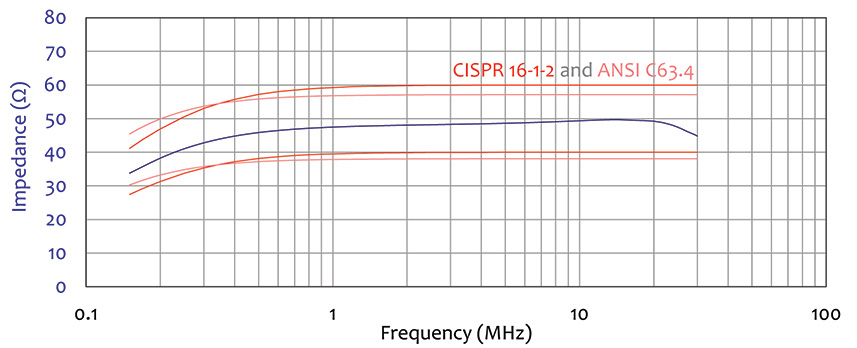
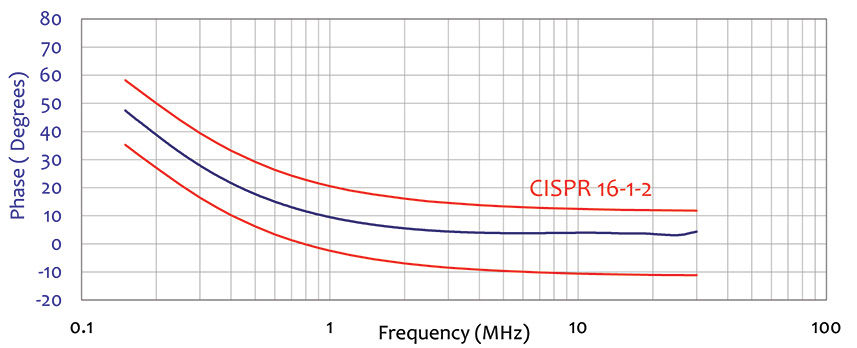
- Implements a precision-controlled 50 Ω / 50 µH four-conductor impedance stabilization network fully compliant with CISPR 16-1-2 and ANSI C63.4.
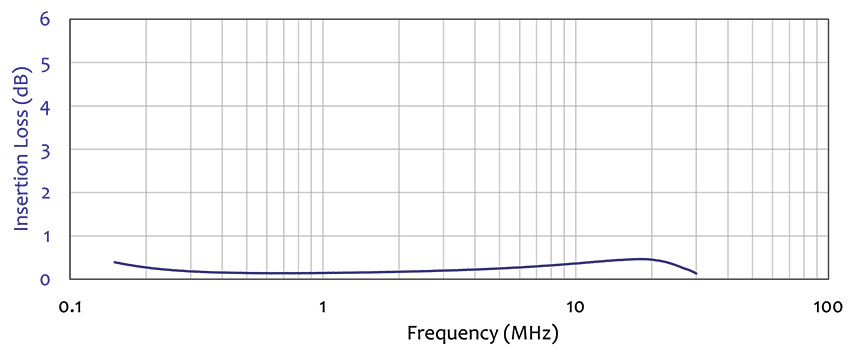
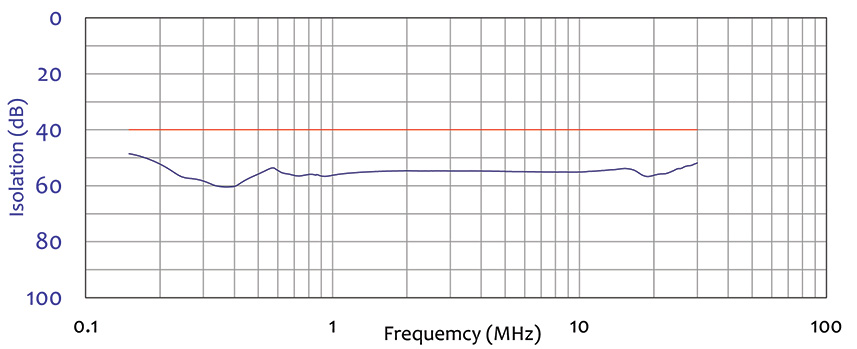
- Maintains controlled impedance characteristics from 150 kHz–30 MHz with verified isolation exceeding 40 dB and insertion loss below 11 dB.
- Supports 32 A continuous per line allowing full-load conducted emissions validation of three-phase EUTs.
- Utilizes air-core inductors to eliminate magnetic saturation and maintain phase accuracy under high current conditions.
- Improves measurement repeatability in compliance labs by providing defined and stable power line impedance independent of the facility mains.
- Enhances test setup accuracy for motor drives, EV chargers, UPS systems, converters, and industrial automation equipment.
- Reduces measurement uncertainty by isolating the EUT from upstream power disturbances and external noise sources.
- Optimizes multi-phase testing efficiency through remote fiber-optic line switching, minimizing reconnections and operator handling.
- Protects EMI receivers and spectrum analyzers via integrated transient limiting and broadband filtering.
- Supports structured EMC workflows with forced-air cooling for extended high-current testing sessions.
Features
- ▸ Mid-range LI-3P-1X three-phase LISN, 32 A per line — suited for commercial HVAC blower units, mid-range motor drives, industrial pumps, packaging machinery, and smaller CNC machines.
- ▸ 150 kHz to 30 MHz frequency range — covers the standard CISPR / ANSI commercial conducted emissions band; full coverage for FCC, CE, and EN compliance testing of three-phase products.
- ▸ Fully compliant with CISPR 16-1-2 and ANSI C63.4 — the 50 Ω / 50 μH four-conductor V-network is calibrated to the standard, accepted by accredited EMC test laboratories worldwide.
- ▸ Four-conductor design covers L1, L2, L3, and Neutral — supports both Delta (3-wire) and Wye (4-wire) three-phase configurations; one independent stabilization network per conductor.
- ▸ 32 A per line current rating with 50 A power connectors — matched to the EUT current draw range for this model in the 1X Series.
- ▸ High voltage rating: 865 Vrms line-to-line, 500 Vrms line-to-ground, 600 VDC — supports worldwide three-phase systems found in commercial and industrial applications.
- ▸ 50/60 Hz mains support
- ▸ Air-core inductors prevent saturation — air-core construction keeps inductance constant at all currents up to the 32 A rating, ensuring the LISN impedance and emissions measurement remain calibrated.
- ▸ Insertion loss < 11 dB; isolation > 40 dB — well-controlled signal path for accurate emissions measurement and effective decoupling of the EUT from facility power line noise.
- ▸ Built-in transient limiter — integrated protection for the EMI receiver input from EUT switching transients, eliminating the need for an external transient limiter accessory.
- ▸ Remote line switching via RLI V2.0 fiber optic interface — USB-connected interface unit with optical isolation switches between L1, L2, L3, and N from the control room without entering the test setup; enables fully automated test sequences.
- ▸ Manual front-panel line selection also provided — backup operation without the remote interface, useful for setup, manual diagnostics, and bench-top pre-compliance work.
- ▸ 50 Ω N-type female RF connector — standard interface for direct connection to EMI receivers and spectrum analyzers.
- ▸ Passive louvered-panel cooling — quiet bench-top operation without cooling fans, suitable for use directly adjacent to acoustic-sensitive test environments.
- ▸ Individually calibrated — each unit ships with calibration data; ISO 17025 accredited calibration available on request.
- ▸ Three-year standard warranty — backed by manufacturer support.
Specifications
| Model | LI-3P-132 |
|---|---|
| Series | 1X Series — Four-conductor 50 Ω / 50 μH, CISPR 16-1-2 / ANSI C63.4 |
| Standards Compliance | CISPR 16-1-2 (CE) & ANSI C63.4 (FCC) |
| Application | Commercial three-phase power line conducted emissions tests |
| Frequency Range | 150 kHz – 30 MHz |
| Network Type | 50 Ω, 50 μH, four-conductor (air-core) |
| Current Rating (per line) | 32 A |
| Power Connector Rating | 50 A |
| Max AC Voltage (Line-to-Line) | 865 Vrms |
| Max AC Voltage (Line-to-Ground) | 500 Vrms |
| Max DC Voltage | 600 VDC |
| AC Frequency Support | 50/60 Hz only |
| Insertion Loss | < 11 dB |
| Isolation | > 40 dB |
| Transient Limiter | Built-in |
| RF Measurement Port | 50 Ω N-type (female) |
| Remote Interface | RLI V2.0 via fiber optic |
| Local Line Selection | Front-panel push-buttons (L1, L2, L3, N) |
| Power Configurations | Delta (3-wire) and Wye (4-wire) |
| Cooling | Louvered side panels (passive) |
| Dimensions (H × W × D) | 14.25 × 14.6 × 16.88 in |
| Weight | 41 lbs (18.6 kg) |
| Operating Temperature | 5 °C to 40 °C |
| Calibration | Individual; ISO 17025 accredited available on request |
| Warranty | Three-year standard warranty |
All values are typical, unless specified. All specifications subject to change without notice.
🔍 Not Sure This Is The Right LISN?
Compare all 25 Com-Power LISN models side-by-side with our interactive selection tool. Filter by current, voltage, frequency, and standards to find your perfect match.
Compare All LISN Models →LI-3P-132 V2.0 Three-Phase LISN FAQs
What is the LI-3P-132 and what class of equipment is it designed to test?
The LI-3P-132 is a four-conductor, 50Ω/50 μH, three-phase Line Impedance Stabilization Network rated at 32 amperes per phase. It is designed for power line conducted emissions compliance testing of medium-power three-phase industrial and commercial equipment, such as motor drives, uninterruptible power supplies, industrial heating systems, and three-phase power conversion equipment operating within the 32 A current class.
Which EMC compliance standards does the LI-3P-132 satisfy?
The LI-3P-132 is fully compliant with CISPR 16-1-2 for European CE marking and ANSI C63.4 for FCC compliance in the United States. It also supports testing under AS/NZS, VCCI, ISED Canada, and other international commercial EMI/EMC regulatory frameworks.
What frequency range does the LI-3P-132 cover for conducted emissions testing?
The LI-3P-132 operates from 150 kHz to 30 MHz, covering the full frequency range required by CISPR 16-1-2 and ANSI C63.4 for power line conducted disturbance voltage measurements. A single LISN unit addresses the complete regulatory test band without requiring instrument changes or network substitutions.
How does the LI-3P-132 maintain a stable power line impedance for the EUT during testing?
The 50 μH inductors in the LI-3P-132 network present a high impedance to RF disturbance voltages while passing the fundamental power frequency current to the EUT. The air-core construction prevents inductance variation due to core saturation or permeability changes, ensuring the network impedance remains within CISPR 16-1-2 tolerance across the full operating range.
What Delta and Wye three-phase configurations can the LI-3P-132 accommodate?
The LI-3P-132 uses a four-conductor network with L1, L2, L3, and Neutral conductors, supporting both three-phase Delta and three-phase Wye configurations. This flexibility allows engineers to test equipment regardless of how the facility power distribution or the EUT power input is configured.
How does the fiber optic remote switching system of the LI-3P-132 support automated EMC testing?
The RLI V2.0 Remote LISN Interface uses a fiber optic connection to allow remote selection of L1, L2, L3, or Neutral from outside the test enclosure. Because fiber optic links are electrically isolated, they can be integrated with automated test software without creating ground loops or introducing RF interference into the shielded test environment.
What are the voltage and current limits of the LI-3P-132 for EUT power connections?
The LI-3P-132 supports a maximum continuous current of 32 amperes per phase, a maximum AC voltage of 865 V RMS line-to-line and 500 V RMS line-to-ground, and a maximum DC voltage of 600 V. These ratings accommodate a broad range of industrial three-phase equipment operating on standard 400 V or 480 V distribution systems.
How does the internal termination of non-selected lines affect measurement accuracy on the LI-3P-132?
When a line is selected for measurement, the remaining three conductors are automatically terminated into 50Ω internally. This maintains correct network impedance on all conductors simultaneously and prevents cross-coupling between phases from distorting the disturbance voltage on the selected line, ensuring results consistent with CISPR 16-1-2.
What protection does the LI-3P-132 transient limiter provide to the connected EMI receiver?
The built-in Transient Limiter clamps instantaneous voltage transients at the RF measurement port before they can damage the input stage of an EMI receiver or spectrum analyzer. Integrated low-pass and high-pass filters further reduce out-of-band energy, protecting sensitive measurement hardware during EUT power switching events.
Why is air-core inductor construction important for the 50 μH LISN network in the LI-3P-132?
Air-core inductors are immune to saturation at high current levels and do not exhibit permeability variation with temperature or frequency. For a 32 A rated LISN, this ensures the network impedance characteristic remains accurate and within CISPR 16-1-2 tolerances even under full load conditions.
What insertion loss and isolation specifications does the LI-3P-132 meet?
The LI-3P-132 achieves an insertion loss of less than 11 dB and provides more than 40 dB of isolation between the mains input and the RF measurement port across 150 kHz to 30 MHz. The high isolation prevents mains-borne facility noise from masking or corrupting the EUT disturbance voltages under measurement.
How is the LI-3P-132 calibrated and what calibration documentation accompanies each unit?
Every LI-3P-132 is individually calibrated per CISPR 16-1-2 and ANSI C63.4. A calibration report covering impedance, phase, isolation, and insertion loss versus frequency is provided with each unit, together with a certificate of calibration. ISO 17025 accredited calibration is available upon request for laboratories operating under formal quality management systems.
What grounding requirements apply to the LI-3P-132 during test setup?
The LI-3P-132 mounting plate is left unpainted to ensure a direct, low-impedance connection to the conductive ground plane or bonded test table surface. Proper earth bonding is essential because three-phase equipment can generate substantial leakage currents that must be safely returned to earth while maintaining the defined LISN impedance conditions of CISPR 16-1-2.
What connector ratings are used on the LI-3P-132 power input and EUT output ports?
The LI-3P-132 uses color-coded 50A rated plug and receptacle connectors on both the mains power input and EUT power output ports, with five positions per port for L1, L2, L3, Neutral, and Protective Earth. The RF measurement port uses a 50Ω N-Type female connector compatible with standard EMC measurement cables.
In which industrial test scenarios is the LI-3P-132 the preferred LISN selection over the LI-3P-116?
The LI-3P-132 is the appropriate choice when the EUT draws between 16 and 32 amperes per phase. Typical applications include medium-power variable frequency drives, three-phase welding equipment, commercial HVAC systems, industrial lighting controls, and multi-axis servo drive systems where the 16 A rating of the LI-3P-116 would be exceeded.
How does the LI-3P-132 support both local and remote operation in an EMC laboratory setup?
The LI-3P-132 provides two methods for line selection. Local operation uses membrane push-buttons on the front panel for manual selection. Remote operation uses the RLI V2.0 interface over a 10-meter fiber optic cable, allowing fully automated or operator-controlled switching from outside a shielded room or semi-anechoic chamber.
What accessories are available to simplify power cable connections on the LI-3P-132?
The LI-3P-132 is compatible with the LIA-COAX-E coaxial adapter with plug pins for the EUT power port and the LIA-COAX-M coaxial adapter with plug sockets for the mains input port. These optional accessories simplify cable management and allow non-standard power cable configurations to be connected to the LISN without custom wiring.
How is the LI-3P-132 used when testing a 32 A per phase three-phase welding power source for CISPR 11 compliance?
Three-phase MIG and TIG welding power sources are classified as ISM equipment under CISPR 11 and must meet conducted emissions limits on their power input leads. A welding power source drawing up to 32 A per phase connects to the LI-3P-132 EUT output port with the welding output terminating into a calibrated arc-welding or resistive dummy load. Conducted emissions sweeps from 150 kHz to 30 MHz on all four conductors, with the unit at steady-state welding output, capture the harmonic content from the high-frequency inverter stages switching at several tens of kHz. The RLI V2.0 enables sequential line switching from outside the test room throughout the measurement.
What does a real-world conducted emissions pre-compliance session look like for a 25 kVA three-phase isolation transformer with integral rectifier?
A 25 kVA three-phase isolation transformer with an integral AC-DC rectifier output drawing approximately 28 A per phase from a 400 V Wye supply connects to the LI-3P-132 with the DC output loaded to rated current. Conducted emissions scans from 150 kHz to 30 MHz reveal rectifier switching ripple and any resonant interaction between transformer leakage inductance and rectifier filter capacitors. If emissions exceed the applicable limit, the engineer adds input-side common-mode chokes or differential filter capacitors and re-measures using the LI-3P-132 to verify the improvement before scheduling a formal accredited test.
How do semiconductor capital equipment manufacturers use the LI-3P-132 when qualifying plasma etch or CVD system power supplies?
Plasma etch and CVD system power supplies in semiconductor fabrication draw 20 to 32 A per phase from facility distribution. Manufacturers use the LI-3P-132 to meet SEMI S22 or CISPR 11 requirements for semiconductor manufacturing equipment. Connected between the fab facility supply simulation and the power supply under test, with the plasma chamber simulated by a matched RF load, conducted emissions sweeps capture broadband noise from the RF generator’s switching stages. Results guide the design of input-side EMI filters that prevent conducted interference from propagating to the clean-room facility power distribution.
How is the LI-3P-132 used at an accredited laboratory when a manufacturer needs separate conducted emissions test reports for multiple global markets?
A manufacturer targeting simultaneous market entry in Europe, North America, and Asia-Pacific may need separate reports citing CISPR 11 (CE marking), ANSI C63.4 (FCC), and AS/NZS CISPR 11 (Australia and New Zealand). An accredited laboratory using the LI-3P-132 — which complies with both CISPR 16-1-2 and ANSI C63.4 — can produce a single set of measured data from 150 kHz to 30 MHz on all four conductors and generate separate market-specific reports applying each applicable limit set to the same measurement data, minimizing the number of test events required.
What is a typical scenario where an industrial robot manufacturer uses the LI-3P-132 during type testing of a robot controller for the European market?
An industrial robot controller powering a six-axis arm typically draws 20 to 30 A per phase from a 400 V supply during peak axis motion. For CE marking under the Machinery Directive and EMC Directive, it must meet EN 61000-6-4 conducted emissions limits. An accredited notified body laboratory connects it to the LI-3P-132, operates the robot through a programmed worst-case motion sequence, and sweeps 150 kHz to 30 MHz on all four conductors. The formal test report referencing the LI-3P-132 calibration data becomes part of the technical file supporting the CE declaration of conformity.

Quote Request
Other EMC Test Equipment
- Absorbing Clamps
- Antenna Kits
- Antenna Masts - Automated and Manual
- Antennas
- Bulk Current Injection probes
- CDNs - Coupling Decoupling Network
- Comb Generators
- Conducted Immunity Test Systems
- Current Monitor Probes
- Current Probe Calibration Fixtures
- EM Clamps
- Feed Through Capacitor
- ISNs - Impedance Stabilization Network
- LISNs - Single Phase
- LISNs - TEMPEST
- LISNs - Three Phase
- Magnetic Field Generator
- Near Field Probes
- Power Amplifiers
- Pre-compliance Emissions Test Systems
- Preamplifiers
- Spectrum Analyzers
- Surge Generators
- System Controllers
- Transient Limiters
- Tripods For EMC
- Turntables