
AL-130R Active Loop Antenna for EMC Test
- The Model AL-130R is compliant with CISPR 16-1-4.
- It is ideal for emissions measurements as required by various EMC standards such as FCC 18, CISPR 11, CISPR 13, CISPR 14, CISPR 32 and many more.
- The built-in, low-noise preamplifier, increases overall measurement sensitivity as well as the overall signal to noise ratio.
- As per ANSI C63.4-2014, the use of active loop antenna for compliance testing is permitted in a non-sheilded environment ONLY if the saturation indicator is continuously monitored during the course of testing.
- Com-Power’s Remote Antenna Interface (RAI-100) comes in very handy for this application. It is a compact controller which can be used to enable/ disable RF measurement circuits and to monitor saturation and battery low conditions remotely via a fiber optic cable up to 30 mtrs in length.
Features
- ▸ Low-frequency EMC coverage — spans 9 kHz to 30 MHz, the band where commercial product compliance standards (ANSI C63.4, CISPR, EN, ETSI) require magnetic-field emissions measurements.
- ▸ Built-in low-noise preamplifier — integrated amplifier improves measurement sensitivity and signal-to-noise ratio without requiring external amplification stages.
- ▸ Dual E-field and H-field measurement — ships with calibration factors for both electric- and magnetic-field measurements, allowing the same antenna to characterize both coupling mechanisms.
- ▸ Battery-powered for cable-free operation — rechargeable 6 V NiMH battery pack delivers 10–12 hours per charge, eliminating ground-loop concerns from external power leads during sensitive low-frequency measurements.
- ▸ Front-panel status indicators — dedicated LEDs for RF on/off, power, battery low, amplifier saturation, and battery charging status give the operator immediate diagnostic feedback.
- ▸ Saturation detection for non-shielded testing — built-in saturation indicator satisfies ANSI C63.4-2014 requirements that allow active loop antennas to be used in non-shielded environments only when saturation is continuously monitored.
- ▸ Optional fiber-optic remote control — pairs with the Com-Power RAI-100 Remote Antenna Interface to monitor saturation, battery, and RF status, and to enable/disable the measurement circuit, over fiber-optic links up to 30 meters.
- ▸ Electrostatically shielded loop element — 0.5 m × 0.5 m loop with electrostatic shielding rejects E-field pickup when performing pure H-field measurements.
- ▸ Standard tripod mounting — 1/4"-20 threaded hole on the preamp enclosure base; pairs with the Com-Power AT-220 Tripod for adjustable loop center heights of 0.95 to 1.35 meters (37–53 inches).
- ▸ Durable powder-coated aluminum construction — high-grade aluminum body with powder-coat finish for daily use across most lab and field environments.
- ▸ Calibrated per IEEE 291 — individually calibrated using NIST-traceable equipment per the IEEE 291 procedure for loop antennas; ISO 17025 accredited calibration available on request.
- ▸ Three-year standard warranty — backed by manufacturer support.
Specifications
| Product Name | Active Loop Antenna |
|---|---|
| Frequency Range | 9 kHz to 30 MHz |
| Loop Size | 19" × 19" (0.5 m × 0.5 m), with electrostatic shield |
| Nominal Impedance | 50 Ω (output port) |
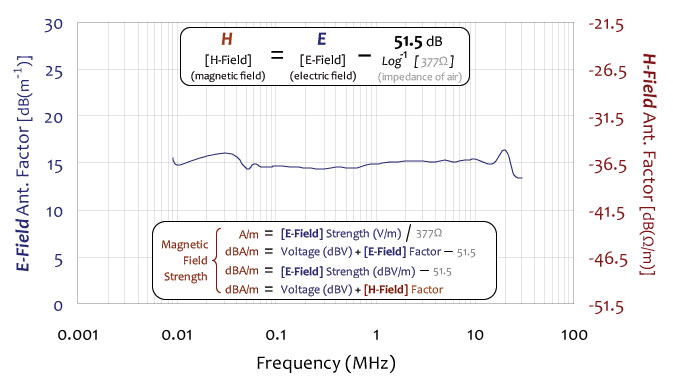
| E-Field Antenna Factor | 13.4 to 16.4 dB(m-1) [average: 14.9] |
| Antenna Factor Variation | ±1.5 dB |
| Saturation Level | > 1 V/m / > 120 dBµV/m (> 2.65 mA/m / > 68.5 dBµA/m) |
| Sensitivity (typical) | -3 dBµA/m @ 10 kHz; -44 dBµA/m @ 1 MHz |
| RF Connector | BNC-type (female) |
| Applicable Standards | ANSI C63.4, CISPR, EN, ETSI, etc. |
| Battery Type | 6 VDC NiMH (rechargeable) |
| Average Battery Life | 10 to 12 hours |
| AC Adapter Output | 6 VDC (unregulated), 500 mA |
| Calibration | Individually calibrated per IEEE 291, NIST traceable |
| Dimensions (H × W × D) | 20.1" × 19.7" × 10.6" [51 × 50 × 27 cm] |
| Weight | 5.5 lbs [2.5 kg] |
All values are typical, unless specified. All specifications are subject to change without notice.
🔍 Not Sure Which Antenna You Need?
Compare all Com-Power antenna models side-by-side with our interactive selection tool. Filter by frequency range, antenna category, application, polarization, and power handling to find your perfect match.
Compare All Antenna Models →AL-130R Active Loop Antenna – Frequently Asked Questions
1. What is the AL-130R active loop antenna and what is it used for in EMC testing?
The AL-130R active loop antenna is a CISPR 16-1-4 compliant active magnetic field antenna designed for low-frequency radiated emissions testing from 9 kHz to 30 MHz. It is used to measure magnetic field emissions generated by equipment such as switching power supplies, motors, transformers, cable harnesses, industrial controls, and other products that produce strong low-frequency H-field radiation. Because this frequency range is dominated by magnetic field coupling rather than far-field electric radiation, a loop antenna is the correct measurement device for many compliance and diagnostic tasks. The AL-130R includes a built-in battery-operated low-noise preamplifier to improve sensitivity and make it easier to capture weak emissions accurately during both compliance and pre-compliance testing.
2. Why is the 9 kHz to 30 MHz frequency range important for EMC and EMI measurements?
The 9 kHz to 30 MHz range is important because many real-world EMI problems originate in this region, especially from power conversion circuits, switching regulators, motor drives, inductive components, and long cable structures that radiate low-frequency magnetic fields. In many EMC standards, this range is evaluated with a loop antenna because the dominant mechanism is magnetic coupling close to the equipment under test. A conventional broadband electric field antenna is not the right tool for this kind of measurement. The AL-130R is therefore useful when engineers need to capture emissions that are strongly influenced by current flow, magnetic coupling, and inductive sources rather than higher-frequency far-field radiation.
3. How does the AL-130R differ from a passive loop antenna?
The AL-130R is an active loop antenna, which means it includes a built-in low-noise preamplifier directly in the antenna assembly. A passive loop antenna does not include amplification and relies entirely on the receiver or an external preamplifier. The advantage of the AL-130R is improved overall sensitivity and a better signal-to-noise ratio, especially when measuring low-level emissions. Because the signal is amplified close to the loop, cable losses and external noise sources have less effect on the measurement chain. Passive loops can still be preferred in some cases where users want maximum dynamic range or standard-specific geometry, but for many commercial EMC applications, the active approach is more convenient and efficient.
4. Why does the AL-130R use a built-in low-noise preamplifier?
The built-in low-noise preamplifier improves the antenna’s ability to detect weak magnetic field emissions by boosting the signal before it travels through the coaxial cable to the measurement instrument. This helps reduce the impact of cable loss and improves the effective signal-to-noise ratio of the entire system. In practical EMC testing, that means the user can measure low-level emissions more confidently, especially near compliance thresholds. This is one of the main reasons active loop antennas are widely used in commercial radiated emissions work: they make the overall measurement system more sensitive without requiring a separate external amplifier setup.
5. What is the purpose of the built-in rechargeable battery and why is battery operation useful?
The AL-130R uses a 6 VDC NiMH rechargeable battery with an average operating time of about 10 to 12 hours. Battery operation is useful because it electrically isolates the antenna from external power sources that could introduce unwanted noise or interference into the measurement environment. In EMC work, even the antenna power arrangement can influence measurement quality if not properly controlled. Using a self-contained battery-operated loop helps maintain cleaner measurements, especially in low-level emissions testing where noise contamination can affect data quality. It also improves portability and simplifies chamber use when the antenna must be positioned away from external power infrastructure.
6. What is the size of the loop and why does loop size matter in low-frequency emissions measurements?
The AL-130R has a loop size of approximately 19 inches × 19 inches (0.5 m × 0.5 m). Loop size matters because it affects how much magnetic flux the antenna intercepts and therefore influences sensitivity and calibration behavior. A loop of this size is suitable for standardized low-frequency EMC measurements and offers a practical balance between sensitivity, handling, and compliance with accepted measurement methods. Larger loops generally capture more magnetic field energy, but they must also remain consistent with the intended standard and calibration method. In this case, the AL-130R is configured for recognized EMC use rather than as an arbitrary near-field pickup loop.
7. What EMC standards is the AL-130R intended to support?
The AL-130R is identified as CISPR 16-1-4 compliant and is suitable for emissions measurements under standards such as FCC Part 18, CISPR 11, CISPR 13, CISPR 14, CISPR 32, EN 55011, EN 55032, and ANSI C63.4. This makes it useful for a broad range of commercial, industrial, medical, and electronic product testing programs. The antenna is especially relevant where magnetic field emissions in the low-frequency range must be measured using a loop antenna instead of a conventional broadband electric field antenna. For labs working across multiple standards families, this kind of compatibility is important because it allows the same antenna to support diverse product categories and regulatory frameworks.
8. What is the saturation indicator and why is it important during testing?
The saturation indicator shows whether the antenna or its built-in active circuitry is being overloaded by excessively strong signals. This is critical because once the amplifier saturates, the output is no longer a faithful representation of the actual field being measured. The result can be under-reporting, distortion, or otherwise invalid test data. In low-frequency emissions testing, strong magnetic sources can sometimes overload active loops if not monitored properly. A built-in saturation indication helps the operator determine whether the measurement remains within the antenna’s usable operating range. This is especially important in compliance work, where valid measurements depend on the measurement chain operating linearly.
9. What is the RAI-100 remote antenna interface and how is it used with the AL-130R?
The optional RAI-100 Remote Antenna Interface is a compact controller used to remotely monitor and control key antenna functions through a fiber optic link up to 30 meters long. It allows the user to monitor saturation status and battery-low conditions without introducing electrical interference into the test environment. This is especially useful inside EMC chambers and semi-anechoic environments where minimizing cable-coupled noise is important. The page also notes that, under ANSI C63.4-2014, the use of an active loop antenna for compliance testing in a non-shielded environment is permitted only if the saturation indicator is continuously monitored during testing. In that kind of setup, the RAI-100 becomes extremely helpful because it allows the operator to observe antenna status remotely without compromising measurement integrity.
10. How is the AL-130R calibrated and why does that calibration matter?
The AL-130R includes individual calibration per IEEE 291 with NIST traceability. Calibration is essential because it establishes the antenna factor and performance reference needed to convert the antenna output into meaningful field-strength values. NIST traceability adds confidence that the calibration chain is linked back to recognized national standards, which is important for quality systems, lab consistency, and formal compliance documentation. For many EMC laboratories, calibration is not just a specification on paper; it is what makes the measurement defensible, repeatable, and credible across time and across different test sites.
11. What is antenna factor and how does it apply to the AL-130R?
Antenna factor is the relationship between the field strength at the antenna and the voltage present at the output connector. In practical EMC testing, it is used to convert what the receiver sees into the actual field level that the product is emitting. The AL-130R lists E-field antenna factors in the range of approximately 13.4 to 16.4 dB(m-1), with specified variation limits. Stable and calibrated antenna factor behavior is important because it reduces uncertainty and makes the measurement chain more predictable over the entire operating range. Without proper antenna factor data, the receiver reading by itself is not sufficient for accurate compliance reporting.
12. What kinds of products and emission sources are commonly tested with the AL-130R?
The AL-130R is well suited for evaluating products that generate low-frequency magnetic emissions, including switching power supplies, motors, transformers, industrial controllers, medical devices, automotive electronics, and equipment with significant cable current or inductive coupling effects. These are exactly the kinds of products where low-frequency radiated emissions can become a compliance problem, especially when magnetic field radiation is stronger than what would be captured effectively by a standard broadband antenna. It is also useful during troubleshooting because it helps engineers identify whether the emissions are related to current loops, magnetics, wiring geometry, or power conversion behavior.
13. Can the AL-130R be used for pre-compliance testing and design troubleshooting?
Yes. The AL-130R is very useful for pre-compliance testing because it allows engineers to identify low-frequency magnetic emission problems before formal compliance testing begins. During product development, engineers can use it to compare design revisions, evaluate layout changes, test shielding strategies, and determine whether a power stage, cable arrangement, or transformer assembly is causing excessive H-field emissions. This can significantly reduce time and cost later in the certification process. In many labs, a loop antenna like the AL-130R is used not only for final measurements but also as an engineering tool for early detection and debugging.
14. What RF connector and impedance does the AL-130R use, and why is that practical?
The AL-130R uses a BNC-type female RF connector and has a nominal output impedance of 50 ohms. This is practical because BNC connectors are common in low-frequency EMC systems and are easy to integrate with standard measurement equipment such as EMI receivers, spectrum analyzers, and preselector chains. At these frequencies, a BNC interface is mechanically convenient, electrically suitable, and widely supported in test laboratories. The 50-ohm output also matches the standard impedance of most RF measurement equipment, helping preserve measurement consistency and reducing mismatch-related uncertainty.
15. Why is the AL-130R considered a shielded loop antenna, and why does shielding matter?
The AL-130R is described as a loop antenna intended for magnetic field measurements, and shielding is important in this type of design because it helps reduce unwanted coupling from electric fields. A shielded loop is designed so that the antenna responds primarily to the magnetic field component rather than being excessively influenced by nearby electric field energy. In EMC testing, this improves measurement fidelity because the objective is often to isolate the H-field contribution from the equipment under test. Better rejection of unwanted electric field pickup leads to cleaner, more reliable magnetic field data.
16. How does the AL-130R compare with a simple near-field probe or handheld loop?
The AL-130R is more than a simple handheld diagnostic loop. It is a calibrated, compliance-oriented active loop antenna designed for standardized measurements over a defined frequency range. A small handheld near-field probe can be useful for local troubleshooting on a PCB or cable, but it is usually not the correct instrument for formal low-frequency radiated emissions measurements. The AL-130R provides known geometry, calibrated performance, built-in amplification, battery-powered operation, and optional remote monitoring. That makes it far better suited for repeatable EMC measurements where accuracy and comparability matter.
17. Why would an EMC lab choose the AL-130R over other loop antennas?
An EMC lab may choose the AL-130R because it combines several useful capabilities into one integrated system: CISPR 16-1-4 compliance, 9 kHz to 30 MHz coverage, a built-in battery-operated low-noise preamplifier, individual IEEE 291 calibration with NIST traceability, and the option to add the RAI-100 fiber optic remote interface for status monitoring. This combination helps improve sensitivity, simplify setup, reduce interference from external power sources, and support both compliance and engineering use cases. For labs that need a practical, standards-aligned solution for low-frequency H-field emissions measurements, the AL-130R is a strong choice.
Application Notes (PDF)
- AN-107 — What is Antenna Factor?
- AN-106 — Use of Antenna Factor for EMC Measurements
- Selecting the Right EMI Antenna
- EMC Antenna Calibration Requirements, Methodologies, and Best Practices
- NIST Antenna Calibration Services — Com-Power Capabilities and Traceability
- Com-Power EMC Antenna Product Line — Complete Specifications
Interactive Tools
- Antenna Finder Wizard
- Com-Power Antenna & Field Strength Calculator
- Com-Power EMC Compliance Limits Calculator
- Com-Power Cable Loss & Attenuation Calculator
Industry Applications
- EMC Considerations for IoT and Smart Home Devices
- Medical Device EMC Compliance — IEC 60601-1-2 Essentials
- Automotive EMC Testing — ISO 11452 / CISPR 25
- EV Charging Systems — EMC Requirements and Compliance
Blog Articles


Quote Request
Other EMC Test Equipment
- Absorbing Clamps
- Antenna Kits
- Antenna Masts - Automated and Manual
- Antennas
- Bulk Current Injection probes
- CDNs - Coupling Decoupling Network
- Comb Generators
- Conducted Immunity Test Systems
- Current Monitor Probes
- Current Probe Calibration Fixtures
- EM Clamps
- Feed Through Capacitor
- ISNs - Impedance Stabilization Network
- LISNs - Single Phase
- LISNs - TEMPEST
- LISNs - Three Phase
- Magnetic Field Generator
- Near Field Probes
- Power Amplifiers
- Pre-compliance Emissions Test Systems
- Preamplifiers
- Spectrum Analyzers
- Surge Generators
- System Controllers
- Transient Limiters
- Tripods For EMC
- Turntables