
High Power Log Periodic Antenna
- Com-Power ALP-100 is lightweight, compact, and rugged. It operates over the frequency range of 200 MHz to 1 GHz.
- This antenna is designed exclusively for applications requiring up to 500 watts of power.
- It has low VSWR and high power handling capabilities. So it can be utilized as a receiving antenna for radiated emissions tests, or as a transmitting antenna for radiated immunity tests.
- It is suitable for use in any normal test environment, such as an absorber-lined chamber or outdoors on an open area test site.
- Each antenna is individually calibrated per ANSI C63.5 with NIST traceability. The calibration data and certificate is provided.
- Recognized ISO 17025 accredited calibration is also available upon request.
- The ALP-100 is also suitable as an EMI test antenna for qualification-level regulatory compliance measurements (FCC, CE, RTCA DO-160, FDA, SAE Automotive, etc.).
Features
- ▸ High-power broadband immunity antenna — rated for up to 500 Watts continuous (CW) input power across 200 MHz to 1 GHz, generating field strengths required by automotive, military, and aerospace radiated immunity standards.
- ▸ Continuous broadband sweep without tuning — covers 200 MHz to 1 GHz as a single continuous antenna; one antenna replaces 15–20 tuned-dipole element changes, dramatically reducing immunity test setup time.
- ▸ Heavy-gauge corrosion-resistant aluminum construction — built to handle the thermal and mechanical stress of high-power continuous operation; suitable for daily use in lab and outdoor environments under extreme weather.
- ▸ Hinged polarization-change mount — integrated hinge mechanism allows the operator to switch between horizontal and vertical polarization in seconds without re-mounting the antenna.
- ▸ Dual-purpose emissions and immunity capability — functions as a transmitting antenna for radiated immunity (the primary application) and as a receiving antenna for radiated emissions measurements, allowing one antenna to serve both test types in a full-service lab.
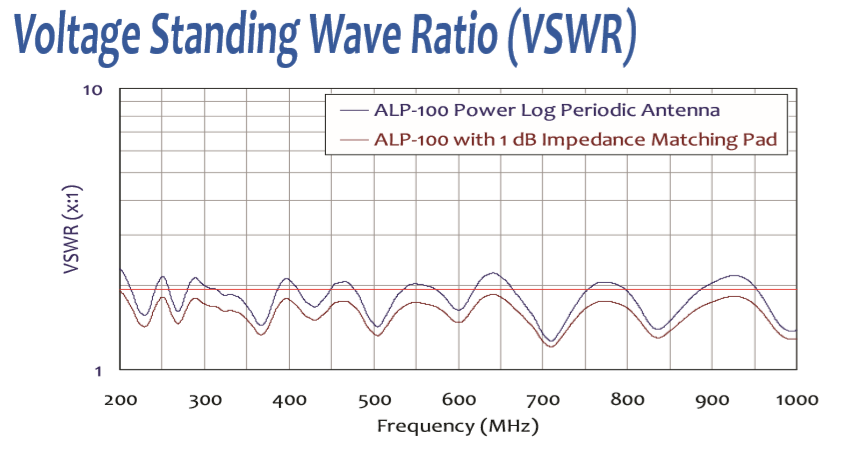
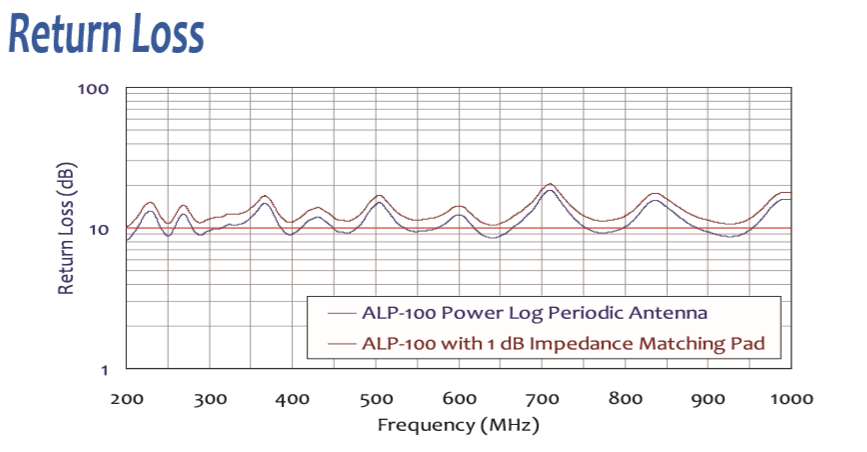
- ▸ Optional 1 dB impedance-matching pad — available factory-fitted matching pad further flattens VSWR and improves return loss for amplifier protection during high-power immunity sweeps.
- ▸ NSA calibration alternative for OATS / SAC — a pair of ALP-100 antennas can be used in lieu of tuned dipoles for Normalized Site Attenuation calibrations, eliminating the time-consuming process of tuning element lengths at each discrete frequency.
- ▸ Standard 1/4"-20 tripod/mast mounting — mounting assembly accepts the Com-Power AT-812 Antenna Tripod, AM-400 Antenna Mast, or any compatible support structure.
- ▸ Regulatory compliance applications — suitable for qualification-level measurements per FCC, CISPR, EN, ETSI, FAA, MIL-STD-461, RTCA DO-160, FDA, and SAE Automotive standards, including IEC 61000-4-3 and ISO 11452-2 radiated immunity.
- ▸ General-purpose RF utility — useful for site comparisons, shielding effectiveness testing of large enclosures, field monitoring, and site surveys beyond formal compliance work.
- ▸ Individually calibrated, NIST-traceable — calibrated per ANSI C63.5; calibration data and certificate ship with each unit; ISO 17025 accredited calibration available on request.
- ▸ Three-year standard warranty — backed by manufacturer support.
Specifications
| Product Name | Power Log Periodic Antenna |
|---|---|
| Frequency Range | 200 MHz to 1 GHz |
| Polarization | Linear |
| Nominal Impedance | 50 Ω |
| Power Handling | 500 Watts (continuous) |
| Connector | N-type (female) |
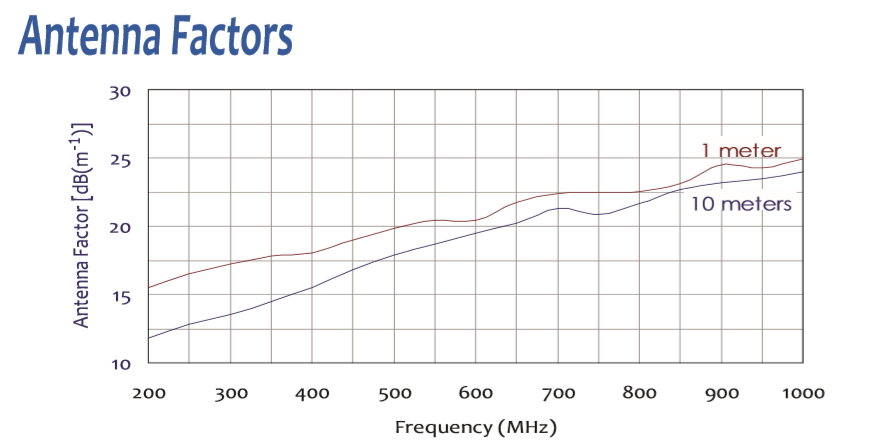
| Antenna Factor | 11.7 to 24.0 dB(m-1) [average: 18.7] |
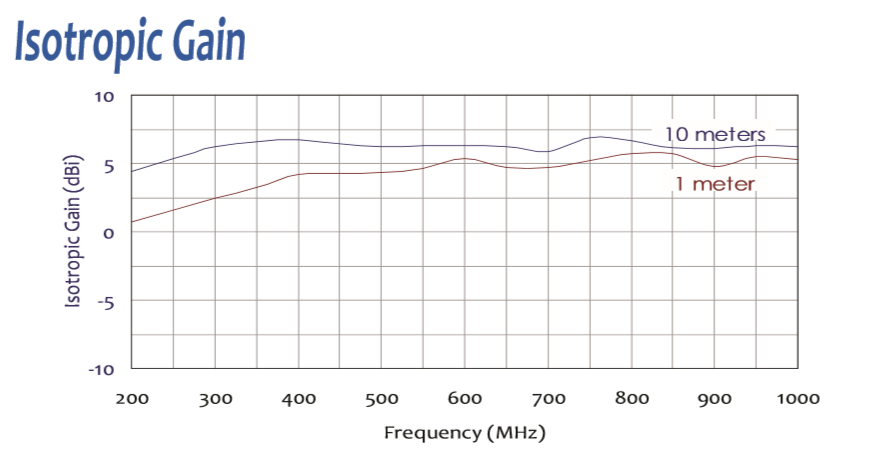
| Isotropic Gain | 4.4 to 6.9 dBi [average: 6.2] |
| VSWR | 1.42 to 2.28 : 1 [average: 1.83] |
| Return Loss | 8.2 to 15.2 dB [average: 10.9] |
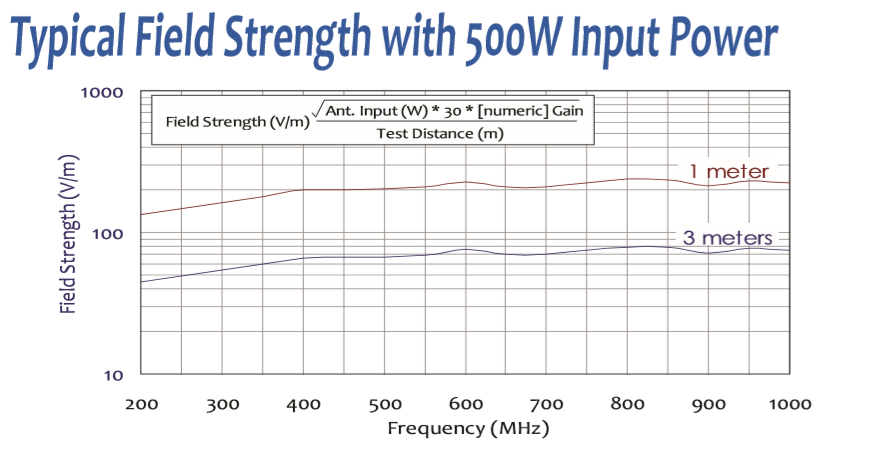
| Radiated Field Strength | See typical field strength graph (with 500 W input power) |
| Applicable Standards | FCC, CISPR, EN, ETSI, FAA, MIL-STD-461, SAE, etc. |
| Calibration | Individually calibrated per ANSI C63.5, NIST traceable |
| Dimensions (H × W × D) | 29.5" × 5.3" × 30.1" [74.9 × 13.5 × 76.5 cm] |
| Weight | 4 lbs [1.8 kg] |
All values are typical, unless specified. All specifications are subject to change without notice.
🔍 Not Sure Which Antenna You Need?
Compare all Com-Power antenna models side-by-side with our interactive selection tool. Filter by frequency range, antenna category, application, polarization, and power handling to find your perfect match.
Compare All Antenna Models →ALP-100 High Power Log Periodic Antenna – Frequently Asked Questions
1. What is the ALP-100 high power log periodic antenna and what is it designed to do in EMC testing?
The ALP-100 is a high-power broadband log periodic dipole array antenna covering 200 MHz to 1 GHz. It is designed for both radiated emissions measurements and radiated immunity testing, which makes it a particularly versatile antenna in EMC laboratories. Its design emphasis is on combining broad frequency coverage with substantially higher power handling than a compact engineering antenna, allowing it to serve not only as a receiving antenna for compliance and diagnostic work, but also as a transmitting antenna for serious immunity field generation. In practical lab planning, this dual-purpose capability is one of the main reasons the ALP-100 stands out.
2. Why is 500 watts of continuous power handling so important for the ALP-100?
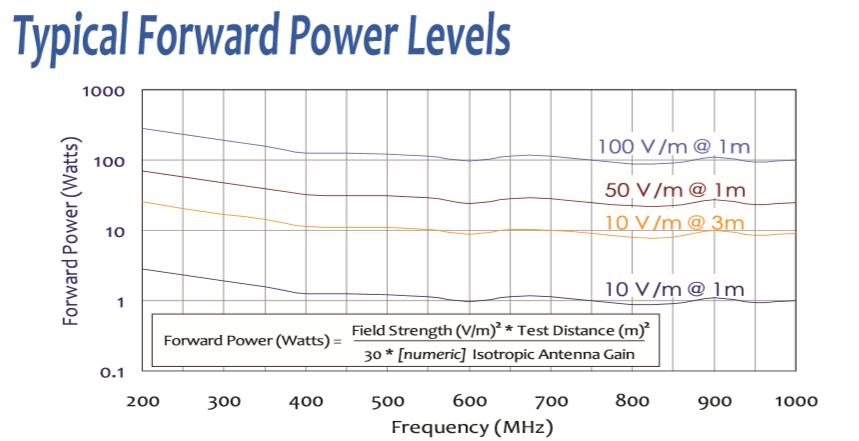
The 500-watt continuous-wave power capability is central to the antenna’s role in radiated immunity testing. To establish strong electric fields across the 200 MHz to 1 GHz range, especially at realistic test distances such as 1 meter or 3 meters, the antenna must be able to accept substantial RF power without becoming the limiting factor in the test system. Lower-power antennas may be useful for engineering checks, but they can become restrictive in compliance-oriented or high-field environments. The ALP-100 gives labs significantly more transmit-side capability, which supports higher field strengths, broader use with serious amplifiers, and better suitability for standards-based immunity work.
3. What kinds of EMC tests commonly use the ALP-100 in real laboratory environments?
The ALP-100 is commonly used for radiated immunity testing, radiated emissions measurements, engineering troubleshooting, chamber investigations, site comparison work, shielding effectiveness measurements, and selected site validation tasks. In a full-service EMC lab, that means one antenna can contribute to both the transmit and receive sides of the workflow. For example, a lab might use it one day to generate fields for an immunity program under IEC or automotive requirements, and the next day use it as a receiving antenna to investigate radiated emissions from a large electronic system. That flexibility is valuable because it helps reduce the number of separate antennas needed for overlapping frequency regions.
4. Which standards and application areas is the ALP-100 relevant to?
Based on the provided page source, the ALP-100 is relevant to standards and programs such as IEC 61000-4-3, ISO 11452-2, MIL-STD-461, RTCA DO-160, FCC, CISPR, EN, and automotive or aerospace EMC programs. That is an important range because it places the antenna in both commercial compliance work and higher-demand qualification environments. In practical terms, it means the ALP-100 is suitable not only for general EMC product evaluation, but also for more demanding sectors such as defense, transportation, avionics, and automotive electronics where broadband high-field exposure can be part of the required test regime.
5. How does the ALP-100 compare with the ALC-100 in real buying decisions?
The ALP-100 and ALC-100 overlap partly in frequency coverage, but they serve different priorities. The ALC-100 is the more compact, lightweight, engineering-convenience option and is especially attractive for smaller chambers, portable use, and pre-compliance work. The ALP-100, by contrast, is the antenna to choose when higher RF power handling and stronger transmit capability are required. In other words, a development lab that values portability above all may prefer the ALC-100, while a compliance or immunity-focused lab that needs serious field generation capability should generally prefer the ALP-100. That distinction is essential because choosing only by frequency range would miss the real technical difference between the two products.
6. Why is the ALP-100 especially useful for radiated immunity testing?
The ALP-100 is especially useful for radiated immunity work because it combines broad frequency coverage, meaningful gain, low VSWR, and strong power handling. Those characteristics work together to support more efficient RF field generation. In immunity testing, the antenna is not just a passive accessory; it is a major determinant of how effectively amplifier power is converted into field strength at the test point. A low-VSWR, moderate-gain, high-power antenna can reduce wasted power, improve consistency across the band, and help labs reach target field levels more practically. That is why antennas like the ALP-100 are often central to immunity system design rather than being chosen as an afterthought.
7. What does the stated gain and low VSWR mean in practical EMC operation?
The stated average gain of about 6 dBi and average VSWR around 1.2:1 are strong practical indicators of efficient antenna behavior. Gain helps direct more RF energy forward, which improves field generation for a given amplifier output. Low VSWR indicates good impedance matching, which reduces reflected power and improves the stability of the power transfer from amplifier to antenna. In real immunity systems, these characteristics mean the ALP-100 can help a lab reach required fields more efficiently and with fewer mismatch-related problems. In receive mode, the same well-behaved broadband characteristics support stable measurement performance across the band.
8. Can the ALP-100 be used as both a transmitting and receiving antenna?
Yes. One of the major strengths of the ALP-100 is that it can be used in transmit mode for radiated immunity tests and receive mode for radiated emissions measurements. This is especially valuable in labs that want to streamline their inventory and use one robust antenna across multiple tasks. From a workflow perspective, dual-use capability also helps with correlation and familiarity. Engineers who know the antenna’s behavior in one context can apply that understanding in another. While some programs may still require additional antennas for lower frequencies or for frequencies above 1 GHz, the ALP-100 covers an important part of the EMC spectrum with strong flexibility.
9. How does the ALP-100 compare with horn antennas in EMC test strategy?
Horn antennas and log periodic antennas serve overlapping but distinct purposes. Horn antennas are generally more appropriate at higher frequencies above the upper end of the ALP-100’s range and are often chosen when higher directivity and higher gain are required in those bands. The ALP-100, however, is the more natural choice within 200 MHz to 1 GHz, especially when broadband immunity or emissions work is needed over that range. In practical EMC planning, the ALP-100 often fills the mid-band role, while horn antennas take over in the upper-frequency region. A serious EMC lab may need both, but not for the same reason.
10. How does the ALP-100 support standards such as IEC 61000-4-3 and ISO 11452-2?
Standards such as IEC 61000-4-3 and ISO 11452-2 require controlled radiated fields across defined frequency regions, often with strong attention to field strength, repeatability, and setup discipline. The ALP-100 supports that environment by offering enough broadband transmit capability to generate meaningful fields through much of the relevant band. In real use, the antenna becomes part of a system that includes an amplifier, directional coupler or monitoring approach, field probe feedback, and chamber or test setup controls. The antenna’s role is to make broadband field generation more efficient and more manageable across the required frequencies.
11. What kinds of products are commonly tested with the ALP-100?
The ALP-100 is suitable for a very broad range of products, including automotive modules, industrial electronics, medical equipment, avionics subsystems, military electronics, information technology equipment, laboratory instruments, communication devices, and embedded control systems. It is particularly valuable when products must be tested for both radiated emissions and radiated susceptibility in the same general band. In real engineering programs, this antenna can support product validation from development through qualification, especially when the product class faces strict EMC expectations or operates in electrically noisy environments.
12. Why is ANSI C63.5 calibration with NIST traceability important for the ALP-100?
Even though the ALP-100 is a high-power antenna, it is still a measurement-grade EMC tool, and calibration remains important. Individual calibration per ANSI C63.5 with NIST traceability supports confidence in the antenna factor and performance data used in receive-mode measurements and in broader lab documentation practices. For engineering teams, it improves measurement defensibility and helps internal results correlate better with accredited external labs. For formal quality systems, the traceable calibration path also supports compliance documentation, asset management, and repeatability expectations. This is especially important in organizations that must demonstrate disciplined measurement practice rather than just rough engineering observation.
13. How does the ALP-100 help simplify broadband EMC work compared with switching multiple antennas?
A broadband antenna like the ALP-100 reduces the need to change antennas repeatedly across the test band, which improves workflow speed and reduces the risk of setup inconsistency. Every antenna swap introduces opportunities for position error, cable disturbance, mounting variation, and time loss. By covering 200 MHz to 1 GHz in one antenna, the ALP-100 helps engineers maintain a more stable setup while sweeping a wide frequency region. This matters in both emissions and immunity work because repeatability is often improved when fewer physical changes are made between measurements.
14. Can the ALP-100 be used for site work such as shielding studies, chamber checks, and NSA-related tasks?
Yes. A pair of broadband antennas like the ALP-100 can be very useful in site comparison work, chamber investigations, shielding effectiveness evaluation, and selected NSA-related workflows. One practical advantage is that broadband antennas can speed up tasks that would otherwise require slower frequency-by-frequency tuned dipole adjustment. While the exact appropriateness depends on the method and standard being applied, the ALP-100 is clearly useful in broader EMC site engineering work beyond simple product testing. That increases its value in labs that must maintain not only product test capability, but also test environment performance.
15. What practical setup details matter most when using the ALP-100 in daily lab work?
Important setup details include stable mounting, correct polarization orientation, suitable cable and amplifier selection, proper spacing, and disciplined chamber or OATS positioning. The ALP-100 uses a standard RF connector and common EMC mounting approaches, which makes lab integration easier. But as with any serious EMC antenna, repeatability depends on more than the antenna itself. The operator must control antenna height, angle, orientation, and cable routing consistently. In real immunity work, field probe feedback and amplifier management are also important. In real emissions work, antenna positioning and polarization transitions remain essential for capturing worst-case results.
16. When is the ALP-100 the right long-term investment for an EMC lab?
The ALP-100 is the right long-term investment when a lab needs a serious broadband antenna that can support both receive-side and transmit-side EMC work in the 200 MHz to 1 GHz region. It is especially valuable for labs that regularly perform radiated immunity testing, want meaningful power handling, and also need the same antenna class to support emissions and engineering diagnostics. In long-term operational terms, the ALP-100 helps reduce compromises between convenience and capability. It is more than just a broadband antenna; it is a practical EMC lab antenna for organizations that need strong performance across overlapping measurement and field-generation workflows.
Application Notes (PDF)
- AN-107 — What is Antenna Factor?
- AN-106 — Use of Antenna Factor for EMC Measurements
- Selecting the Right EMI Antenna
- Considerations when Selecting an Antenna for RF Immunity Testing
- EMC Antenna Calibration Requirements, Methodologies, and Best Practices
- NIST Antenna Calibration Services — Com-Power Capabilities and Traceability
- Com-Power EMC Antenna Product Line — Complete Specifications
- Accounting for Ambient Noise
Interactive Tools
- Antenna Finder Wizard
- Com-Power Antenna & Field Strength Calculator
- Com-Power EMC Compliance Limits Calculator
- Com-Power Cable Loss & Attenuation Calculator
- Com-Power VSWR / Return Loss / Mismatch Loss Calculator
- Com-Power Free Space Path Loss & Link Budget Calculator
Industry Applications
- EMC Considerations for IoT and Smart Home Devices
- Automotive EMC Testing — ISO 11452 / CISPR 25
- 5G Equipment EMC Testing — New Challenges in EMC Compliance
- Medical Device EMC Compliance — IEC 60601-1-2 Essentials
- EV Charging Systems — EMC Requirements and Compliance
Blog Articles


Quote Request
Other EMC Test Equipment
- Absorbing Clamps
- Antenna Kits
- Antenna Masts - Automated and Manual
- Antennas
- Bulk Current Injection probes
- CDNs - Coupling Decoupling Network
- Comb Generators
- Conducted Immunity Test Systems
- Current Monitor Probes
- Current Probe Calibration Fixtures
- EM Clamps
- Feed Through Capacitor
- ISNs - Impedance Stabilization Network
- LISNs - Single Phase
- LISNs - TEMPEST
- LISNs - Three Phase
- Magnetic Field Generator
- Near Field Probes
- Power Amplifiers
- Pre-compliance Emissions Test Systems
- Preamplifiers
- Spectrum Analyzers
- Surge Generators
- System Controllers
- Transient Limiters
- Tripods For EMC
- Turntables