
AH-118 Wide Band Horn Antenna
AH-118 is a double Ridge Guide broadband horn antenna designed to operate within the frequency range of 700 MHz to 18 GHz.
-
Wide frequency range, operating from 700 MHz to 18 GHz, with excellent efficiency between 1 GHz and 18 GHz.
-
Designed for broadband transmit and receive applications in EMI and EMC testing environments.
-
Ideal for regulatory compliance testing such as FCC, CE, MIL-STD-461, RTCA DO-160, and FDA standards.
-
Capable of handling high input power levels up to 300 Watts for radiated immunity applications.
-
Individually calibrated per ANSI C63.5 or SAE ARP958 with NIST traceability for reliable results.
-
Optional ISO 17025 accredited calibration available upon request for enhanced measurement confidence.
-
Built with rugged heavy-gauge aluminum and corrosion-resistant coating for long-term indoor or outdoor use.
-
Features a 1/4-inch x 20 threaded mounting hole for secure installation on tripods or test fixtures.
-
Supports a wide range of testing, including EIRP/ERP measurements, site surveys, and shielding effectiveness.
-
Equipped with a high-quality N-type coaxial connector for stable and low-loss RF signal performance.
Features
- ▸ Broadband 1–18 GHz coverage (usable from 700 MHz) — one antenna handles WiFi 2.4/5/6 GHz, all 5G FR1 sub-6 GHz bands, ISM, satellite C/X/Ku-band, 24 GHz radar lower edge, and the upper portion of MIL-STD-461 RE102 in a single sweep.
- ▸ Double ridge waveguide design — provides extended low-frequency response (down to 700 MHz) without sacrificing high-frequency efficiency, enabling true 700 MHz–18 GHz transmit/receive operation.
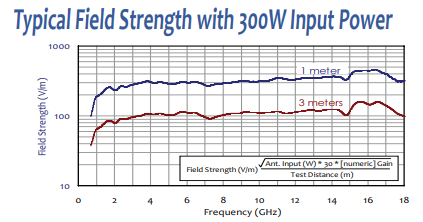
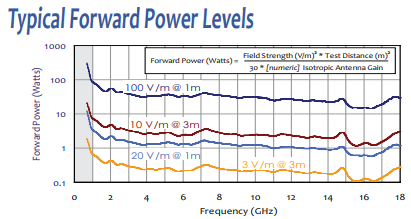
- ▸ 300 W CW power handling — transmits up to 300 watts continuous wave for radiated immunity testing, supporting field strengths required by IEC 61000-4-3, ISO 11452-2, and DO-160.
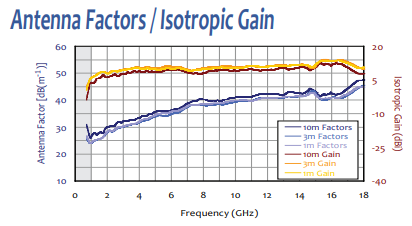
- ▸ Isotropic gain 3.6–12.6 dBi — rises with frequency to deliver the directional gain needed at the high end of the band where free-space path loss is greatest.
- ▸ Precision N-type female connector — high-quality coaxial interface rated for 18 GHz, eliminating the need for waveguide setups for the entire band.
- ▸ Transmit and receive capable — functions both as a receiving antenna for emissions measurements and as a transmitting antenna for radiated immunity testing, eliminating the need to swap antennas between test types.
- ▸ ERP / EIRP substitution antenna — commonly used as a calibrated reference for determining Effective Radiated Power and Effective Isotropic Radiated Power of intentional radiators in FCC/TCB certification and ETSI acceptance tests.
- ▸ Heavy-gauge aluminum with corrosion-resistant coating — rugged enough for daily indoor and outdoor laboratory use, including continuous OATS exposure under extreme weather.
- ▸ Compact and lightweight — just 4 lbs maximum and 7.8″ × 9.5″ × 5.6″, easy to position, mount, and transport between test sites.
- ▸ Standard 1/4″-20 tripod/mast mounting — mounts on the AT-812 Antenna Tripod, AM-400 Antenna Mast, or any compatible support; right-angle bracket included for vertical-orientation mounting.
- ▸ Regulatory compliance applications — suitable for qualification-level measurements per FCC Part 15/18, CE, MIL-STD-461 RE102/RS103, RTCA DO-160, FDA, SAE Automotive, ANSI C63.4, and CISPR 22/32.
- ▸ Individually calibrated, NIST-traceable — calibrated per ANSI C63.5 or SAE ARP-958; calibration data and certificate ship with each unit; ISO 17025 accredited calibration available on request.
- ▸ Three-year standard warranty — backed by manufacturer support.
Specifications
| Product Name | Double Ridge Horn Antenna |
|---|---|
| Frequency Range | 1 GHz to 18 GHz (usable from 700 MHz) |
| Polarization | Linear |
| Nominal Impedance | 50 Ω |
| Power Handling | 300 Watts (continuous) |
| Connector | Precision N-type (female) |
| Antenna Factor | 26.4 to 47.4 dB(m-1) [average: 38.9] |
| Isotropic Gain | 3.6 to 12.6 dBi [average: 9.1] |
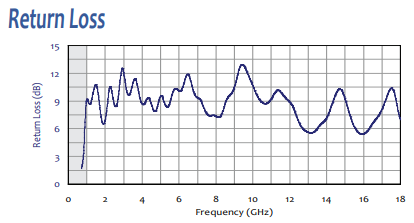
| VSWR | 1.58 to 3.32 : 1 [average: 2.25] |
| Return Loss | 5.4 to 12.9 dB [average: 8.8] |
| Radiated Field Strength | See typical field strength graph (with 300 W input power) |
| -3 dB Beamwidth | See typical -3 dB beamwidth graph (E-plane and H-plane) |
| Applicable Standards | FCC, CISPR, EN, ETSI, FAA, MIL-STD, SAE, etc. |
| Calibration | Individually calibrated per ANSI C63.5 or SAE ARP-958, NIST traceable |
| Mounting | 1/4″-20 threaded hole; right-angle bracket included |
| Dimensions (H × W × D) | 5.6″ × 9.5″ × 8.1″ [14.2 × 24.1 × 20.6 cm] |
| Weight | 3 lbs [1.4 kg] |
All values are typical, unless specified. All specifications are subject to change without notice.
.png)
 Beamwidth.png)
🔍 Not Sure Which Antenna You Need?
Compare all Com-Power antenna models side-by-side with our interactive selection tool. Filter by frequency range, antenna category, application, polarization, and power handling to find your perfect match.
Compare All Antenna Models →AH-118 Broadband Double Ridge Horn Antenna – Frequently Asked Questions
1. What is the AH-118 broadband horn antenna and what is its role in EMC testing?
The AH-118 is a broadband double ridge horn antenna designed to operate from approximately 1 GHz to 18 GHz. It is used for both radiated emissions measurements and radiated immunity testing in EMC environments. In modern EMC labs, this antenna becomes critical once testing moves above 1 GHz, where emissions from high-speed digital electronics, switching power supplies, and wireless communication modules dominate. The AH-118 serves as the primary antenna for these microwave frequency measurements due to its wide bandwidth and stable directional performance.
2. Why is the 1 GHz to 18 GHz range so important in current EMC compliance programs?
This frequency range includes most modern electromagnetic activity generated by electronic systems, including: - WiFi (2.4 GHz, 5 GHz, 6 GHz) - Cellular and 5G FR1 bands - High-speed digital harmonics - Industrial RF devices As electronics become faster and more integrated, emissions increasingly occur at higher frequencies. EMC standards such as FCC, CISPR 32, and IEC standards require testing in this range, making the AH-118 essential for compliance validation.
3. How does the AH-118 differ from log periodic antennas used below 1 GHz?
Log periodic antennas provide broadband coverage with moderate gain and are typically used below 1 GHz. In contrast, the AH-118 provides: - Higher gain - Directional radiation pattern - Improved signal-to-noise ratio This allows for more accurate measurements at higher frequencies where signals are weaker and environmental reflections are more significant.
4. How is the AH-118 used in radiated emissions testing?
In emissions testing, the AH-118 functions as a receiving antenna. It captures electromagnetic radiation from the device under test and delivers the signal to measurement equipment such as: - EMI receivers - Spectrum analyzers The antenna factor is applied to convert voltage readings into field strength values, ensuring compliance with regulatory limits.
5. How is the AH-118 used in radiated immunity testing?
In immunity testing, the AH-118 acts as a transmitting antenna. It is driven by an RF power amplifier to generate controlled electromagnetic fields directed at the equipment under test. This setup is used in standards such as IEC 61000-4-3 to verify that devices operate correctly under RF exposure.
6. What real-world EMC issues does the AH-118 help identify?
The antenna helps engineers detect: - High-frequency emissions from digital circuits - Leakage through shielding enclosures - Cable radiation effects - Interference between system components These issues are often difficult to identify without a directional high-frequency antenna.
7. Why is directional gain important for horn antennas like the AH-118?
Directional gain allows the antenna to focus energy in a specific direction, improving: - Measurement accuracy - Field strength efficiency - Reduction of ambient noise This is especially important in immunity testing, where field strength must be precisely controlled.
8. How does polarization affect measurements using the AH-118?
The AH-118 provides linear polarization and must be used in both horizontal and vertical orientations during testing. This ensures that worst-case emissions or susceptibility conditions are captured, as required by EMC standards.
9. What are the advantages of a double ridge horn design?
Double ridge horns provide: - Wide bandwidth - Stable impedance - Consistent radiation pattern These features allow a single antenna to cover a large frequency range efficiently.
10. What standards commonly require the use of horn antennas like AH-118?
The AH-118 is used in testing for: - FCC Part 15 - CISPR 32 / CISPR 22 - IEC 61000-4-3 - RTCA DO-160 These standards require accurate measurements above 1 GHz.
11. How does antenna gain influence radiated immunity field generation?
Higher antenna gain increases field strength for a given input power. This allows: - Lower amplifier requirements - More efficient testing - Better field uniformity The AH-118 provides a balanced gain suitable for most EMC testing scenarios.
12. What role does VSWR play in antenna performance?
Low VSWR ensures efficient power transfer between the amplifier and antenna. This reduces reflected power and improves system stability during testing.
13. How does the AH-118 improve EMC lab efficiency?
It reduces: - Antenna switching - Setup time - Measurement variability This allows faster testing and more reliable results.
14. What industries rely heavily on the AH-118?
Industries include: - Consumer electronics - Automotive - Aerospace - Telecommunications All require testing in the GHz range.
15. What mounting and setup considerations are important?
The antenna must be securely mounted on a mast or tripod with proper alignment. Consistent positioning is critical for repeatable results.
16. When should engineers choose the AH-118 over other horn antennas?
The AH-118 is the best choice when: - Broadband coverage from 1 GHz to 18 GHz is needed - Both emissions and immunity testing are required - A general-purpose horn antenna is needed for EMC labs It is often the default horn antenna for most EMC facilities.
Application Notes (PDF)
- AN-107 — What is Antenna Factor?
- AN-106 — Use of Antenna Factor for EMC Measurements
- Selecting the Right EMI Antenna
- Considerations when Selecting an Antenna for RF Immunity Testing
- EMC Antenna Calibration Requirements, Methodologies, and Best Practices
- NIST Antenna Calibration Services — Com-Power Capabilities and Traceability
- Com-Power EMC Antenna Product Line — Complete Specifications
- Accounting for Ambient Noise
Interactive Tools
- Antenna Finder Wizard
- Com-Power Antenna & Field Strength Calculator
- Com-Power EMC Compliance Limits Calculator
- Com-Power Cable Loss & Attenuation Calculator
- Com-Power VSWR / Return Loss / Mismatch Loss Calculator
- Com-Power Free Space Path Loss & Link Budget Calculator
Industry Applications
- EMC Considerations for IoT and Smart Home Devices
- Automotive EMC Testing — ISO 11452 / CISPR 25
- 5G Equipment EMC Testing — New Challenges in EMC Compliance
- Medical Device EMC Compliance — IEC 60601-1-2 Essentials
- EV Charging Systems — EMC Requirements and Compliance
Blog Articles


Quote Request
Other EMC Test Equipment
- Absorbing Clamps
- Antenna Kits
- Antenna Masts - Automated and Manual
- Antennas
- Bulk Current Injection probes
- CDNs - Coupling Decoupling Network
- Comb Generators
- Conducted Immunity Test Systems
- Current Monitor Probes
- Current Probe Calibration Fixtures
- EM Clamps
- Feed Through Capacitor
- ISNs - Impedance Stabilization Network
- LISNs - Single Phase
- LISNs - TEMPEST
- LISNs - Three Phase
- Magnetic Field Generator
- Near Field Probes
- Power Amplifiers
- Pre-compliance Emissions Test Systems
- Preamplifiers
- Spectrum Analyzers
- Surge Generators
- System Controllers
- Transient Limiters
- Tripods For EMC
- Turntables