
AH-220 Horn Antenna for MIL-STD
-
Broadband Double Ridge Horn antenna covering 200 MHz to 2 GHz for EMC testing
-
Linear polarization with 50 Ω impedance ensures accurate and repeatable measurements
-
High power handling up to 800 W enables strong RF field generation for immunity tests
-
Designed for MIL-STD-461 RE102 radiated emissions testing setups
-
Ideal for radiated immunity testing to generate controlled RF fields
-
Suitable for EMC chamber characterization and validation
-
Used for shielding effectiveness testing of enclosures and rooms
-
Effective for field monitoring and RF site surveys
-
Supports both transmit and receive applications in EMC labs
-
Compatible with tripods and standard mounting for vertical and horizontal polarization
Features
- ▸ Designed from concept to production for MIL-STD-461 RE102 — the AH-220 is built to the exact 69 × 94.5 cm aperture specified by RE102 for the 200 MHz–1 GHz band, removing the dimensional ambiguity that comes with using non-purpose-built antennas for MIL testing.
- ▸ 200 MHz to 2 GHz frequency coverage — bridges the gap between low-frequency biconical/log-periodic antennas and high-frequency horns, covering communications, navigation, radar harmonics, and cable resonance bands critical to military and aerospace EMC.
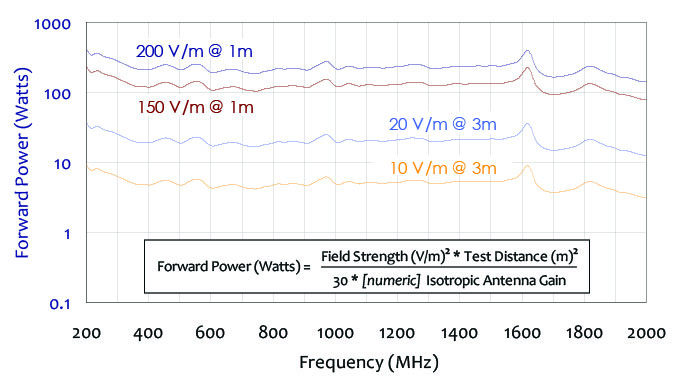
- ▸ 800 W CW power handling — highest in the coaxial passive horn lineup — the AH-220 sustains 800 watts continuous wave at its N-type input, enabling MIL-STD-461 RS103 immunity testing at field strengths above 200 V/m.
- ▸ Double ridge waveguide construction — provides broadband impedance match and stable radiation pattern across the full 200 MHz–2 GHz range without resonant gaps or polarization variation.
- ▸ High gain compared to biconicals or log-periodics — reduces amplifier power requirements for a given target field strength and improves receive sensitivity for low-level emissions measurements.
- ▸ Lightweight large-aperture construction — high-grade aluminum with corrosion-resistant conductive coating keeps weight to 29.5 lbs (13.4 kg) despite the 27.2″ × 37.2″ × 37″ aperture demanded by the MIL spec.
- ▸ Two mounting plates — separate 1/4″-20 mounting bases for vertical and horizontal polarization, located near the antenna's center of gravity for stable tripod operation; AT-220 Antenna Tripod recommended.
- ▸ High-quality N-type female connector — rated for 800 W CW through 2 GHz, eliminating the need for waveguide setups across the whole band.
- ▸ Transmit and receive capable — serves as the receiving antenna for RE102 200 MHz–1 GHz emissions and as the transmitting antenna for RS103 radiated immunity, eliminating antenna swaps between test phases.
- ▸ Chamber and OATS applications — suitable for chamber characterization, large-enclosure shielding effectiveness testing, field monitoring, and outdoor site surveys.
- ▸ Calibrated per SAE ARP-958 — individually calibrated per SAE ARP-958 with NIST traceability, the procedure typically required for military and aerospace antenna calibration; ISO 17025 accredited calibration available on request.
- ▸ Three-year standard warranty — backed by manufacturer support.
Specifications
| Product Name | Double Ridge Horn Antenna for MIL-STD-461 |
|---|---|
| Frequency Range | 200 MHz to 2 GHz |
| Polarization | Linear |
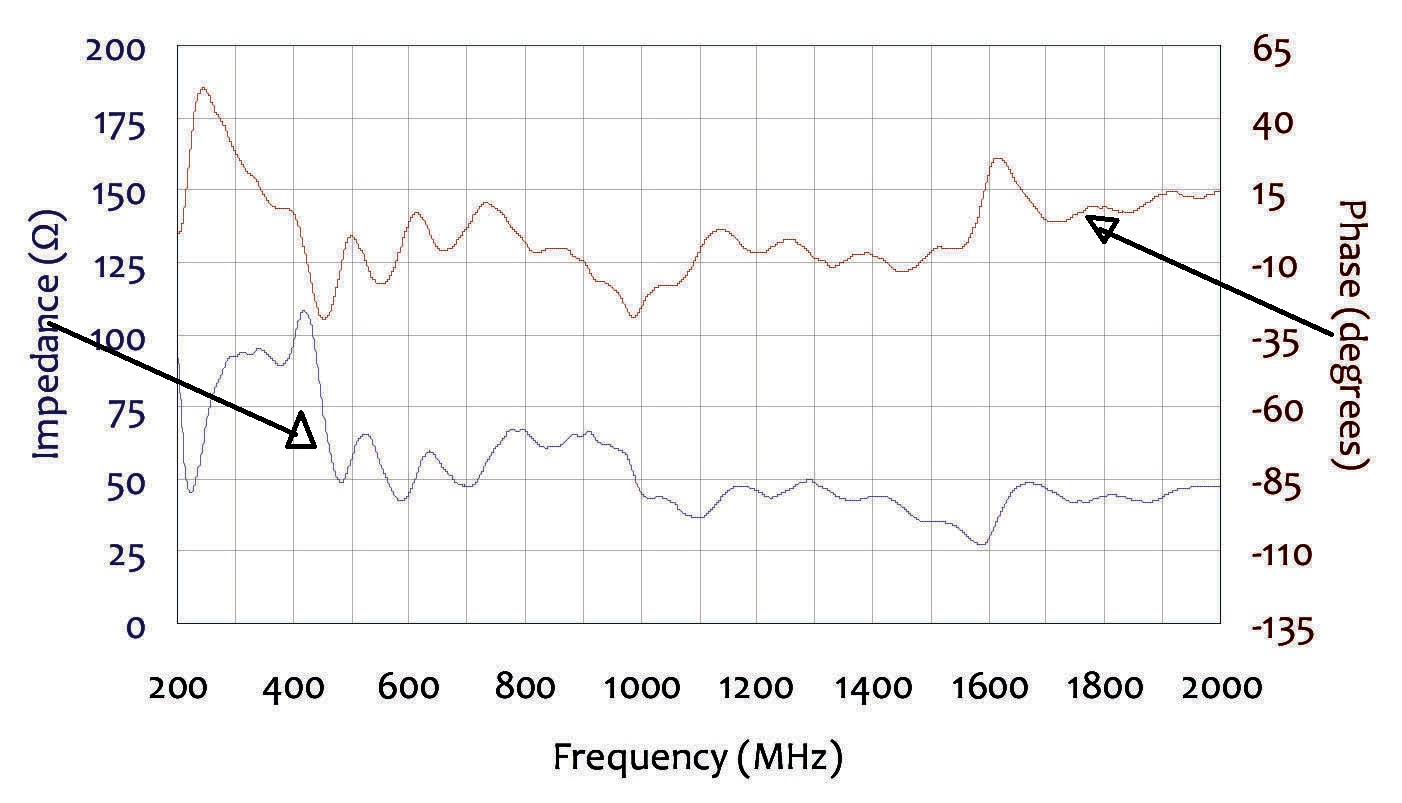
| Nominal Impedance | 50 Ω |
| Power Handling (CW) | 800 Watts (continuous) |
| Connector | N-type (female) |
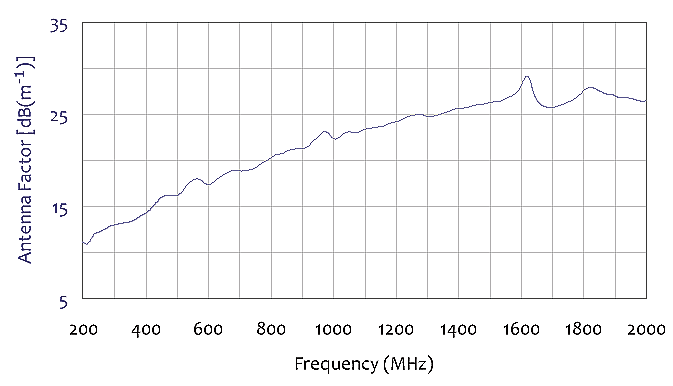
| Antenna Factor | See typical antenna factor graph |
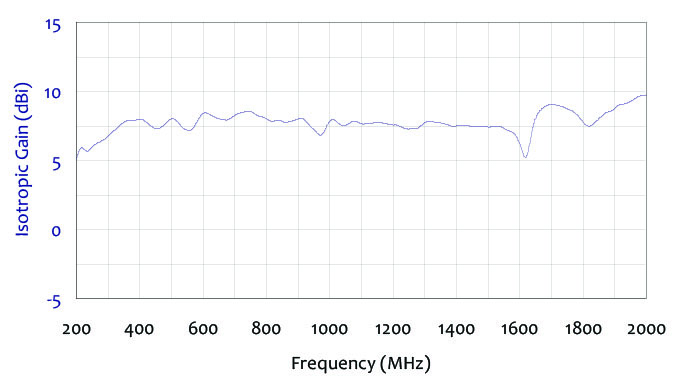
| Isotropic Gain | See typical isotropic gain graph |
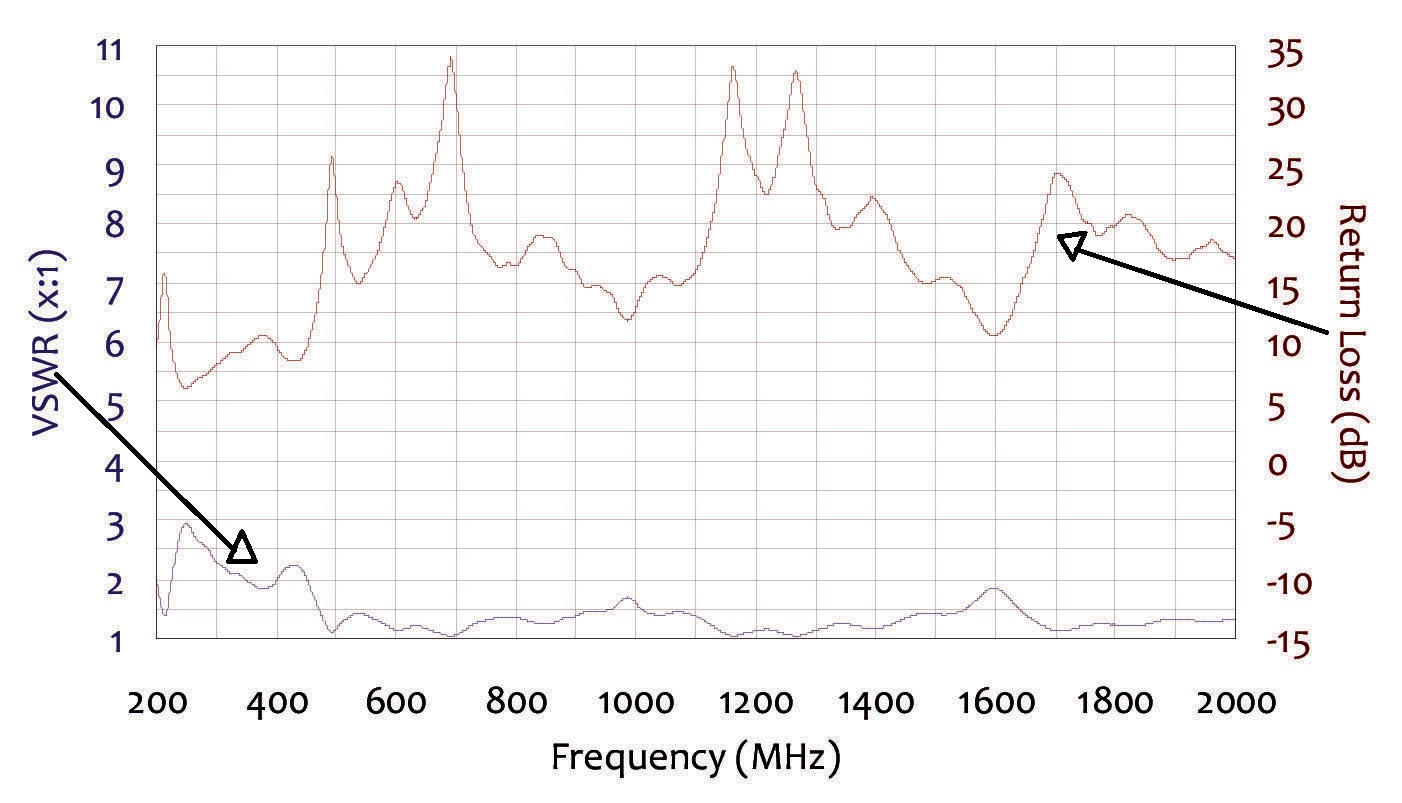
| VSWR / Return Loss | See typical VSWR and return loss graphs |
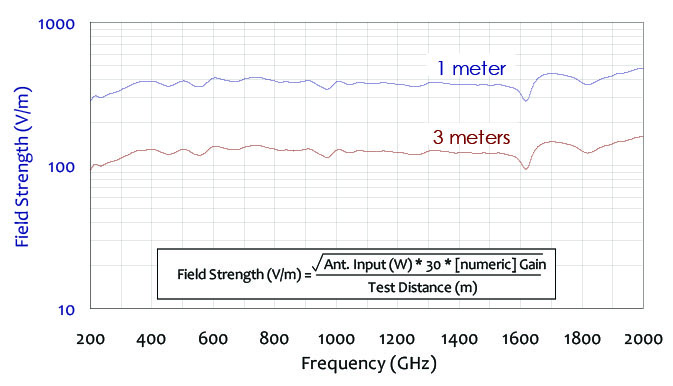
| Radiated Field Strength | See typical field strength graph (with 800 W input power) |
| Applicable Standards | MIL-STD-461 (RE102, RS103); also FCC, CISPR, EN, ETSI, FAA, RTCA DO-160, SAE |
| Calibration | Individually calibrated per SAE ARP-958, NIST traceable |
| Mounting | Two 1/4″-20 mounting plates (vertical & horizontal polarization) |
| Recommended Tripod | AT-220 Antenna Tripod |
| Aperture Dimensions | 69 × 94.5 cm (per MIL-STD-461 RE102 specification) |
| Dimensions (H × W × D) | 27.2″ × 37.2″ × 37″ [69 × 94.5 × 94 cm] |
| Weight | 29.5 lbs [13.4 kg] |
All values are typical, unless specified. All specifications are subject to change without notice.
🔍 Not Sure Which Antenna You Need?
Compare all Com-Power antenna models side-by-side with our interactive selection tool. Filter by frequency range, antenna category, application, polarization, and power handling to find your perfect match.
Compare All Antenna Models →AH-220 Broadband Double Ridge Horn Antenna – Frequently Asked Questions
1. What is the AH-220 horn antenna and what makes it unique compared to other EMC antennas?
The AH-220 is a broadband double ridge horn antenna designed to operate from approximately 200 MHz to 2 GHz. What makes it unique is that it bridges the gap between traditional low-frequency antennas (like biconical and log periodic) and higher-frequency horn antennas. It is specifically engineered to meet MIL-STD-461 requirements, where antenna geometry and performance are tightly controlled. In practical EMC testing, it is one of the few antennas that can cover this frequency range with both high power handling and standard-compliant characteristics.
2. Why is the 200 MHz to 2 GHz range critical in military and aerospace EMC testing?
This frequency band includes many operational and interference-critical systems such as communication radios, navigation systems, radar harmonics, and cable resonance frequencies. In military and aerospace equipment, failures in this range can lead to mission-critical issues. The AH-220 ensures accurate measurement and field generation in this band, which is often where the most complex EMC interactions occur.
3. How does AH-220 differ from log periodic antennas in the same frequency range?
While log periodic antennas also cover portions of this band, the AH-220 offers: - Higher gain and directionality - Better control of field uniformity - Compliance with MIL-STD antenna geometry Log periodic antennas are typically used for general broadband scanning, whereas AH-220 is used when precision, repeatability, and compliance to strict standards are required.
4. How is AH-220 used in radiated emissions testing (RE102)?
In RE102 testing, the AH-220 acts as a receiving antenna. It captures electromagnetic radiation emitted by the equipment under test and feeds it into an EMI receiver. The antenna’s characteristics ensure accurate measurement of emissions within the defined military standard limits, especially in environments where compliance must be strictly verified.
5. How is AH-220 used in radiated immunity testing (RS103)?
In RS103 testing, the AH-220 is used as a transmitting antenna. It is driven by a high-power RF amplifier to generate controlled electromagnetic fields. These fields are used to test the immunity of equipment to external RF interference, ensuring proper operation under harsh electromagnetic environments.
6. Why does AH-220 support high power levels (up to ~800W)?
High power handling allows the antenna to generate strong electromagnetic fields required by military standards. In real test setups, high power ensures that: - Required field strengths are achieved - Field uniformity is maintained - Test repeatability is improved This is essential for compliance testing where insufficient field strength could invalidate results.
7. What industries rely on the AH-220 for EMC testing?
The AH-220 is primarily used in: - Defense and military systems - Aerospace and avionics - Government EMC laboratories - Military contractors and integrators These industries require strict compliance with standards such as MIL-STD-461.
8. Why is antenna geometry important for AH-220?
MIL standards define not just performance but also antenna physical characteristics. The AH-220 is built to match these requirements, ensuring consistent results across different laboratories and test facilities. This makes it a standardized measurement tool rather than just a general-purpose antenna.
9. What are the advantages of using AH-220 over smaller horn antennas?
The AH-220 provides: - Better low-frequency performance - Larger aperture for improved field distribution - More uniform radiation pattern This makes it more effective for lower GHz and sub-GHz EMC testing compared to smaller horns.
10. How does the AH-220 improve measurement accuracy?
Its directional pattern reduces interference from surrounding reflections, while its stable gain ensures reliable conversion of measured signals into field strength values. This leads to more accurate and repeatable measurements.
11. What role does polarization play when using AH-220?
The AH-220 supports linear polarization. Engineers must perform measurements in both horizontal and vertical orientations to capture worst-case emissions or susceptibility conditions, as required by standards.
12. How does AH-220 compare with biconical antennas?
Biconical antennas are omnidirectional and used for lower frequencies, whereas AH-220 provides directional control and higher gain. This makes AH-220 more suitable for controlled testing environments and compliance verification.
13. What are common real-world failure modes detected using AH-220?
- Cable resonance emissions - Shielding leakage - RF coupling into sensitive circuits - System-level interference issues These are particularly common in large or complex electronic systems.
14. What setup considerations are critical when using AH-220?
Proper antenna positioning, stable mounting, correct polarization, and controlled distance from the equipment under test are essential for accurate and repeatable measurements.
15. Why is AH-220 often required rather than optional in MIL testing?
MIL-STD testing often specifies exact antenna types and configurations. Using a different antenna could invalidate the test. Therefore, AH-220 is often mandatory for compliance.
16. When should engineers choose AH-220 over other antennas?
Choose AH-220 when: - Testing must meet MIL-STD-461 - High power field generation is required - Frequency range is 200 MHz to 2 GHz - Repeatability and standard compliance are critical
Application Notes (PDF)
- AN-107 — What is Antenna Factor?
- AN-106 — Use of Antenna Factor for EMC Measurements
- Selecting the Right EMI Antenna
- Considerations when Selecting an Antenna for RF Immunity Testing
- EMC Antenna Calibration Requirements, Methodologies, and Best Practices
- NIST Antenna Calibration Services — Com-Power Capabilities and Traceability
- Com-Power EMC Antenna Product Line — Complete Specifications
- Accounting for Ambient Noise
Interactive Tools
- Antenna Finder Wizard
- Com-Power Antenna & Field Strength Calculator
- Com-Power EMC Compliance Limits Calculator
- Com-Power Cable Loss & Attenuation Calculator
- Com-Power VSWR / Return Loss / Mismatch Loss Calculator
- Com-Power Free Space Path Loss & Link Budget Calculator
Industry Applications
- EMC Considerations for IoT and Smart Home Devices
- Automotive EMC Testing — ISO 11452 / CISPR 25
- 5G Equipment EMC Testing — New Challenges in EMC Compliance
- Medical Device EMC Compliance — IEC 60601-1-2 Essentials
- EV Charging Systems — EMC Requirements and Compliance
Blog Articles


Quote Request
Other EMC Test Equipment
- Absorbing Clamps
- Antenna Kits
- Antenna Masts - Automated and Manual
- Antennas
- Bulk Current Injection probes
- CDNs - Coupling Decoupling Network
- Comb Generators
- Conducted Immunity Test Systems
- Current Monitor Probes
- Current Probe Calibration Fixtures
- EM Clamps
- Feed Through Capacitor
- ISNs - Impedance Stabilization Network
- LISNs - Single Phase
- LISNs - TEMPEST
- LISNs - Three Phase
- Magnetic Field Generator
- Near Field Probes
- Power Amplifiers
- Pre-compliance Emissions Test Systems
- Preamplifiers
- Spectrum Analyzers
- Surge Generators
- System Controllers
- Transient Limiters
- Tripods For EMC
- Turntables