
20 Amps LISN for CISPR 16 & ANSI C63.4
- ▸ Extended-range 9 kHz to 30 MHz dual-conductor LISN, 20 A per line — extends measurements 16 times lower than standard 1x-series LISNs, the only single-phase Com-Power LISN that captures the 9 kHz to 150 kHz band where modern switching converters now place dominant emissions.
- ▸ Dual 50 µH + 250 µH air-core network — implements CISPR 16-1-2 V-network plus the ANSI C63.4 250 µH configuration in one unit, supporting both US FCC and international CISPR-based product testing without changing instruments.
- ▸ Integrated dual-conductor enclosure with universal EUT receptacle and IEC C20 mains input — 270 VAC / 380 VDC, 14 ADC, 50 Ω N-type RF port; insertion loss below 0.5 dB above 15 kHz and isolation above 60 dB above 150 kHz.
- ▸ LED driver and switching power supply emissions testing below 150 kHz — modern LED drivers and SMPS often operate with switching frequencies of 50–100 kHz, placing fundamental and low-order harmonics in the 9–150 kHz band that 1x-series LISNs cannot characterize.
- ▸ Smart energy meters and power line communication equipment — products operating in the CENELEC A/B/C/D bands (3–148.5 kHz) for power line communication require LISN coverage starting at 9 kHz per EN 50065 and product family standards.
- ▸ Solar inverters, EV charging modules, and battery management systems — renewable-energy power conversion equipment with low-frequency switching content; the 9 kHz lower limit is now mandatory for many product family standards covering this category.
- ▸ Medical devices per IEC 60601-1-2 — medical imaging electronics, patient monitors, and laboratory instruments with sensitive low-frequency conducted emissions characteristics that must be qualified across the 9 kHz–30 MHz extended range.
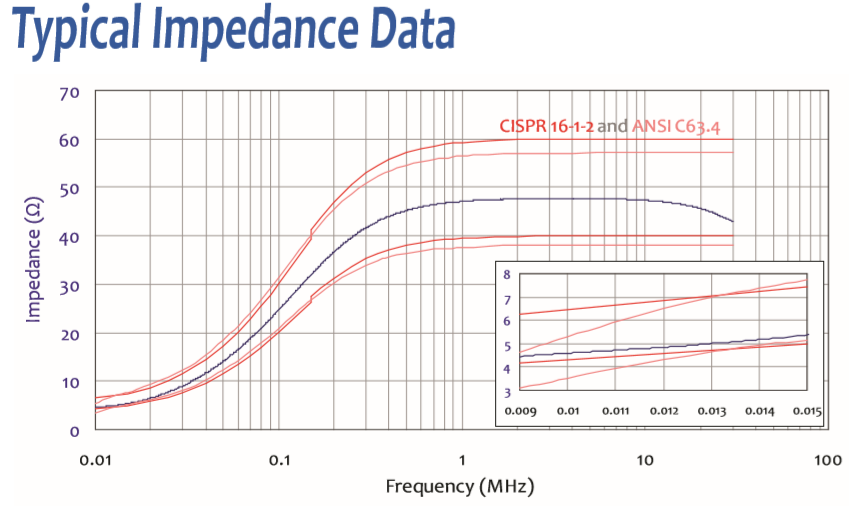
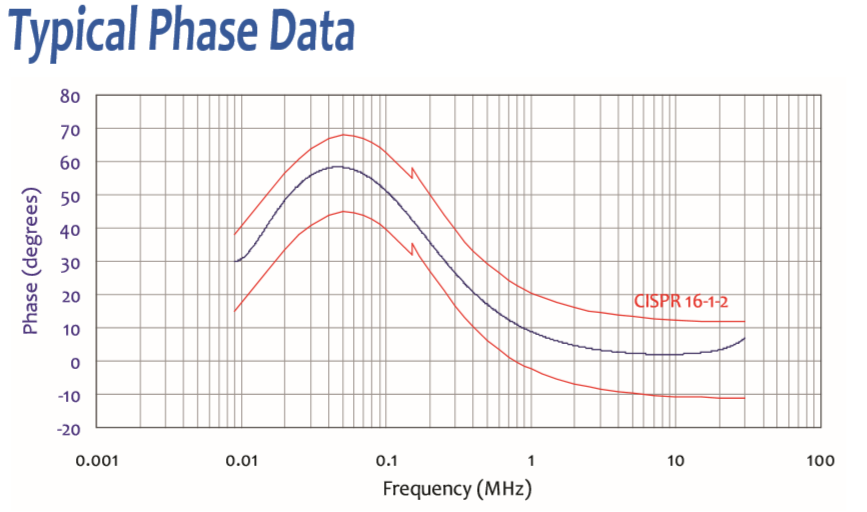
- ▸ NIST-traceable individual calibration with three-year warranty — impedance, phase, isolation, and insertion loss data supplied with each unit; ISO 17025 accredited calibration available on request; recommended LIT-153A or LIT-930A transient limiter accessory available separately for additional EMI receiver protection during testing.
Features
- ▸ Single-enclosure dual-conductor 2x Series LISN — both Line and Neutral networks in one chassis with front-panel test lead selection switch; the only Com-Power 20 A LISN that includes the ANSI C63.4 250 µH network alongside the standard 50 µH V-network.
- ▸ Extended 9 kHz to 30 MHz frequency range — reaches well below the 150 kHz floor of the 1x Series, covering CISPR 16 Band A (9–150 kHz) and Band B (150 kHz–30 MHz) for full-spectrum conducted emissions testing.
- ▸ Dual 250 µH + 50 µH air-core inductors — the 250 µH inductor provides impedance stabilization at low frequencies (9 kHz–150 kHz), while the 50 µH inductor handles the standard 150 kHz–30 MHz range; air-core construction prevents saturation.
- ▸ Fully compliant with CISPR 16-1-2 and ANSI C63.4 — covers both standards' V-network requirements and the ANSI 250 µH network that the 1x Series cannot.
- ▸ Essential for sub-150 kHz product testing — LED drivers, electronic ballasts, switch-mode power supplies, solar inverters, EV chargers, PLC devices, smart meters, and medical devices where applicable standards require emissions characterization in the 9–150 kHz band.
- ▸ 20 A AC / 14 A DC current rating, 270 VAC / 380 VDC voltage rating — covers the same product class as the LIN-120C with extended frequency reach.
- ▸ IEC 60320 C20 mains input + universal multi-configuration EUT receptacle — accepts AC plugs from most countries (Type A, B, C, G, I, etc.) without adapters for fast setup of plug-in commercial products.
- ▸ 50 Ω N-type female RF connector — standard interface for direct connection to EMI receivers and spectrum analyzers; insertion loss < 1 dB above 15 kHz, isolation > 50 dB above 50 kHz.
- ▸ External transient limiter recommended — pair with the Com-Power LIT-153B (or similar 9 kHz–30 MHz transient limiter) for impedance matching, out-of-band filtering, and EMI receiver input protection.
- ▸ 3-phase ready — a second LI-220C pair extends the setup to 3-phase Wye or Delta power systems.
- ▸ Individually NIST-traceable calibrated — impedance, phase, isolation, and insertion loss data shipped with each unit, including both 250 µH and 50 µH configurations. ISO 17025 accredited calibration available on request.
- ▸ Three-year standard warranty — backed by manufacturer support.
Specifications
| Model | LI-220C |
|---|---|
| Series | 2x Series — Single-enclosure dual-conductor with 250 + 50 µH networks |
| Specification | CISPR 16-1-2 / ANSI C63.4 |
| Application | Extended-range Power Line conducted emissions tests (lighting, medical, power electronics) |
| Frequency Range | 9 kHz – 30 MHz |
| Inductors | 250 & 50 µH (air-core, dual-network) |
| Current Rating | 20 Amperes AC, 14 Amperes DC |
| Voltage Rating | 270 VAC (Line to Ground), 380 VDC |
| RF Connector | 50 Ohms N-type (female) |
| Insertion Loss | 6 dB to 1 dB (9 kHz – 15 kHz); < 1 dB (15 kHz – 30 MHz) |
| Isolation | 20 – 40 dB (9 kHz – 50 kHz); > 50 dB (50 kHz – 30 MHz) |
| Mains Connection | IEC 60320 C-20 |
| EUT Connection | Universal multi-configuration receptacle |
| Dimensions | 16.75 × 15.5 × 7.5 in (42.5 × 39.3 × 19 cm) |
| Weight | 20.5 lbs (9.3 kg) |
| Calibration | Individual, NIST-traceable; ISO 17025 accredited available on request |
| Warranty | Three-year standard warranty |
All values are typical, unless specified. All specifications subject to change without notice.
🔍 Not Sure This Is The Right LISN?
Compare all 25 Com-Power LISN models side-by-side with our interactive selection tool. Filter by current, voltage, frequency, and standards to find your perfect match.
Compare All LISN Models →LI-220C CISPR 16-1-2 / ANSI C63.4 Dual-Conductor LISN FAQs
What is the LI-220C and how does it differ from single-conductor LISNs such as the LI-125C and LI-150C?
The LI-220C is a dual-conductor, 50Ω, 50 μH / 250 μH Line Impedance Stabilization Network (LISN) rated at 20 A AC per line that houses both the Line and Neutral networks within a single enclosure. Unlike the LI-125C and LI-150C, which are sold as separately housed pairs requiring individual connection to each power line conductor, the LI-220C combines both networks in one unit with a universal multi-configuration EUT power receptacle and a standard IEC C20 mains input receptacle. This integrated design simplifies setup, reduces connections, and speeds up testing of products that plug into a standard outlet.
What standards does the LI-220C comply with and what network types does it implement?
The LI-220C is fully compliant with CISPR 16-1-2 and ANSI C63.4. For CISPR 16-1-2 it implements a 50Ω / 50 μH + 5Ω V-network. For ANSI C63.4 it implements both the 50 μH and 250 μH network configurations. This dual-standard capability in a single instrument allows laboratories testing products for both US FCC compliance and international CISPR-based markets to use one LISN for both test programs.
What is the frequency range of the LI-220C and how does the extended lower limit of 9 kHz differ from the 150 kHz lower limit of other commercial LISNs?
The LI-220C covers 9 kHz to 30 MHz. The extended 9 kHz lower limit reflects the CISPR 16-1-2 and ANSI C63.4 requirement to cover modern EMI receiver ranges, and is especially relevant for products generating sub-150 kHz conducted disturbances: switch-mode power supplies with low switching frequencies, smart energy meters, power line communication equipment, and EV charging systems. Below 150 kHz, insertion loss increases from below 0.5 dB at 150 kHz to below 6.5 dB at 9 kHz, and isolation decreases from above 60 dB at 150 kHz to above 10 dB at 9 kHz.
What is the current rating of the LI-220C and what class of products does it support?
The LI-220C is rated at 20 A AC RMS per line and 14 A DC. This covers the majority of commercial products that plug into a standard AC outlet: desktop computers, monitors, audio/video equipment, network equipment, small-to-mid power supplies, LED drivers, small motor-driven appliances, and test equipment drawing up to 20 A at 120 V (2.4 kW) or 230 V (4.6 kW).
What is the voltage rating of the LI-220C and what power systems does it support?
The LI-220C is rated at 270 VAC RMS and 380 VDC line to ground. The mains input uses a standard IEC C20 receptacle. The EUT output uses a universal multi-configuration receptacle accommodating AC plugs from most countries — Type A, B, C, G, I, and others — without adapters, eliminating adapter inventory issues for laboratories receiving products from international manufacturers.
How does the dual-conductor design of the LI-220C work and how is the Line / Neutral measurement selection made?
The LI-220C contains two independent LISN networks (Line/L1 and Neutral/L2) within a single chassis. A front-panel TEST LEAD SELECTION switch connects the RF measurement port to either the Line or Neutral network. The unused network’s RF port is internally terminated at 50 Ω automatically. The operator never needs to manually swap coaxial cables between measurements — reducing connection errors and ensuring both networks remain connected to the EUT throughout the measurement sequence.
What is the universal EUT receptacle of the LI-220C and what advantage does it provide?
The EUT power output port is a universal multi-configuration AC receptacle that accepts almost any EUT plug without adapters. In an EMC test laboratory receiving products from worldwide manufacturers, this eliminates adapter inventory management, contact resistance uncertainty, and mechanical fit issues. Products from the US, Europe, UK, Australia, and most other markets plug directly into the LI-220C EUT port.
How does the LI-220C achieve its defined impedance and why are air-core inductors used?
Each internal network contains a 50 μH air-core inductor in series with its power line conductor, combined with capacitor and resistor networks to produce the defined 50 Ω CISPR characteristic and ANSI 50 μH / 250 μH configurations. Air-core inductors prevent saturation — a ferromagnetic core would saturate at elevated current, causing inductance to drop below 50 μH and invalidating the measurement. Air-core inductors maintain specified inductance at all currents up to the 20 A rating.
Why is the mounting plate of the LI-220C left unpainted and what grounding procedure is required?
The unpainted mounting plate enables a low-impedance metal-to-metal bond to the test setup ground plane. The LISN’s internal capacitors create leakage current paths between power line conductors and the chassis that must return to earth ground for valid measurements and personnel safety. The mounting plate must be bonded to the reference ground plane before any power connection is made.
What RF connector does the LI-220C use and what should be connected to the RF measurement port?
The LI-220C uses a 50 Ω N-type female RF connector — a single port that serves both Line and Neutral networks via the internal selection switch. This port connects via 50 Ω coaxial cable through a Com-Power Transient Limiter to an EMI receiver or spectrum analyzer. The cable never needs to be moved between conductor measurements.
What insertion loss and isolation does the LI-220C provide across its 9 kHz to 30 MHz range?
From 150 kHz to 30 MHz: insertion loss below 0.5 dB, isolation above 60 dB. From 9 kHz to 150 kHz: insertion loss increases linearly (log-frequency) from below 0.5 dB at 150 kHz to below 6.5 dB at 9 kHz; isolation decreases from above 60 dB to above 10 dB. Frequency-dependent insertion loss corrections from the unit’s individual calibration data must be applied when measuring in the 9 kHz to 150 kHz sub-band.
How is the LI-220C individually calibrated and what calibration data is supplied?
Every LI-220C is individually calibrated per CISPR 16-1-2 and ANSI C63.4. Impedance, phase, isolation, and insertion loss data across the full 9 kHz to 30 MHz range are supplied with a certificate of calibration. ISO 17025 accredited calibration is also available upon request for laboratories or manufacturers requiring traceable calibration documentation under formal quality management systems.
What is the warranty coverage for the LI-220C?
The LI-220C carries a three-year warranty from Com-Power Corporation. As a passive instrument, it has a long service life under normal laboratory conditions. Periodic recalibration on a one- or two-year interval is recommended to maintain traceability and confirm both internal Line and Neutral networks continue to meet published specifications.
What are the physical dimensions and weight of the LI-220C?
The LI-220C measures 7.5 x 17 x 15.35 inches (19 x 43 x 39 cm) and weighs 20.5 lbs (9.3 kg). As a single-enclosure dual-conductor unit it occupies the bench footprint of one box rather than two. It requires bonding to the ground plane via the unpainted mounting plate, an IEC C19-to-C20 power cable at the mains input, direct EUT plug insertion into the universal receptacle, and a single coaxial cable through a Transient Limiter to the EMI receiver.
What is a Transient Limiter and why does Com-Power recommend one with the LI-220C?
A Transient Limiter inserted between the RF measurement port and the EMI receiver clamps voltage transients generated by EUT switching events, provides 10 dB of attenuation and impedance matching, and incorporates low-pass and high-pass filter sections that attenuate out-of-band emissions. It is especially important with the LI-220C because its universal receptacle accepts a wide variety of products including switching power supplies and motor-driven appliances that generate significant power line transients.
How does the LI-220C compare to the LIN-120C and to the separately housed LI-125C and LI-150C pairs?
The LI-220C (9 kHz–30 MHz, external Transient Limiter required) and LIN-120C (150 kHz–30 MHz, built-in Transient Limiter with ON/OFF bypass) are both single-enclosure dual-conductor models at 20 A. The LI-220C is preferred when sub-150 kHz measurements or the ANSI 250 μH network are needed. The separately housed LI-125C (25 A) and LI-150C (50 A) pairs offer higher current ratings but require more setup steps. For lower-power products needing the extended 9 kHz range or ANSI dual-network, the LI-220C is the right choice.
What types of equipment cannot be tested with the LI-220C?
The LI-220C is not suitable for: equipment exceeding 20 A AC or 14 A DC (use LI-125C, LI-150C, or LI-1100C); DO-160 testing (use LI-325C or LI-350); MIL-STD-461 testing (use LI-400C or LI-4100); CISPR 25 automotive testing (use LI-550C). For three-phase systems, two LI-220C units can cover four conductors as shown in the connection diagrams, though the LI-3P series is purpose-built for three-phase compliance programs.
How can the LI-220C be installed in a three-phase power system?
As shown in the LI-220C connection diagrams, two LI-220C units cover a three-phase system: one unit handles Phase A and Phase B, the second handles Phase C and Neutral. The RF measurement port of the non-active LISN network is terminated at 50 Ω. This allows CE measurements on all four conductors of a three-phase Wye system. For dedicated three-phase compliance programs, a purpose-built LI-3P series LISN provides a more integrated solution.
How is the LI-220C used for conducted emissions pre-compliance testing on a switching power adapter for a consumer electronics product?
The LI-220C’s universal EUT receptacle accepts the product’s power plug directly without adapters, and the front-panel Line/Neutral selection switch eliminates cable reconnection between conductor measurements. The adapter is loaded to rated output current with an electronic load and a spectrum analyzer scans from 9 kHz to 30 MHz. The 9 kHz lower limit reveals sub-150 kHz emissions invisible on a 150 kHz-limited LISN but relevant for certain market certifications, guiding filter design before formal laboratory testing.
How is the LI-220C used to test a smart home energy monitor or power line communication device where sub-150 kHz emissions are critical?
Smart home energy monitors and PLC devices (PRIME, G3-PLC) inject signals onto the power line at 9–148.5 kHz, and incidental conducted disturbances from their power supply circuitry must also meet limits across the full 9 kHz to 30 MHz range. The LI-220C’s 9 kHz lower limit makes it the appropriate LISN for this product category — a 150 kHz-limited LISN would miss the entire sub-150 kHz conducted disturbance spectrum. The frequency-dependent insertion loss correction from individual calibration data must be carefully applied across the sub-150 kHz band where insertion loss varies with frequency.
How does an international product certification laboratory use the LI-220C for both FCC (ANSI C63.4) and CE marking (CISPR 16-1-2) compliance in a single test session?
For EN 55032 (CISPR 16-1-2), the LI-220C is configured in its 50 μH + 5Ω CISPR V-network mode. For ANSI C63.4, it provides both the 50 μH and 250 μH configurations. The universal EUT receptacle accepts any product plug without adapters. This multi-standard capability in a single instrument reduces equipment investment for laboratories supporting both US and international conducted emissions compliance programs, with a single calibration certificate covering both CISPR 16-1-2 and ANSI C63.4 configurations.
How is the LI-220C used in a DC power system test configuration?
The LI-220C’s 380 VDC / 14 A DC rating supports testing of 48 VDC telecom equipment, 24 VDC and 48 VDC industrial control systems, 380 VDC data center power distribution components, and battery-powered equipment with DC-DC converters. As shown in the LI-220C DC connection diagram, the positive DC supply connects to L1 (Line input), the negative DC supply connects to L2 (Neutral input), and earth ground connects to the chassis ground terminal. The dual-conductor design measures both positive and negative bus conductors through a single LI-220C unit in the same manner as the AC single-phase configuration.


Quote Request
Other EMC Test Equipment
- Absorbing Clamps
- Antenna Kits
- Antenna Masts - Automated and Manual
- Antennas
- Bulk Current Injection probes
- CDNs - Coupling Decoupling Network
- Comb Generators
- Conducted Immunity Test Systems
- Current Monitor Probes
- Current Probe Calibration Fixtures
- EM Clamps
- Feed Through Capacitor
- ISNs - Impedance Stabilization Network
- LISNs - Single Phase
- LISNs - TEMPEST
- LISNs - Three Phase
- Magnetic Field Generator
- Near Field Probes
- Power Amplifiers
- Pre-compliance Emissions Test Systems
- Preamplifiers
- Spectrum Analyzers
- Surge Generators
- System Controllers
- Transient Limiters
- Tripods For EMC
- Turntables