
100A Heavy-Duty Three-Phase LISN
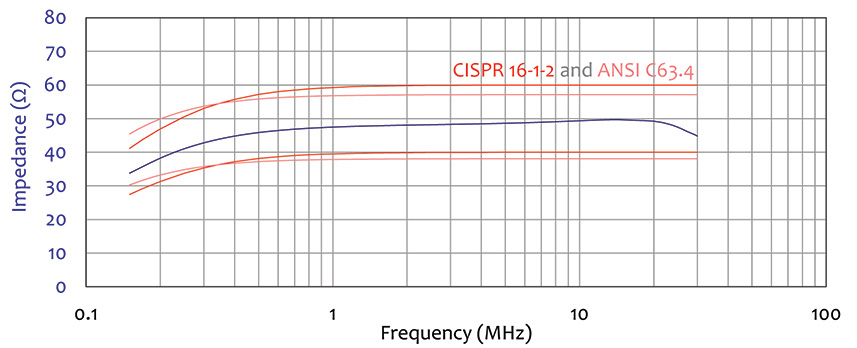
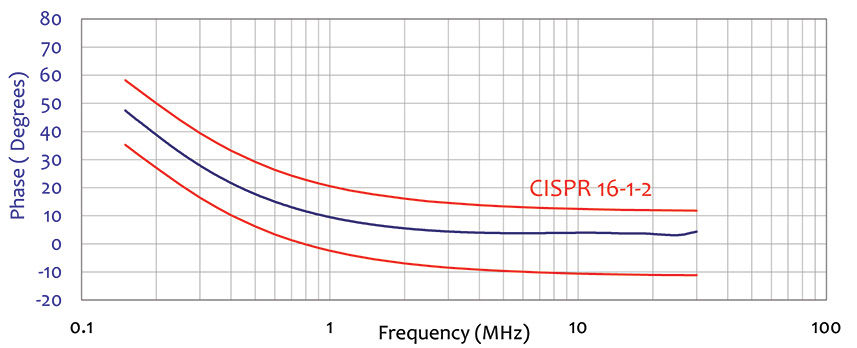
- Implements a precision-controlled 50 Ω / 50 µH four-conductor impedance stabilization network fully compliant with CISPR 16-1-2 and ANSI C63.4.
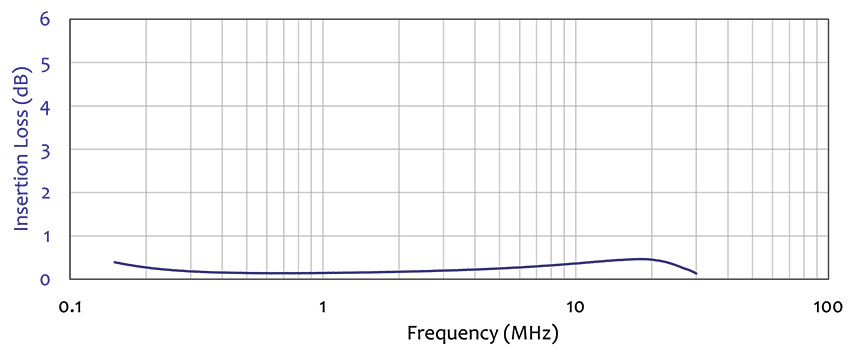
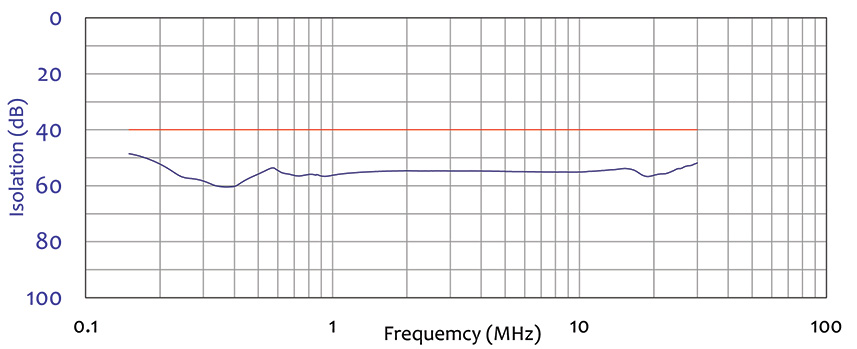
- Maintains controlled impedance characteristics from 150 kHz–30 MHz with verified isolation exceeding 40 dB and insertion loss below 11 dB.
- Supports 100 A continuous per line allowing full-load conducted emissions validation of three-phase EUTs.
- Utilizes air-core inductors to eliminate magnetic saturation and maintain phase accuracy under high current conditions.
- Improves measurement repeatability in compliance labs by providing defined and stable power line impedance independent of the facility mains.
- Enhances test setup accuracy for motor drives, EV chargers, UPS systems, converters, and industrial automation equipment.
- Reduces measurement uncertainty by isolating the EUT from upstream power disturbances and external noise sources.
- Optimizes multi-phase testing efficiency through remote fiber-optic line switching, minimizing reconnections and operator handling.
- Protects EMI receivers and spectrum analyzers via integrated transient limiting and broadband filtering.
Features
- ▸ Highest-current LI-3P-1X three-phase LISN, 100 A per line with active cooling — suited for high-capacity motor drives, large industrial machinery, EV charging stations, heavy industrial manufacturing equipment, and large-scale UPS systems.
- ▸ 150 kHz to 30 MHz frequency range — covers the standard CISPR / ANSI commercial conducted emissions band; full coverage for FCC, CE, and EN compliance testing of three-phase products.
- ▸ Fully compliant with CISPR 16-1-2 and ANSI C63.4 — the 50 Ω / 50 μH four-conductor V-network is calibrated to the standard, accepted by accredited EMC test laboratories worldwide.
- ▸ Four-conductor design covers L1, L2, L3, and Neutral — supports both Delta (3-wire) and Wye (4-wire) three-phase configurations; one independent stabilization network per conductor.
- ▸ 100 A per line current rating with 100 A power connectors — matched to the EUT current draw range for this model in the 1X Series.
- ▸ High voltage rating: 865 Vrms line-to-line, 500 Vrms line-to-ground, 600 VDC — supports worldwide three-phase systems found in commercial and industrial applications.
- ▸ 50/60 Hz mains support
- ▸ Air-core inductors prevent saturation — air-core construction keeps inductance constant at all currents up to the 100 A rating, ensuring the LISN impedance and emissions measurement remain calibrated.
- ▸ Insertion loss < 11 dB; isolation > 40 dB — well-controlled signal path for accurate emissions measurement and effective decoupling of the EUT from facility power line noise.
- ▸ Built-in transient limiter — integrated protection for the EMI receiver input from EUT switching transients, eliminating the need for an external transient limiter accessory.
- ▸ Remote line switching via RLI V2.0 fiber optic interface — USB-connected interface unit with optical isolation switches between L1, L2, L3, and N from the control room without entering the test setup; enables fully automated test sequences.
- ▸ Manual front-panel line selection also provided — backup operation without the remote interface, useful for setup, manual diagnostics, and bench-top pre-compliance work.
- ▸ 50 Ω N-type female RF connector — standard interface for direct connection to EMI receivers and spectrum analyzers.
- ▸ Louvered panels plus 2 internal cooling fans — the 100 A rating demands continuous forced-air cooling for sustained high-current commercial conducted emissions tests.
- ▸ Individually calibrated — each unit ships with calibration data; ISO 17025 accredited calibration available on request.
- ▸ Three-year standard warranty — backed by manufacturer support.
Specifications
| Model | LI-3P-1100 |
|---|---|
| Series | 1X Series — Four-conductor 50 Ω / 50 μH, CISPR 16-1-2 / ANSI C63.4 |
| Standards Compliance | CISPR 16-1-2 (CE) & ANSI C63.4 (FCC) |
| Application | Commercial three-phase power line conducted emissions tests |
| Frequency Range | 150 kHz – 30 MHz |
| Network Type | 50 Ω, 50 μH, four-conductor (air-core) |
| Current Rating (per line) | 100 A |
| Power Connector Rating | 100 A |
| Max AC Voltage (Line-to-Line) | 865 Vrms |
| Max AC Voltage (Line-to-Ground) | 500 Vrms |
| Max DC Voltage | 600 VDC |
| AC Frequency Support | 50/60 Hz only |
| Insertion Loss | < 11 dB |
| Isolation | > 40 dB |
| Transient Limiter | Built-in |
| RF Measurement Port | 50 Ω N-type (female) |
| Remote Interface | RLI V2.0 via fiber optic |
| Local Line Selection | Front-panel push-buttons (L1, L2, L3, N) |
| Power Configurations | Delta (3-wire) and Wye (4-wire) |
| Cooling | Louvered panels + 2 internal fans |
| Dimensions (H × W × D) | 17.36 × 17.77 × 20.78 in |
| Weight | 57.5 lbs (30.4 kg) |
| Operating Temperature | 5 °C to 40 °C |
| Calibration | Individual; ISO 17025 accredited available on request |
| Warranty | Three-year standard warranty |
All values are typical, unless specified. All specifications subject to change without notice.
🔍 Not Sure This Is The Right LISN?
Compare all 25 Com-Power LISN models side-by-side with our interactive selection tool. Filter by current, voltage, frequency, and standards to find your perfect match.
Compare All LISN Models →LI-3P-1100 V2.0 Three-Phase LISN FAQs
What is the LI-3P-1100 V2.0 and what segment of industrial equipment is it intended for?
The LI-3P-1100 V2.0 is a four-conductor, 50Ω/50 μH, three-phase Line Impedance Stabilization Network rated at 100 amperes per phase. It is the highest-current model in the Com-Power LI-3P-1x series and is intended for conducted emissions compliance testing of large-scale industrial equipment such as high-power motor drives, industrial welding systems, large UPS installations, high-current power rectifiers, and energy storage system converters operating at or near 100 A per phase.
Which EMC standards does the LI-3P-1100 V2.0 comply with?
The LI-3P-1100 V2.0 is fully compliant with CISPR 16-1-2 for European CE marking and ANSI C63.4 for FCC conducted emissions testing. It also supports regulatory testing under AS/NZS, VCCI, ISED Canada, and other international commercial EMI/EMC standards that adopt equivalent conducted emissions measurement methodologies.
What frequency range does the LI-3P-1100 cover for power line conducted emissions testing?
The LI-3P-1100 operates from 150 kHz to 30 MHz, covering the complete conducted emissions frequency band defined by CISPR 16-1-2 and ANSI C63.4. This single-unit coverage of the full regulatory band is essential for efficient compliance testing of high-power industrial equipment, which often cannot be easily reconfigured or interrupted between frequency sub-bands.
What EUT voltage and current ratings does the LI-3P-1100 support?
The LI-3P-1100 supports a maximum continuous current of 100 amperes per phase, a maximum AC voltage of 865 V RMS line-to-line and 500 V RMS line-to-ground, and a maximum DC voltage of 600 V. On a 400 V three-phase supply, a 100 A rating corresponds to equipment with apparent power up to approximately 70 kVA, encompassing some of the largest three-phase equipment categories subject to conducted emissions compliance testing.
How does the LI-3P-1100 maintain a defined stable impedance at 100 A for accurate disturbance voltage measurements?
The LI-3P-1100 uses air-core inductors for the 50 μH network elements. Air-core construction eliminates magnetic saturation and permeability variation that would occur in ferrite or steel-core designs at 100 A load currents. This guarantees the network impedance presented to the EUT remains within the narrow tolerance band specified by CISPR 16-1-2, ensuring valid and reproducible disturbance voltage measurements.
Why does the LI-3P-1100 use fiber optic control for remote line switching rather than a conventional interface?
At 100 A operating levels, conductive control interfaces create serious risks of ground-loop currents, common-mode noise injection, and safety hazards. The fiber optic link of the RLI V2.0 Remote LISN Interface carries no electrical current, providing complete galvanic isolation between the test environment and the external control point, while maintaining full remote switching capability of L1, L2, L3, and Neutral.
How does remote line switching on the LI-3P-1100 improve safety and productivity in high-current test environments?
Switching via the RLI V2.0 remote interface eliminates the need for personnel to enter the shielded test room or physically access the LISN between each phase measurement. At 100 A, power cables are physically large and inflexible, making manual reconnection between measurements time-consuming and potentially disruptive to the EUT operating state, so remote switching provides both a significant productivity improvement and a measurable reduction in operator risk.
What happens to the three non-selected conductors while one line is being measured on the LI-3P-1100?
The LI-3P-1100 automatically terminates the three non-selected conductors into 50Ω internally whenever a line is selected for measurement. The active measurement line is simultaneously terminated by the 50Ω input impedance of the connected EMI receiver. This four-conductor simultaneous termination is a specific requirement of CISPR 16-1-2 and prevents inter-phase impedance coupling from affecting disturbance voltage readings.
What Delta and Wye three-phase power configurations can the LI-3P-1100 accommodate?
The LI-3P-1100 four-conductor network supports both three-phase Delta and three-phase Wye configurations with conductors for Line 1, Line 2, Line 3, and Neutral. This broad compatibility allows the LISN to be used with large industrial equipment regardless of whether the facility supply or the EUT uses a Delta or Wye distribution topology.
How does the LI-3P-1100 transient limiter protect sensitive measurement instrumentation during high-power testing?
Large industrial equipment at 100 A can produce extremely high-energy switching transients when motors start, contactors open, or drive inverters commutate. The built-in Transient Limiter clamps these transients at the RF measurement port before they can reach the EMI receiver input. Integrated low-pass and high-pass filters additionally suppress out-of-band signals, reducing the probability of receiver overload during the broadband high-emission environments typical of high-power three-phase equipment testing.
What insertion loss and isolation performance does the LI-3P-1100 V2.0 provide?
The LI-3P-1100 achieves an insertion loss of less than 11 dB and provides isolation of greater than 40 dB between the mains supply and the RF measurement port across 150 kHz to 30 MHz. The 40 dB isolation is critical when testing in industrial facilities where the mains supply itself may carry significant conducted noise from adjacent equipment on the same electrical distribution system.
What thermal management system does the LI-3P-1100 use to support continuous 100 A operation?
The LI-3P-1100 uses louvered side panels combined with two user-controlled internal forced-air cooling fans powered by a dedicated 15 V DC supply. This active forced-air cooling system dissipates the heat generated by 100 A continuous current through the air-core inductors and internal wiring, allowing the LISN to sustain rated operation during long-duration test sequences without thermal derating.
How is the LI-3P-1100 calibrated and what documentation is supplied with each unit?
Every LI-3P-1100 V2.0 is individually calibrated per CISPR 16-1-2 and ANSI C63.4. A full calibration data set covering impedance, phase, isolation, and insertion loss versus frequency is included with each unit along with a certificate of calibration. ISO 17025 accredited calibration is available upon request for laboratories that require recognized third-party calibration documentation as part of their accreditation program.
Why must the LI-3P-1100 be bonded to an earth ground plane and what risks arise if this is omitted?
The unpainted mounting plate of the LI-3P-1100 is designed for direct metal-to-metal bonding to a conductive ground plane. At 100 A, leakage currents flowing through the LISN chassis to earth can be substantial, posing a shock hazard if earth bonding is inadequate. A floating or high-impedance chassis ground also alters the network impedance reference conditions of CISPR 16-1-2, invalidating disturbance voltage measurements.
What power connector types and ratings are used on the LI-3P-1100?
The LI-3P-1100 uses color-coded 100A rated receptacle and plug connectors on both the mains power input and EUT power output ports, with five conductor positions per port for L1, L2, L3, Neutral, and Protective Earth. The RF measurement port uses a 50Ω N-Type female connector compatible with standard EMC coaxial measurement cables.
In what industry sectors and test programs is the LI-3P-1100 V2.0 most applicable?
The LI-3P-1100 is most applicable in heavy industrial EMC test laboratories, power electronics and drive system development centers, electric vehicle charging infrastructure test facilities, renewable energy inverter qualification labs, data center power equipment test environments, and military and aerospace ground support equipment test programs where three-phase equipment at or near 100 A per phase requires conducted emissions compliance verification.
How does the LI-3P-1100 compare physically to the smaller models in the LI-3P-1x series?
The LI-3P-1100 measures 17.36″ H × 17.77″ W × 20.78″ D and weighs 57.54 lbs, sharing a chassis footprint with the LI-3P-163 but with higher internal component ratings. This larger chassis accommodates the heavy-gauge air-core inductors, 100A rated connectors, and forced-air cooling required for continuous high-current operation, and represents a significant size increase compared to the 16 A and 32 A models in the series.
How is the LI-3P-1100 used when qualifying a large three-phase data center UPS for CISPR 32 conducted emissions compliance?
Large three-phase online UPS systems rated at 60 to 80 kVA draw up to 100 A per phase from the facility supply at full load. The LI-3P-1100 connects between the power supply simulation and the UPS power input in a shielded test room, with the UPS loaded to rated kVA by a resistive load bank or server load simulation. Conducted emissions sweeps from 150 kHz to 30 MHz are performed on all four conductors in both online double-conversion mode and battery bypass mode. The LI-3P-1100’s 100 A continuous rating ensures it handles the full load current through extended test sequences without derating.
What does a conducted emissions test configuration look like for a 100 A per phase three-phase motor drive system used in EV manufacturing automation?
EV manufacturing facilities use large three-phase servo drive systems and robotic welding power systems drawing up to 100 A per phase to power body shop, paint shop, and assembly automation. The LI-3P-1100 connects between a simulated facility supply and the drive system input, and the drive operates through its full production motion cycle using a mechanical load simulation. Sweeps from 150 kHz to 30 MHz on all four conductors confirm the drive system will not interfere with the plant power distribution or with the sensitive measurement equipment used on the EV production line.
How is the LI-3P-1100 used by a test laboratory performing VCCI conducted emissions testing on a large three-phase industrial power conversion system for the Japanese market?
Japan’s VCCI requirements for industrial equipment adopt CISPR 11 limits and measurement methods, requiring a CISPR 16-1-2 compliant LISN. For a system drawing up to 100 A per phase from the Japanese 200 V three-phase 50 Hz or 60 Hz supply, the LI-3P-1100 is configured at the appropriate voltage and frequency. Sweeps from 150 kHz to 30 MHz are compared against VCCI Class A limits, and the formal test report citing the LI-3P-1100 calibration data supports the VCCI registration required for marketing in Japan.
How does a prime contractor use the LI-3P-1100 when qualifying a high-power three-phase industrial power supply for an offshore oil and gas platform?
Offshore platform electrical systems must meet strict conducted emissions requirements to prevent interference with safety-critical navigation, communications, and control systems sharing the platform power infrastructure. The LI-3P-1100 connects between the prime contractor’s integration test facility supply and the equipment drawing 100 A per phase, with sweeps from 150 kHz to 30 MHz compared against IEC 61000-6-4 or platform-specific EMC specifications. The forced-air cooling is critical because offshore qualification often requires the EUT at rated load for extended periods to demonstrate thermal stability simultaneously with EMC compliance.
What is a real-world scenario where the LI-3P-1100 is used to troubleshoot a conducted emissions failure at an accredited laboratory before a critical certification deadline?
When a large three-phase system fails its conducted emissions certification test, the LI-3P-1100 enables immediate in-session troubleshooting without ending the test session. After identifying failing frequencies on the formal sweep, the manufacturer’s EMC engineer sequentially installs and removes filter components at the three-phase input while the EUT remains at rated load. Real-time measurement feedback from the LI-3P-1100 and EMI receiver allows the team to identify the dominant emission source, determine whether a common-mode or differential-mode filter is needed, and size the filter to achieve the required margin — all within the same test session. This in-session troubleshooting capability can be the difference between meeting a certification deadline and scheduling a costly additional test event weeks later.

Quote Request
Other EMC Test Equipment
- Absorbing Clamps
- Antenna Kits
- Antenna Masts - Automated and Manual
- Antennas
- Bulk Current Injection probes
- CDNs - Coupling Decoupling Network
- Comb Generators
- Conducted Immunity Test Systems
- Current Monitor Probes
- Current Probe Calibration Fixtures
- EM Clamps
- Feed Through Capacitor
- ISNs - Impedance Stabilization Network
- LISNs - Single Phase
- LISNs - TEMPEST
- LISNs - Three Phase
- Magnetic Field Generator
- Near Field Probes
- Power Amplifiers
- Pre-compliance Emissions Test Systems
- Preamplifiers
- Spectrum Analyzers
- Surge Generators
- System Controllers
- Transient Limiters
- Tripods For EMC
- Turntables