
16A Three-Phase LISN for Conducted EMI Testing
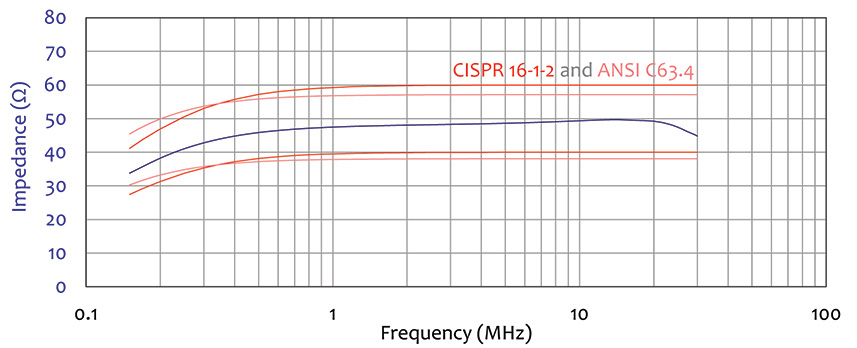
- Implements a precision-controlled 50 Ω / 50 µH four-conductor impedance stabilization network fully compliant with CISPR 16-1-2 and ANSI C63.4.
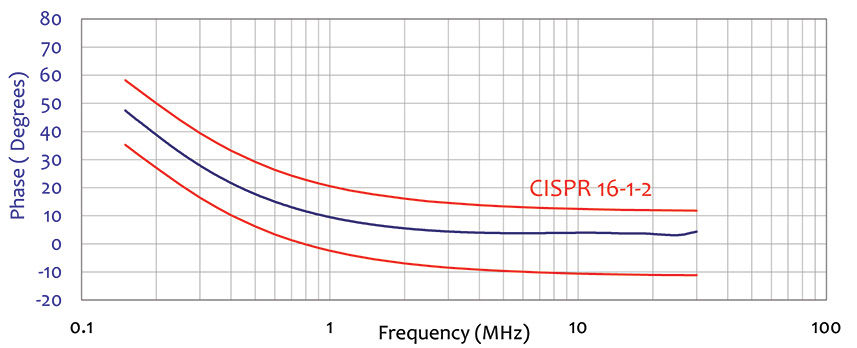
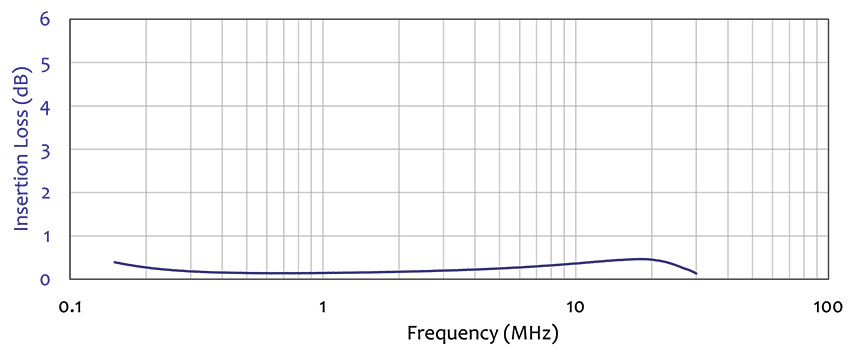
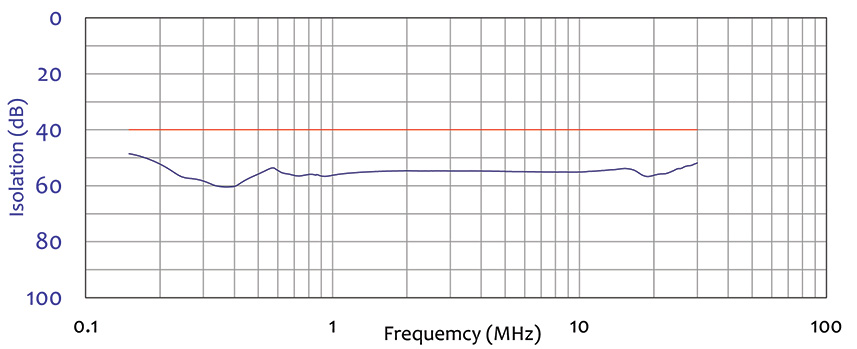
- Maintains controlled impedance characteristics from 150 kHz–30 MHz with verified isolation exceeding 40 dB and insertion loss below 11 dB.
- Supports 16 A continuous per line allowing full-load conducted emissions validation of three-phase EUTs.
- Utilizes air-core inductors to eliminate magnetic saturation and maintain phase accuracy under high current conditions.
- Improves measurement repeatability in compliance labs by providing defined and stable power line impedance independent of the facility mains.
- Enhances test setup accuracy for motor drives, EV chargers, UPS systems, converters, and industrial automation equipment.
- Reduces measurement uncertainty by isolating the EUT from upstream power disturbances and external noise sources.
- Optimizes multi-phase testing efficiency through remote fiber-optic line switching, minimizing reconnections and operator handling.
- Protects EMI receivers and spectrum analyzers via integrated transient limiting and broadband filtering.
- Supports structured EMC workflows with forced-air cooling for extended high-current testing sessions.
Features
- ▸ Lowest-current LI-3P-1X three-phase LISN, 16 A per line — the entry point of the 1X Series for low-power three-phase equipment such as small motors, bench-top industrial tools, low-power PLCs, and laboratory instruments.
- ▸ 150 kHz to 30 MHz frequency range — the standard CISPR / ANSI commercial conducted emissions band; full coverage for FCC, CE, and EN compliance testing of three-phase products.
- ▸ Fully compliant with CISPR 16-1-2 and ANSI C63.4 — the 50 Ω / 50 µH four-conductor V-network is calibrated to both standards, accepted by accredited EMC test laboratories worldwide.
- ▸ Four-conductor design covers L1, L2, L3, and Neutral — supports both Delta (3-wire) and Wye (4-wire) three-phase configurations; one independent stabilization network per conductor.
- ▸ Built-in transient limiter — integrated protection for the EMI receiver input from EUT switching transients, eliminating the need for an external transient limiter accessory.
- ▸ Remote line switching via RLI V2.0 fiber optic interface — USB-connected interface unit with optical isolation switches between L1, L2, L3, and N from the control room without entering the test setup; enables fully automated test sequences.
- ▸ Manual front-panel line selection also provided — backup operation without the remote interface, useful for setup, manual diagnostics, and bench-top pre-compliance work.
- ▸ High voltage rating: 865 Vrms line-to-line, 500 Vrms line-to-ground, 600 VDC — supports worldwide three-phase systems including 480 V, 600 V, and high-voltage DC bus configurations.
- ▸ Air-core inductors prevent saturation — air-core construction keeps inductance constant at all currents up to the 16 A rating, ensuring the LISN impedance and emissions measurement remain calibrated.
- ▸ Insertion loss < 11 dB; isolation > 40 dB — well-controlled signal path for accurate emissions measurement; effective decoupling of the EUT from facility power line noise.
- ▸ 50 Ω N-type female RF connector — standard interface for direct connection to EMI receivers and spectrum analyzers; 25 A power connectors at mains and EUT ports.
- ▸ Passive louvered-panel cooling — quiet bench-top operation without cooling fans, suitable for use directly adjacent to acoustic-sensitive test environments.
- ▸ Individually calibrated — each unit ships with calibration data; ISO 17025 accredited calibration available on request.
- ▸ Three-year standard warranty — backed by manufacturer support.
Specifications
| Model | LI-3P-116 |
|---|---|
| Series | 1X Series — Four-conductor 50 Ω / 50 μH, CISPR 16-1-2 / ANSI C63.4 |
| Standards Compliance | CISPR 16-1-2 (CE) & ANSI C63.4 (FCC) |
| Application | Commercial three-phase power line conducted emissions tests |
| Frequency Range | 150 kHz – 30 MHz |
| Network Type | 50 Ω, 50 μH, four-conductor (air-core) |
| Current Rating (per line) | 16 A |
| Power Connector Rating | 25 A |
| Max AC Voltage (Line-to-Line) | 865 Vrms |
| Max AC Voltage (Line-to-Ground) | 500 Vrms |
| Max DC Voltage | 600 VDC |
| AC Frequency Support | 50/60 Hz only |
| Insertion Loss | < 11 dB |
| Isolation | > 40 dB |
| Transient Limiter | Built-in |
| RF Measurement Port | 50 Ω N-type (female) |
| Remote Interface | RLI V2.0 via fiber optic |
| Local Line Selection | Front-panel push-buttons (L1, L2, L3, N) |
| Power Configurations | Delta (3-wire) and Wye (4-wire) |
| Cooling | Louvered side panels (passive) |
| Dimensions (H × W × D) | 14.25 × 14.6 × 16.88 in |
| Weight | 34 lbs (15.4 kg) |
| Operating Temperature | 5 °C to 40 °C |
| Calibration | Individual; ISO 17025 accredited available on request |
| Warranty | Three-year standard warranty |
All values are typical, unless specified. All specifications subject to change without notice.
🔍 Not Sure This Is The Right LISN?
Compare all 25 Com-Power LISN models side-by-side with our interactive selection tool. Filter by current, voltage, frequency, and standards to find your perfect match.
Compare All LISN Models →LI-3P-116 V2.0 Three-Phase LISN FAQs
What is the LI-3P-116 and what role does a LISN play in conducted emissions testing?
The LI-3P-116 is a four-conductor, 50Ω/50 μH, three-phase Line Impedance Stabilization Network rated at 16 amperes per phase. A LISN provides a defined, stable impedance at the power port of the Equipment Under Test (EUT), isolates the test circuit from the power source, and couples conducted disturbance voltages to the RF measurement port. This ensures repeatable, standardized conditions required for power line conducted emissions compliance testing.
Which international EMC standards does the LI-3P-116 support?
The LI-3P-116 is fully compliant with CISPR 16-1-2 for CE marking in Europe and ANSI C63.4 for FCC testing in the United States. It also supports conducted emissions testing under AS/NZS for Australia and New Zealand, VCCI for Japan, ISED for Canada, and other international commercial EMI/EMC regulations.
What frequency range does the LI-3P-116 cover and why does it matter for compliance testing?
The LI-3P-116 operates from 150 kHz to 30 MHz, which is exactly the frequency range specified by CISPR 16-1-2 and ANSI C63.4 for power line conducted emissions measurements. Covering this range with a single LISN eliminates the need for multiple networks across the regulatory test band.
What types of three-phase power configurations is the LI-3P-116 compatible with?
The LI-3P-116 uses a four-conductor network that supports both three-phase Delta and three-phase Wye (Star) power configurations. The four conductors correspond to Line 1, Line 2, Line 3, and Neutral, making the LISN applicable to a wide range of industrial and commercial three-phase EUT power arrangements.
How does the LI-3P-116 remote switching capability improve the efficiency of conducted emissions testing?
The LI-3P-116 includes remote switching of the line under test via the RLI V2.0 Remote LISN Interface, which communicates through a fiber optic connection. This allows the operator or automated test software to sequentially select L1, L2, L3, or Neutral from outside the shielded room without interrupting the test setup, significantly reducing measurement time and the risk of cable disturbance.
Why is fiber optic control used for remote line switching on the LI-3P-116?
Fiber optic control eliminates conductive paths between the inside and outside of a shielded enclosure or semi-anechoic chamber. This prevents the control interface from introducing RF noise or ground loops that could corrupt sensitive conducted emissions measurements, maintaining the integrity of the test environment.
What happens to the non-selected lines during a conducted emissions measurement on the LI-3P-116?
When a specific line is selected for measurement, the remaining lines are automatically terminated into 50Ω internally. The selected line is then terminated by the 50Ω input impedance of the measuring instrument. This ensures correct impedance conditions on all conductors simultaneously, as required by CISPR 16-1-2.
What is the maximum EUT power rating supported by the LI-3P-116?
The LI-3P-116 supports a maximum continuous current of 16 amperes per phase, with a maximum AC voltage of 865 V RMS line-to-line and 500 V RMS line-to-ground. DC voltage up to 600 V DC is also supported. This makes it suitable for testing lower-power three-phase equipment such as industrial controls, power supplies, and variable frequency drives within that current class.
How does the built-in transient limiter protect the measurement receiver during testing?
The integrated Transient Limiter protects the RF measurement port from instantaneous voltage transients that can occur when the EUT is switched on or off. It also includes low-pass and high-pass filters that reduce out-of-band signals reaching the receiver, minimizing the risk of input overload and extending the service life of the connected EMI receiver or spectrum analyzer.
Why does the LI-3P-116 use air-core inductors rather than ferrite-core inductors?
Air-core inductors do not exhibit magnetic saturation or permeability variation with current, temperature, or frequency. This ensures the 50 μH network impedance remains stable and predictable across all operating conditions, which is critical for maintaining measurement accuracy and compliance with CISPR 16-1-2 impedance requirements.
What insertion loss and isolation performance does the LI-3P-116 provide?
The LI-3P-116 achieves an insertion loss (voltage division factor) of less than 11 dB and an isolation of greater than 40 dB across its operating frequency range. The isolation figure ensures that the mains power source does not significantly influence the disturbance voltages being measured at the EUT port.
How is the LI-3P-116 calibrated and what documentation is provided?
Each LI-3P-116 unit is individually calibrated in compliance with CISPR 16-1-2 and ANSI C63.4. Calibration data including impedance, phase, isolation, and insertion loss is supplied with every unit along with a certificate of calibration. ISO 17025 accredited calibration is also available upon request for laboratories requiring recognized accreditation traceability.
Why must the LI-3P-116 mounting plate be connected to earth ground during installation?
Three-phase equipment under test can produce significant leakage currents through the LISN chassis to earth ground. The mounting plate is left unpainted to ensure a low-impedance metal-to-metal bond with the ground plane or test table, which is essential both for safety and for maintaining the defined impedance conditions specified by CISPR 16-1-2.
What connector types are used on the LI-3P-116 power ports and RF measurement port?
The LI-3P-116 uses color-coded 25A rated plug and receptacle connectors on both the mains input and EUT output power ports, with five conductors per port (L1, L2, L3, N, and PE). The RF measurement port uses a 50Ω N-Type female connector, which is standard for EMC test receivers and spectrum analyzers.
In what types of EMC laboratories and industries is the LI-3P-116 typically used?
The LI-3P-116 is used in commercial EMC compliance laboratories, third-party test houses, industrial equipment manufacturers, and product development labs where three-phase equipment up to 16 A per phase requires conducted emissions testing. Typical applications include testing industrial power supplies, motor drives, lighting systems, and building automation equipment.
How does the LI-3P-116 cooling design support continuous operation during long test sequences?
The LI-3P-116 uses louvered side panels combined with two user-controlled internal fans for forced-air cooling. This thermal management approach allows the LISN to sustain continuous operation at rated current without thermal derating, which is important when running extended automated test sequences on high-duty-cycle three-phase equipment.
What is the difference between the LI-3P-116 and the higher-current models in the LI-3P-1x series?
The LI-3P-116 is rated at 16 A per phase and is the entry-level model in the LI-3P-1x series. The LI-3P-132 is rated at 32 A, the LI-3P-163 at 63 A, and the LI-3P-1100 at 100 A per phase. All models share the same 50Ω/50 μH network topology, frequency range, and compliance with CISPR 16-1-2 and ANSI C63.4, differing primarily in current-handling capacity, physical size, and connector ratings.
How is the LI-3P-116 used in a pre-compliance lab to check a three-phase switch-mode power supply before its formal CISPR 32 test?
An engineer developing a three-phase SMPS that must meet CISPR 32 conducted emissions limits connects the LI-3P-116 between the lab three-phase mains and the SMPS power input on a conductive ground plane. A spectrum analyzer replaces the formal EMI receiver to speed up iteration. With the SMPS at rated load, the engineer sweeps 150 kHz to 30 MHz on L1, L2, L3, and Neutral using the RLI V2.0 remote switching, plots peaks against CISPR 32 quasi-peak and average limits, and identifies frequencies with insufficient margin. Because the LI-3P-116 uses the same 50Ω 50 μH network the accredited laboratory will use, pre-compliance results translate directly into predictions of formal test outcome, making each filter design iteration genuinely useful before booking an accredited test slot.
What does a conducted emissions test session look like for a three-phase industrial UPS system using the LI-3P-116?
A three-phase industrial UPS drawing up to 16 A per phase — for example, a 10 kVA UPS on a 400 V Wye supply — connects to the LI-3P-116 EUT output port in a shielded test room at full rated load. An EMI receiver sweeps L1, L2, L3, and Neutral from 150 kHz to 30 MHz via RLI V2.0 remote switching. The UPS is then re-tested in battery mode to capture any emissions difference when the inverter operates without mains synchronization. Both operating modes must meet the applicable conducted emissions limits since the product will be used in both conditions in the field.
How does a contract EMC laboratory use the LI-3P-116 to support a client’s FCC Part 18 industrial equipment authorization?
For a client seeking FCC Part 18 authorization for a three-phase industrial heating or processing system drawing up to 16 A per phase, a contract EMC laboratory sets up the LI-3P-116 on the ground reference plane of its shielded test room. Formal conducted emissions sweeps from 150 kHz to 30 MHz on all four conductors are corrected for the LI-3P-116 insertion loss and compared against FCC Part 18 conducted emissions limits. The test report references the LI-3P-116 and its ISO 17025 calibration certificate as part of the FCC equipment authorization application. The LI-3P-116 meets the ANSI C63.4 LISN requirements accepted by FCC for this test category.
How is the LI-3P-116 used iteratively during EMI filter design for a three-phase servo drive?
During EMI filter design for a three-phase servo drive, the LI-3P-116 serves as the measurement reference throughout the design iteration cycle. A baseline scan from 150 kHz to 30 MHz on all conductors reveals worst-case frequencies and exceedance margins. The engineer adds a first-pass common-mode filter stage, repeats the scan, then adds a differential-mode filter stage and repeats again, continuing until all conductors show sufficient margin below the limit. Using the same LI-3P-116 throughout ensures that observed changes in the emission spectrum are attributable to filter changes rather than measurement variability.
What is a typical use of the LI-3P-116 at an OEM facility testing three-phase motor drives against CISPR 11 industrial limits before CE marking?
An OEM manufacturing three-phase motor drives for industrial machinery uses the LI-3P-116 in its in-house EMC test facility to verify CISPR 11 Group 1 Class A or Class B conducted emissions compliance before CE marking. With the drive at rated mechanical output, sweeps from 150 kHz to 30 MHz confirm the achieved margin against quasi-peak and average limits. For Class B certification, the engineer may need to optimize the drive’s onboard EMI filter or add an external filter module. Once target margin is achieved, the drive is sent to an accredited laboratory for the formal CISPR 11 test that will appear on the CE declaration of conformity.

Quote Request
Other EMC Test Equipment
- Absorbing Clamps
- Antenna Kits
- Antenna Masts - Automated and Manual
- Antennas
- Bulk Current Injection probes
- CDNs - Coupling Decoupling Network
- Comb Generators
- Conducted Immunity Test Systems
- Current Monitor Probes
- Current Probe Calibration Fixtures
- EM Clamps
- Feed Through Capacitor
- ISNs - Impedance Stabilization Network
- LISNs - Single Phase
- LISNs - TEMPEST
- LISNs - Three Phase
- Magnetic Field Generator
- Near Field Probes
- Power Amplifiers
- Pre-compliance Emissions Test Systems
- Preamplifiers
- Spectrum Analyzers
- Surge Generators
- System Controllers
- Transient Limiters
- Tripods For EMC
- Turntables