
LISN for CISPR 25 & 16-1-2, DO-160, FAA, MIL-STD 461
Com-Power LI-350 LISN
-
The LI-350 Line Impedance Stabilization Network (LISN) is designed for conducted emissions testing.
-
It is fully compliant with RTCA DO-160 and MIL-STD-461 standards.
-
This LISN is used for power line conducted emissions tests in commercial and military applications.
-
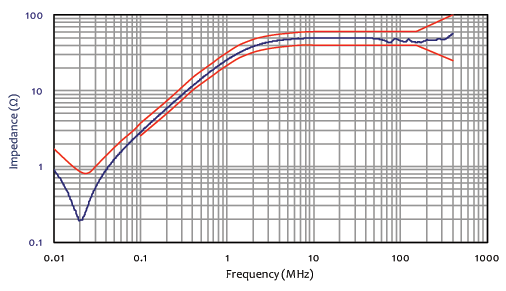
The frequency range is 10 kHz to 400 MHz, covering a wide spectrum for EMC measurements.
-
A 50Ω N-type female RF connector provides a stable and accurate measurement output.
-
The unit supports 50 amperes of current with 480 VAC (50–400 Hz), 270 VAC (800 Hz), and 600 VDC ratings.
-
It uses 5 µH air-core inductors to ensure consistent performance without saturation.
-
Superior Electric SUPERCON® shrouded sockets allow secure connections for mains and EUT wiring.
-
Each unit comes with individual calibration data and a three-year warranty for reliability.
-
Compliant with RTCA DO-160 and MIL-STD-461 standards for conducted emissions testing.
-
Frequency range from 10 kHz to 400 MHz for wide EMC coverage.
-
50Ω N-type female RF connector ensures accurate measurement performance.
-
Handles up to 50 Amperes with AC and DC voltage support.
-
5 µH air-core inductors prevent saturation and maintain stability.
-
Superior Electric SUPERCON® shrouded sockets for safe, reliable connections.
-
Individually calibrated with a certificate for precise results.
-
Three-year manufacturer warranty guarantees product reliability.
Specifications – LI-350 Line Impedance Stabilization Network (LISN)
-
Product Name: Line Impedance Stabilization Network (LISN), Model LI-350
-
Standards Compliance: RTCA DO-160 and MIL-STD-461
-
Application: Power line conducted emissions testing for commercial and military products
-
Frequency Range: 10 kHz to 400 MHz
-
RF Connector: 50Ω N-type (female)
-
Current Rating: 50 Amperes maximum
-
AC Voltage Rating: 480 VAC (50–400 Hz), 270 VAC (800 Hz)
-
DC Voltage Rating: 600 VDC maximum
-
Inductors: 5 µH air-core inductors
-
Mains & EUT Connections: Superior Electric SUPERCON® shrouded sockets
-
Calibration: Individually calibrated with certificate and test data
-
Warranty: Three-year manufacturer warranty
🔍 Not Sure This Is The Right LISN?
Compare all 25 Com-Power LISN models side-by-side with our interactive selection tool. Filter by current, voltage, frequency, and standards to find your perfect match.
Compare All LISN Models →LI-350 DO-160 / MIL-STD-461 Single-Phase LISN FAQs
What is the LI-350 and what type of testing is it designed for?
The LI-350 is a single-conductor, 50Ω, 5 μH Line Impedance Stabilization Network (LISN) designed for power-line conducted emissions compliance testing per RTCA DO-160 and MIL-STD-461 at currents up to 50 amperes. It is the high-power DO-160/MIL-STD-461 5 μH LISN in the Com-Power range, intended for larger aerospace and military equipment exceeding the LI-325C’s 25 A / 270 VAC / 380 VDC ratings — such as high-power avionics power supply units, aircraft galley power systems, military ground vehicle high-power drive electronics, and systems operating from 480 VAC or high-voltage DC bus configurations.
What standards does the LI-350 comply with?
The LI-350 is compliant with RTCA DO-160 (Section 21, conducted emissions for airborne equipment) and MIL-STD-461 (CE101/CE102 conducted emissions for military equipment). Its 5 μH network topology is the LISN configuration specified by both standards, and its extended voltage and current ratings make it appropriate for high-power equipment in modern aircraft and military platforms.
What is the frequency range of the LI-350?
The LI-350 covers 10 kHz to 400 MHz, providing the same frequency coverage as the LI-325C. This covers both the DO-160 Section 21 conducted emissions range and the MIL-STD-461 CE102 range (10 kHz to 10 MHz). The 400 MHz upper limit ensures coverage for modern avionics testing requirements under DO-160G and later.
What is the current rating of the LI-350 and what class of equipment does it support?
The LI-350 is rated at 50 amperes. This supports large aircraft power supply and distribution units, aircraft galley power conversion systems, military ground vehicle main electrical distribution centers, high-power airborne radar and EW system prime power supplies, military shipboard power distribution components, large UAV propulsion power electronics, and military energy storage system power conversion units that exceed the LI-325C’s 25 A limit.
What are the voltage ratings of the LI-350 and what power systems does it support?
The LI-350 supports 480 VAC at 50–400 Hz, 270 VAC at 800 Hz, and 600 VDC. These ratings cover 115 VAC 400 Hz aircraft power, 230 VAC 400 Hz aircraft three-phase power, 270 VDC aircraft HVDC bus, 480 VAC 50/60 Hz military ground and shipboard power, 270 VAC 800 Hz high-frequency military power, and 600 VDC military high-voltage DC bus — making the LI-350 one of the most versatile single-conductor LISNs in the Com-Power aerospace/military range.
Why does the LI-350 use a 5 μH inductor?
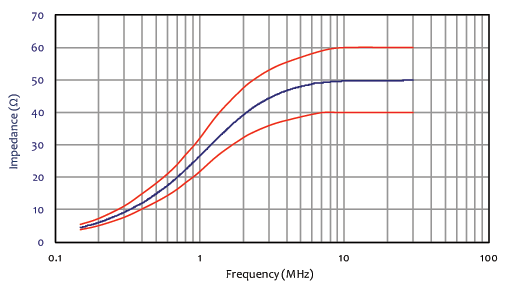
The 5 μH LISN topology is specified by RTCA DO-160 and MIL-STD-461 for aerospace and military conducted emissions testing. It reaches its 50 Ω asymptotic impedance at lower frequencies than a 50 μH commercial LISN, appropriate for the higher-frequency power distribution (400 Hz, 800 Hz) and source impedance characteristics of aircraft and military platforms. Using a 50 μH commercial LISN for DO-160 or MIL-STD-461 testing would produce non-compliant measurements.
The LI-350 is sold as a pair of networks. Why is a pair required?
Conducted emissions compliance requires a LISN in series with each current-carrying conductor simultaneously. One LI-350 is installed in the Line conductor and one in the Neutral (or positive/negative DC). Measurements are performed one conductor at a time with the inactive RF port terminated at 50 Ω. For three-phase systems, a second LI-350 pair accommodates the remaining phase conductors.
What type of connectors does the LI-350 use at the mains and EUT ports?
The LI-350 uses Superior Electric SUPERCON® shrouded sockets at both mains and EUT ports, with color-coded plugs included. At 50 A and up to 480 VAC / 600 VDC, the shrouded design is especially critical for personnel safety given the substantially elevated energy levels compared to typical commercial LISN ratings.
Why is the mounting plate of the LI-350 left unpainted and what grounding is required?
The unpainted mounting plate enables a low-impedance metal-to-metal bond to the DO-160 / MIL-STD-461 bonding plane. At 50 A and voltages up to 480 VAC / 600 VDC, leakage currents through internal capacitors are potentially life-threatening if the earth bond is absent or high-impedance. The mounting plate must be bonded to the bonding plane before any power connection is made.
What RF connector does the LI-350 use?
The LI-350 uses a 50 Ω N-type female RF connector, connecting via 50 Ω coaxial cable to an EMI receiver. The inactive LISN RF port must be terminated at 50 Ω. Com-Power recommends a Transient Limiter between the RF port and receiver — especially important at 50 A and elevated voltages where transient energy is substantially higher than in lower-power configurations.
What insertion loss does the LI-350 provide and how is it applied in post-processing?
The LI-350 uses the same 5 μH network topology as the LI-325C, with insertion loss consistent with a compliant DO-160 / MIL-STD-461 5 μH LISN. The insertion loss correction from individual calibration data must be added to raw receiver readings at each frequency point to obtain actual disturbance voltages, which are compared against applicable DO-160 Section 21 or MIL-STD-461 CE102 limit lines.
How is the LI-350 individually calibrated and what calibration data is supplied?
Every LI-350 is individually calibrated per RTCA DO-160 and MIL-STD-461. Impedance and insertion loss data across the full 10 kHz to 400 MHz range are supplied with a certificate of calibration, verifying impedance against DO-160 and MIL-STD-461 tolerance limits and providing frequency-dependent insertion loss corrections.
What is the warranty coverage for the LI-350?
The LI-350 carries a three-year warranty from Com-Power Corporation. Periodic recalibration on a one- or two-year interval is recommended to maintain traceability for DO-160 and MIL-STD-461 compliance programs.
What are the physical dimensions and weight of the LI-350?
Each LI-350 network measures 15.4 x 7 x 6.6 inches (39.1 x 17.7 x 16.7 cm). A complete single-phase installation requires space for both units on the bonding plane with high-current wiring rated for 50 A at up to 480 VAC or 600 VDC. All wiring must be appropriately insulated for the operating voltage and high-voltage safety procedures must be observed.
How does the LI-350 compare to the LI-325C?
Both use a 5 μH network covering 10 kHz to 400 MHz. The LI-325C is rated at 25 A AC, 270 VAC, 380 VDC. The LI-350 is rated at 50 A, 480 VAC (50–400 Hz), 270 VAC (800 Hz), 600 VDC. Choose the LI-350 when the EUT draws more than 25 A, when the platform voltage exceeds 270 VAC or 380 VDC, when 800 Hz military power is used, or when the DC bus exceeds 380 VDC. For equipment within the LI-325C’s ratings, the LI-325C is the more economical choice.
How does the LI-350 relate to the LI-3100?
The LI-350 (50 A, 5 μH, DO-160/MIL-STD-461, 480 VAC / 600 VDC) and the LI-3100 (100 A forced-air cooling, 5 μH, DO-160/MIL-STD-461F/CISPR 25/CISPR 16-1-2, 480 VAC / 600 VDC) share the same network topology and frequency range but differ in current rating, cooling, and standards coverage. Choose the LI-350 for programs requiring up to 50 A at elevated aerospace/military voltages without forced cooling. Choose the LI-3100 for 100 A programs, forced cooling, or multi-standard coverage including CISPR 25.
What types of equipment cannot be tested with the LI-350?
The LI-350 is not suitable for: equipment exceeding 50 A (use LI-3100); commercial CISPR 16-1-2 / ANSI C63.4 testing (use 50 μH LISNs such as LI-125C or LI-150C); CISPR 25 automotive testing (use LI-550C or LI-3100); or MIL-STD-461 CE102 programs specifically requiring the 50 μH network topology (use LI-400C or LI-4100).
How is the LI-350 used in DO-160 conducted emissions testing of a high-power aircraft galley power conversion system?
Modern wide-body aircraft galley power conversion systems drawing up to 50 A per phase from the 115 VAC 400 Hz aircraft bus require the LI-350 because rated input current exceeds the LI-325C’s limit. The LI-350 pair is installed between the simulated aircraft bus and the galley converter input, operated at rated load. Conducted emissions sweeps from 10 kHz to 400 MHz on Line and Neutral are compared against DO-160 Section 21 limits. The LI-350’s 50 A rating allows full-load testing without derating, ensuring worst-case emissions are captured at maximum operating power.
What does a MIL-STD-461 CE102 test setup using the LI-350 look like for a military ground vehicle power distribution unit?
Military ground vehicles use main power distribution units processing up to 50 A from the 28 VDC or 270 VDC vehicle bus. The LI-350 pair is bonded to the MIL-STD-461 reference bonding plane; the vehicle DC supply connects to mains inputs and the power distribution unit to EUT outputs. With the mains port open per the 5 μH MIL-STD-461 configuration, CE102 sweeps from 10 kHz to 10 MHz on both bus conductors are compared against MIL-STD-461F CE102 limits. The 50 A continuous rating allows testing at maximum rated current representing the vehicle’s worst-case electronic load.
How is the LI-350 applied in conducted emissions testing of a high-power airborne radar transmitter power supply?
High-power airborne radar transmitter power supplies drawing up to 50 A from the aircraft 270 VDC or 115 VAC 400 Hz bus require the LI-350 due to current limits. The LI-350 pair is set up between the simulated aircraft power bus and the radar power supply input, operated with a representative radar load. Multiple operating modes (standby, low-power, full transmit) are tested to identify worst-case conducted emissions, since radar transmitter power supplies often generate different noise spectra at different power levels due to changes in converter switching pattern and load magnitude.
How does the LI-350 support MIL-STD-461 conducted emissions testing on an 800 Hz high-frequency military power system?
Some military systems use 800 Hz AC power distribution to reduce transformer and inductor size. The LI-350’s 270 VAC rating at 800 Hz makes it one of the very few LISNs in the industry capable of supporting conducted emissions testing on 800 Hz military power systems — the LI-325C is not rated for 800 Hz operation. CE102 sweeps from 10 kHz to 10 MHz with the LI-350 capture the 800 Hz fundamental and harmonics appearing as discrete spectral lines within the CE102 measurement band, compared against MIL-STD-461 CE102 limits.


Quote Request
Other EMC Test Equipment
- Absorbing Clamps
- Antenna Kits
- Antenna Masts - Automated and Manual
- Antennas
- Bulk Current Injection probes
- CDNs - Coupling Decoupling Network
- Comb Generators
- Conducted Immunity Test Systems
- Current Monitor Probes
- Current Probe Calibration Fixtures
- EM Clamps
- Feed Through Capacitor
- ISNs - Impedance Stabilization Network
- LISNs - Single Phase
- LISNs - TEMPEST
- LISNs - Three Phase
- Magnetic Field Generator
- Near Field Probes
- Power Amplifiers
- Pre-compliance Emissions Test Systems
- Preamplifiers
- Spectrum Analyzers
- Surge Generators
- System Controllers
- Transient Limiters
- Tripods For EMC
- Turntables