
ACL-6000 CombiLog Hybrid EMI Test Antenna
- Covers 30 MHz–6 GHz as a receiving antenna for broadband radiated emissions measurements.
- Operates 80 MHz–6 GHz as a transmitting antenna for radiated immunity and RF susceptibility testing.
- Hybrid CombiLog antenna architecture combining biconical and log-periodic elements to achieve stable wideband performance with linear polarization.
- Enables radiated emissions compliance testing per FCC, CISPR, EN, and ETSI standards across a single broadband antenna platform.
- Supports radiated immunity testing from 80 MHz–6 GHz, including IEC 61000-4-3 electric-field immunity testing and RF susceptibility evaluations.
- Provides accurate broadband measurements in semi-anechoic chambers and open area test sites used for EMC certification testing.
- Suitable for EMC site validation tasks such as chamber comparisons, site surveys, and normalized site attenuation verification.
- Effective for shielding effectiveness testing of large enclosures, cabinets, and equipment racks requiring wideband RF illumination.
- Supports field monitoring, diagnostic EMC troubleshooting, and antenna substitution measurements during compliance investigations.
- Ideal for qualification testing of consumer, industrial, automotive, IT, and medical electronic systems requiring broadband EMI/EMS antenna coverage.
Features
- ▸ Extended-band hybrid coverage — covers 30 MHz to 6 GHz as a receiving antenna and 80 MHz to 6 GHz as a transmitting antenna in a single assembly, reaching well into the microwave band that older CombiLog designs cannot cover.
- ▸ Hybrid log-periodic / biconical design — combines a log-periodic structure with low-frequency elements integrated into the feed lines, providing the bandwidth advantages of both antenna types in one assembly without the dead bands of conventional antenna swaps.
- ▸ Common-mode chokes installed — suppress common-mode currents flowing on the outer conductor of the coaxial feed/receive cable, reducing measurement uncertainty caused by cable-borne pickup.
- ▸ Frequency-dependent power handling for immunity testing — supports input power levels that vary with frequency for radiated immunity testing across the full transmit band; refer to the maximum input power graph for exact values at each frequency.
- ▸ Tight balance/symmetry per CISPR 16-1-4 — antenna symmetry held to better than ±1 dB, complying with the balance requirements of ANSI C63.5 and CISPR 16-1-4.
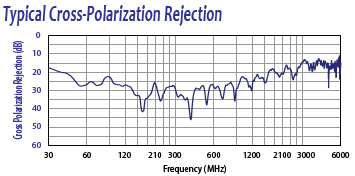
- ▸ Good cross-polarization performance — high cross-polarization rejection across the operating band minimizes measurement error caused by orthogonal-polarization field components.
- ▸ Detailed pattern characterization — supplied with E-plane and H-plane radiation pattern data at 14 frequencies from 30 MHz to 6 GHz, supporting accurate field-uniformity calculations during chamber commissioning and immunity test setup.
- ▸ Transmit and receive capability — functions as a receiving antenna for emissions testing and as a transmitting antenna for radiated immunity testing using the same hardware.
- ▸ Compact for the bandwidth it covers — weighs only 11 lbs (5 kg), making it lighter and more manageable than typical wideband antennas covering similar frequency ranges.
- ▸ Regulatory compliance applications — suitable for qualification-level measurements per FCC, CISPR, EN, ETSI, and other major commercial EMC standards.
- ▸ General-purpose RF utility — useful for shielding effectiveness testing, site comparisons, field monitoring, and site surveys beyond formal compliance work.
- ▸ Individually calibrated, NIST-traceable — calibrated per ANSI C63.5; calibration data and certificate ship with each unit; ISO 17025 accredited calibration available on request.
- ▸ Three-year standard warranty — backed by manufacturer support.
Specifications
| Product Name | CombiLog Hybrid Antenna |
|---|---|
| Model | ACL-6000 |
| Frequency Range | 30 MHz to 6 GHz (receive / emissions); 80 MHz to 6 GHz (transmit / immunity) |
| Polarization | Linear |
| Antenna Symmetry (Balance) | < ±1 dB |
| Cross-Polarization Rejection | See typical cross-polarization rejection graph |
| Nominal Impedance | 50 Ω |
| Maximum Input Power | See maximum input power vs. frequency graph (frequency-dependent) |
| Connector | N-type (female) |
| Antenna Factor | See typical antenna factor graph |
| Isotropic Gain | See typical isotropic gain graph |
| VSWR | See typical VSWR graph |
| -3 dB Beamwidth | See typical -3 dB beamwidth graph |
| Maximum Radiated Field | See typical forward power level graph (CW and 80% AM) |
| Antenna Patterns | E-plane (horizontal) and H-plane (vertical) patterns supplied at 30 MHz, 50 MHz, 90 MHz, 150 MHz, 200 MHz, 250 MHz, 500 MHz, 1 GHz, 2 GHz, 2.5 GHz, 3 GHz, 3.5 GHz, 4 GHz, 4.5 GHz, 5 GHz, 5.5 GHz, and 6 GHz |
| Applicable Standards | FCC, CISPR, EN, ETSI, etc. |
| Calibration | Individually calibrated per ANSI C63.5, NIST traceable |
| Dimensions (H × W × D) | 45.3" × 18.9" × 51.6" [1150 × 480 × 1310 mm] |
| Weight | 11 lbs [5 kg] |
All values are typical, unless specified. All specifications are subject to change without notice.


.png)

| Title | Link |
|---|---|
| ACL-6000 Antenna Datasheet | View PDF |
🔍 Not Sure Which Antenna You Need?
Compare all Com-Power antenna models side-by-side with our interactive selection tool. Filter by frequency range, antenna category, application, polarization, and power handling to find your perfect match.
Compare All Antenna Models →ACL-6000 CombiLog Hybrid EMI Test Antenna – Frequently Asked Questions
1. What is the ACL-6000 CombiLog hybrid EMI test antenna and what is it designed for?
The ACL-6000 CombiLog hybrid EMI test antenna is a wideband hybrid biconical log antenna designed to cover 30 MHz to 6 GHz as a receiving antenna for radiated emissions measurements and 80 MHz to 6 GHz as a transmitting antenna for radiated immunity and RF susceptibility testing. It combines biconical and log-periodic behavior into a single antenna platform so that one antenna can cover a much wider EMC range than traditional separated antenna approaches. In real EMC environments, this is valuable because modern products often require radiated evaluation well above earlier legacy frequency ranges. The ACL-6000 is built for that broader need. :contentReference[oaicite:11]{index=11}
2. Why is 30 MHz to 6 GHz coverage important in modern EMC testing?
Modern electronic systems generate emissions and face susceptibility risks across a much wider spectrum than older products. Wireless devices, embedded radios, digital buses, high-speed processors, switching supplies, automotive electronics, medical electronics, and industrial control systems can all create or react to RF energy far above 1 GHz. A 6 GHz EMC antenna like the ACL-6000 helps labs avoid coverage gaps across important radiated test bands. This is especially useful when testing newer products that combine conventional electronics with wireless or high-speed digital functions, because the radiated EMC profile can span from tens of megahertz into the multi-gigahertz region. :contentReference[oaicite:12]{index=12}
3. How does the ACL-6000 differ from the AC-220 CombiLog antenna?
The main difference is bandwidth. The AC-220 is designed for emissions up to 2 GHz, while the ACL-6000 extends coverage up to 6 GHz. That added upper range makes the ACL-6000 better suited for modern wideband EMC qualification programs, especially where products must be evaluated well beyond traditional commercial bands. The ACL-6000 is therefore the more future-ready choice when a lab wants a wideband combilog antenna that can support both legacy radiated work and higher-frequency product evaluations in one platform.
4. How does the ACL-6000 compare with separate biconical, log periodic, and horn antennas?
A separate biconical antenna is typically used for lower radiated bands, a log periodic antenna for higher broadband work, and a horn antenna for even higher frequencies where greater directivity and gain are needed. The ACL-6000 sits between those traditional categories by covering a very wide range in one structure. It does not eliminate every possible reason to use a horn, especially in specialized high-field or very directional setups, but it greatly reduces the need for multiple broadband antennas across mainstream radiated EMC work. For many labs, that means fewer antenna changes, fewer setup transitions, and more efficient use of chamber time.
5. What are the biggest real-world workflow advantages of the ACL-6000?
The ACL-6000 helps simplify radiated testing in practical ways. It reduces antenna swaps, minimizes cable reconnections, lowers the chance of setup error, and makes repeated full-band scans more efficient. This matters in production labs, certification labs, design validation teams, and troubleshooting environments where many measurements must be repeated quickly and consistently. Because the antenna covers such a broad range, it can also help labs standardize more of their workflow around a single antenna platform instead of keeping several overlapping antennas mounted, calibrated, and ready.
6. What standards and measurement frameworks is the ACL-6000 intended to support?
The ACL-6000 is described as suitable for FCC, CISPR, EN, ETSI, and IEC 61000-4-3 applications. It also meets ±1 dB antenna symmetry and balance requirements per ANSI C63.5 and CISPR 16-1-4. This is important because it positions the antenna for both compliance and advanced engineering use across multiple industries. In practical terms, it supports emissions measurements, immunity testing, shielding evaluations, site surveys, and broader EMC qualification work for a wide range of products. :contentReference[oaicite:14]{index=14}
7. How is the ACL-6000 used for radiated emissions measurements?
In receive mode, the ACL-6000 is used as a broadband EMI EMC antenna to capture electromagnetic energy emitted by the equipment under test. The received signal is then measured by an EMI receiver or spectrum analyzer and converted into field strength using calibration data. Because the ACL-6000 spans a very wide band, it is especially useful when engineers want to perform wide sweeps with one antenna instead of splitting the job across several antennas. This can help speed up scans and reduce test interruptions during troubleshooting or formal measurements.
8. How is the ACL-6000 used for radiated immunity and RF susceptibility testing?
In transmit mode, the ACL-6000 operates from 80 MHz to 6 GHz and can be driven by an RF amplifier to generate controlled fields for immunity or susceptibility testing. This is useful for IEC 61000-4-3 style testing and for broader engineering evaluations where products must demonstrate reliable operation while exposed to external RF fields. In real applications, this can include testing industrial electronics, automotive modules, medical devices, IT equipment, and consumer products to ensure they continue functioning properly under RF stress. :contentReference[oaicite:15]{index=15}
9. Why is linear polarization important on the ACL-6000?
The ACL-6000 is a linearly polarized antenna, which is important because EMC measurements often depend strongly on antenna orientation. Radiated emissions can change with equipment orientation, cable routing, or structural geometry, and immunity tests may need defined field orientations to match standard requirements. Linear polarization supports controlled testing and helps ensure consistent data collection. This is particularly important in compliance work where antenna rotation and orientation are part of the measurement discipline rather than an afterthought.
10. What does high cross-polarization rejection mean, and why does it matter?
High cross-polarization rejection means the antenna is better at rejecting unwanted orthogonal polarization components. This matters because it improves measurement purity and reduces the chance that the antenna will respond strongly to fields outside the intended polarization orientation. In EMC testing, this supports more accurate radiated measurements and cleaner field generation. The ACL-6000 highlights this as a feature, which is a good sign that the antenna is intended for serious measurement work rather than only general-purpose RF observation. :contentReference[oaicite:16]{index=16}
11. What kinds of real-world products are good candidates for testing with the ACL-6000?
The ACL-6000 is suitable for consumer electronics, industrial electronics, automotive electronics, IT systems, and medical devices. It is especially useful where products have broad radiated signatures or where one program must evaluate many different product types under multiple EMC standards. This includes devices with switching supplies, display electronics, wireless functions, control processors, embedded communications, and high-speed digital interfaces that can create emissions into the multi-gigahertz region. :contentReference[oaicite:17]{index=17}
12. Can the ACL-6000 be used for shielding effectiveness testing, site surveys, and NSA-related work?
Yes. The ACL-6000 is described as suitable for shielding effectiveness measurements, site surveys, and NSA-related EMC tasks. That makes it more than just a product test antenna. In practice, labs often need one antenna that can support chamber investigations, site comparison work, enclosure evaluations, and field diagnostics in addition to formal product testing. Because the ACL-6000 covers such a broad band, it can be a practical choice for engineers who want one antenna to support a wider range of EMC lab activities.
13. Why do ANSI C63.5 calibration and NIST traceability matter for the ACL-6000?
The ACL-6000 is individually calibrated per ANSI C63.5 with NIST traceability, and optional ISO 17025 accredited calibration is also available. This is important because broadband antennas need reliable antenna factor and performance data if they are to be used for serious compliance work. NIST traceability strengthens confidence in the calibration chain, while ISO 17025 options can support formal quality system requirements and accredited lab workflows. In other words, this is not just about hardware performance; it is also about making sure the measurement is traceable, defensible, and accepted in regulated environments. :contentReference[oaicite:18]{index=18}
14. What mechanical and RF interface details matter for the ACL-6000 in daily use?
The ACL-6000 uses a 50 ohm nominal impedance and an N-type female connector, both of which are standard and practical for EMC labs. It is also a physically larger antenna, with approximate dimensions around 1310 mm length, 1150 mm width, and 900 mm depth, and a weight in the 8 to 9 kg class. These details matter because large wideband antennas require stable mounting, proper mast integration, and thoughtful chamber handling. A lab considering the ACL-6000 should think not only about frequency coverage, but also about how it will be mounted, rotated, stored, and positioned consistently during repeated test programs. :contentReference[oaicite:19]{index=19}
15. When is the ACL-6000 a better choice than a narrower-band antenna strategy?
The ACL-6000 is a better choice when the lab values broad coverage, fewer setup changes, and the ability to support both emissions and immunity workflows over a very wide frequency range. It is especially useful in multi-product environments, R&D validation, and modern compliance programs where products must be examined over large bands and where efficiency matters. A narrower-band strategy may still make sense if the lab has very specialized high-gain needs or highly segmented workflows, but for many modern EMC programs the ACL-6000 offers a strong balance of breadth, practicality, and standards-oriented performance.
16. Why would an EMC lab choose the ACL-6000 as a long-term antenna investment?
An EMC lab may choose the ACL-6000 because it offers broad frequency coverage, dual receive/transmit capability, standards-oriented symmetry performance, linear polarization, high cross-polarization rejection, recognized calibration options, and practical usefulness across many EMC applications. As products continue to evolve toward broader RF complexity and higher operating speeds, labs increasingly benefit from antenna platforms that can keep pace. The ACL-6000 is that kind of antenna: a wideband EMI EMC antenna designed not only for today’s compliance tasks, but also for broader modern EMC workflows.
Application Notes (PDF)
- AN-107 — What is Antenna Factor?
- AN-106 — Use of Antenna Factor for EMC Measurements
- Selecting the Right EMI Antenna
- Considerations when Selecting an Antenna for RF Immunity Testing
- EMC Antenna Calibration Requirements, Methodologies, and Best Practices
- NIST Antenna Calibration Services — Com-Power Capabilities and Traceability
- Com-Power EMC Antenna Product Line — Complete Specifications
- Accounting for Ambient Noise
Interactive Tools
- Antenna Finder Wizard
- Com-Power Antenna & Field Strength Calculator
- Com-Power EMC Compliance Limits Calculator
- Com-Power Cable Loss & Attenuation Calculator
- Com-Power VSWR / Return Loss / Mismatch Loss Calculator
- Com-Power Free Space Path Loss & Link Budget Calculator
Industry Applications
- EMC Considerations for IoT and Smart Home Devices
- Automotive EMC Testing — ISO 11452 / CISPR 25
- 5G Equipment EMC Testing — New Challenges in EMC Compliance
- Medical Device EMC Compliance — IEC 60601-1-2 Essentials
- EV Charging Systems — EMC Requirements and Compliance
Blog Articles

Quote Request
Other EMC Test Equipment
- Absorbing Clamps
- Antenna Kits
- Antenna Masts - Automated and Manual
- Antennas
- Bulk Current Injection probes
- CDNs - Coupling Decoupling Network
- Comb Generators
- Conducted Immunity Test Systems
- Current Monitor Probes
- Current Probe Calibration Fixtures
- EM Clamps
- Feed Through Capacitor
- ISNs - Impedance Stabilization Network
- LISNs - Single Phase
- LISNs - TEMPEST
- LISNs - Three Phase
- Magnetic Field Generator
- Near Field Probes
- Power Amplifiers
- Pre-compliance Emissions Test Systems
- Preamplifiers
- Spectrum Analyzers
- Surge Generators
- System Controllers
- Transient Limiters
- Tripods For EMC
- Turntables