
AH-8055 High Power Horn Antenna
-
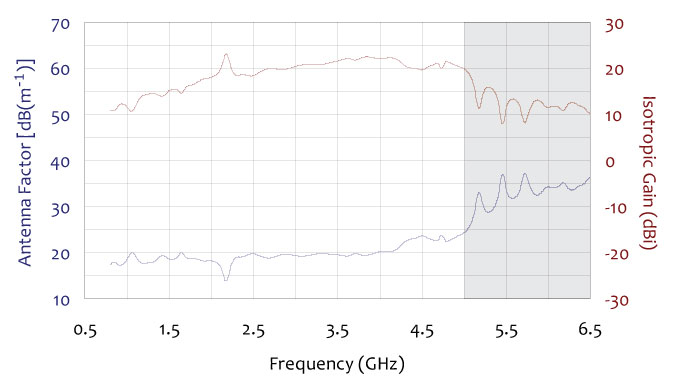
The AH-8055 is a high-gain, broadband horn antenna operating from 800 MHz to 5 GHz, with usable performance up to 6.5 GHz.
-
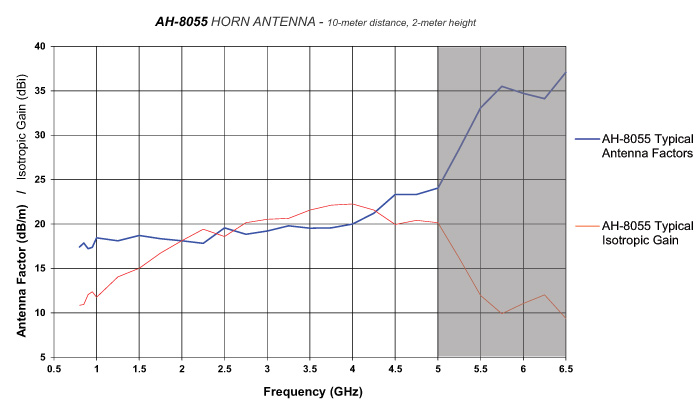
It features high isotropic gain, increasing from over 10 dBi at 800 MHz to over 20 dBi between 3 and 5 GHz.
-
The antenna supports both transmitting and receiving functions for EMC testing applications.
-
Each unit includes individual calibration per ANSI C63.5 or SAE ARP958 with NIST traceability.
-
The AH-8055 is built from high-grade aluminum with a corrosion-resistant conductive coating for indoor and outdoor durability.
-
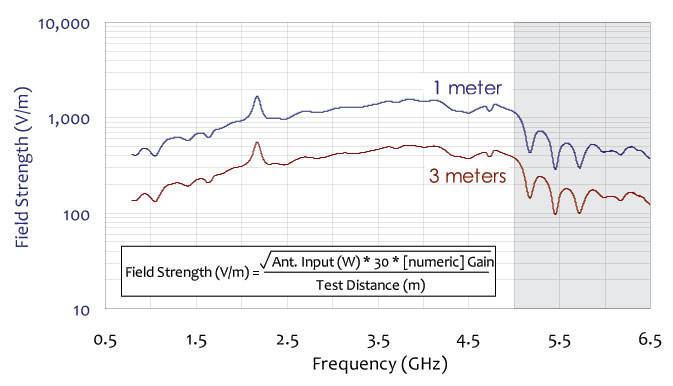
It is capable of handling continuous power levels up to 450 watts, generating field strengths as high as 1,670 V/m at 1 meter.
-
The antenna can also be used for chamber characterization, shielding effectiveness tests, field monitoring, and site surveys.
-
It includes mounting options for vertical and horizontal orientations with recommended support via Com-Power’s AT-220 Tripod.
-
The AH-8055 is ideal for high-field-strength applications in immunity testing with efficient performance and rugged design.
Features
- ▸ Extreme field strength capability — up to 1,670 V/m at 1 m — with 450 W input the AH-8055 generates field strengths far above commercial immunity requirements, targeting automotive safety-critical systems (ABS, airbag, steering) and aerospace HIRF testing.
- ▸ High-gain broadband 800 MHz to 5 GHz design (usable to 6.5 GHz) — one antenna covers cellular bands, ISM, all WiFi 2.4/5/6 GHz, and 5G FR1 sub-6 GHz immunity in a single sweep.
- ▸ High isotropic gain: 10.6 to 23.1 dBi — gain rises with frequency, peaking above 22 dBi between 2–4 GHz; significantly higher than standard double-ridge horns in this band, dramatically reducing the amplifier power needed to reach a target field strength.
- ▸ 450 W CW power handling — sustains 450 watts continuous wave at the N-type input, enabling automotive ISO 11452-2 200 V/m immunity testing and DO-160 Category Z extreme HIRF.
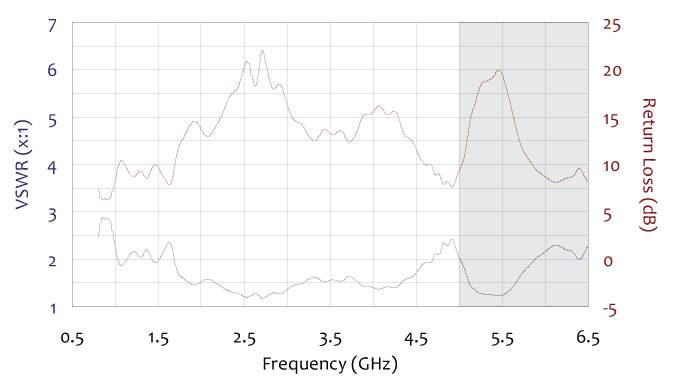
- ▸ Low average VSWR (1.69:1) — flat impedance match across the band protects high-power amplifiers from reflected energy during high-field immunity testing.
- ▸ Precision N-type female connector — rated for the antenna's full power and frequency range; standard coaxial interface eliminates waveguide setup complexity.
- ▸ Two mounting holes — separate 1/4″-20 threaded holes for vertical and horizontal polarization, enabling fast polarization changes during automotive and military immunity sweeps.
- ▸ Heavy-grade aluminum with corrosion-resistant conductive coating — built for daily lab use indoors and outdoors, including continuous OATS exposure under extreme weather conditions.
- ▸ Transmit and receive capable — primarily designed as a transmitting antenna for high-power immunity testing, and equally suitable as a receiving antenna for radiated emissions measurements in the same band.
- ▸ High-power immunity standards covered — supports IEC 61000-4-3, ISO 11452-2 (automotive), MIL-STD-461 RS103, RTCA DO-160 Section 20, and CISPR 16-1-4 SVSWR site validation.
- ▸ Calibrated per SAE ARP-958, 1-meter gain calibration — individually calibrated with NIST traceability; calibration certificate and antenna factor data ship with each unit; ISO 17025 accredited calibration available on request.
- ▸ Three-year standard warranty — backed by manufacturer support.
Specifications
| Product Name | High Gain Horn Antenna |
|---|---|
| Frequency Range | 800 MHz to 5 GHz (usable up to 6.5 GHz) |
| Polarization | Linear |
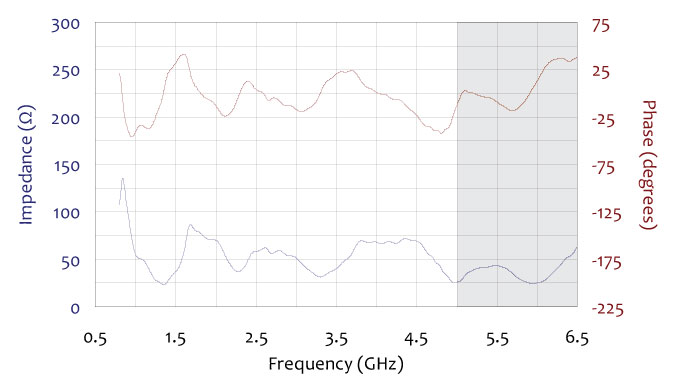
| Nominal Impedance | 50 Ω |
| Power Handling | 450 Watts (continuous) |
| Connector | Precision N-type (female) |
| Antenna Factor | 13.8 to 24.2 dB(m-1) [average: 19.7] |
| Isotropic Gain | 10.6 to 23.1 dBi |
| VSWR (Antenna Port) | 1.17 to 2.88 : 1 [average: 1.69] |
| Return Loss (Antenna Port) | 6.3 to 22 dB [average: 13] |
| Maximum Field Strength | ~1,670 V/m at 1 m (with 450 W input) |
| Radiated Field Strength | See typical field strength graph |
| -3 dB Beamwidth | See typical beamwidth graph (E-plane and H-plane) |
| Calibration | Individually calibrated per SAE ARP-958 (1-meter gain), NIST traceable |
| Mounting | Two 1/4″-20 threaded holes (vertical & horizontal polarization) |
| Applicable Standards | FCC, CISPR, EN, ETSI, FAA, MIL-STD-461, ISO 11452, IEC 61000-4-3, RTCA DO-160, SAE |
| Dimensions (H × W × D) | 17.2″ × 18″ × 27.2″ [43.7 × 45.7 × 69.1 cm] |
| Weight | 20.5 lbs [9.3 kg] |
All values are typical, unless specified. All specifications are subject to change without notice.
🔍 Not Sure Which Antenna You Need?
Compare all Com-Power antenna models side-by-side with our interactive selection tool. Filter by frequency range, antenna category, application, polarization, and power handling to find your perfect match.
Compare All Antenna Models →AH-8055 High-Gain Double Ridge Horn Antenna — Frequently Asked Questions
1. What is the Com-Power AH-8055 and what is it primarily used for?
The AH-8055 is a high-gain, broadband double ridge guide horn antenna covering 800 MHz to 5 GHz, with usable performance up to 6.5 GHz. It is primarily used as a transmit antenna for radiated immunity (RF susceptibility) testing per standards such as IEC 61000-4-3, ISO 11452-2, RTCA DO-160 Section 20, and MIL-STD-461 RS103. Its high isotropic gain — rising from >10 dBi at 800 MHz to >20 dBi between 3 and 5 GHz — delivers very high field strengths with modest amplifier power. The AH-8055 can also be used as a receive antenna for emissions measurements, chamber characterization, shielding effectiveness, and site surveys.
2. What are the AH-8055’s key electrical and mechanical specifications?
Frequency: 800 MHz – 5 GHz (specified), usable to 6.5 GHz. Gain: >10 dBi at 800 MHz, rising to >20 dBi in the 3–5 GHz band. Max continuous power: 450 W CW. Field strength: up to 1,670 V/m at 1 m with 450 W drive. Connector: N-female (50 Ω). Polarization: linear (mountable vertical or horizontal). Construction: high-grade aluminum with corrosion-resistant conductive coating for indoor/outdoor use. Size: 17″ × 17″ × 27.5″ (43.1 × 43.1 × 69.8 cm). Weight: 19.5 lbs (8.8 kg). Calibration: individual per ANSI C63.5 or SAE ARP958 with NIST traceability; ISO 17025 available on request.
3. Why are high-field antennas necessary for RF immunity testing?
Several immunity standards demand field strengths well above commercial thresholds. Automotive standards routinely specify 100 V/m or 200 V/m (with some component-level tests reaching 600 V/m or higher). MIL-STD-461 RS103 requires up to 200 V/m and DO-160 Section 20 can require similar levels, with some variants higher. Generating these fields with a conventional horn may require a prohibitively large power amplifier. The AH-8055’s high isotropic gain lets labs reach these levels with significantly smaller amplifiers — a 250 W amplifier into an AH-8055 can produce stronger fields than a 500 W amplifier into a lower-gain horn.
4. Which EMC standards can the AH-8055 be used for?
The AH-8055 is appropriate for the upper-frequency portion of a wide range of radiated RF immunity and emissions standards:
• IEC 61000-4-3 (commercial radiated RF immunity, 80 MHz–6 GHz)
• ISO 11452-2 (automotive radiated immunity, ALSE method)
• MIL-STD-461 RS103 (military radiated susceptibility, up to 18 GHz; AH-8055 covers the 800 MHz–5 GHz segment)
• RTCA DO-160 Section 20 (airborne equipment radiated susceptibility)
• CISPR 25 (automotive component emissions, where immunity pre-screening is also performed)
• ETSI EN 301 489 series (wireless equipment immunity)
• FCC/ISED wireless device certification pre-screening
5. How does the AH-8055 achieve such high field strengths?
Three factors combine: (1) High isotropic gain (20 dBi peak) — a 20 dBi antenna focuses 100× the energy of an isotropic radiator onto the target axis. (2) Optimized double ridge waveguide geometry — ridges lower the waveguide’s cutoff frequency and flatten impedance across 800 MHz–5 GHz, minimizing VSWR-related reflection loss so more amplifier power reaches the aperture. (3) Robust mechanical and thermal design — aluminum construction and 450 W continuous rating let it sustain the drive levels needed for standard dwell times without derating. The governing relation is E ≈ √(30·P·G) / d, so doubling gain raises field strength by 41 % at fixed power, and 450 W at 20 dBi at 1 m gives roughly 1,670 V/m.
6. What real-world systems and products benefit from AH-8055 testing?
• Automotive safety-critical electronics: ABS controllers, airbag ECUs, electric power steering, battery management systems, ADAS sensors, keyless entry modules, electric vehicle inverters and chargers
• Aerospace and avionics: flight control computers, fly-by-wire actuators, navigation and communication radios, radar altimeters, cabin and cargo management systems
• Defense electronics: C4ISR equipment, radio/SATCOM terminals, ground vehicle electronics, unmanned platforms
• Medical devices: infusion pumps, patient monitors, imaging equipment, implantable-device programmers (per IEC 60601-1-2)
• Industrial automation and IoT: PLCs, motor drives, safety relays, factory-floor wireless gateways, 4G/5G industrial modems
• Wireless products: cellular (LTE/5G sub-6 GHz), Wi-Fi (2.4 & 5 GHz), Bluetooth, Zigbee device immunity verification
7. How does the AH-8055 compare with the Com-Power AH-118?
The AH-118 is a general-purpose double ridge horn covering 700 MHz–18 GHz with 300 W continuous power handling. The AH-8055 covers a narrower 800 MHz–5 GHz but is optimized for high-field generation with 450 W power handling and higher gain in the 3–5 GHz range. Choose AH-118 when you need wider frequency coverage (up through Ku-band) and more moderate field strengths. Choose AH-8055 when you need maximum field strength in the sub-6 GHz range — such as automotive 200 V/m at 5 GHz, MIL-STD-461 RS103 at 200 V/m, or aerospace DO-160 high-level categories — without purchasing a larger amplifier. Many labs own both: AH-8055 for high-field sub-6 GHz, AH-118 for everything above 5 GHz.
8. How does the AH-8055 compare with log-periodic and ridge-guide horn alternatives?
A log-periodic (e.g., Com-Power ALP-100) at 200 MHz–1 GHz has gain of 6–8 dBi — far below the AH-8055’s 10–20 dBi. To hit the same field strength a log-periodic needs roughly 10× more amplifier power. Compared with competing double ridge horns (e.g., A.H. Systems SAS-571, ETS-Lindgren 3117), the AH-8055’s 450 W continuous rating and 1,670 V/m capability place it among the highest-power broadband horns in its frequency class. Its tradeoff — 5 GHz specified upper limit vs. 18 GHz for full-range horns — is intentional: optimization for field strength in the most-used immunity band rather than compromise for wider coverage.
9. How much amplifier power do I need to hit common immunity test levels?
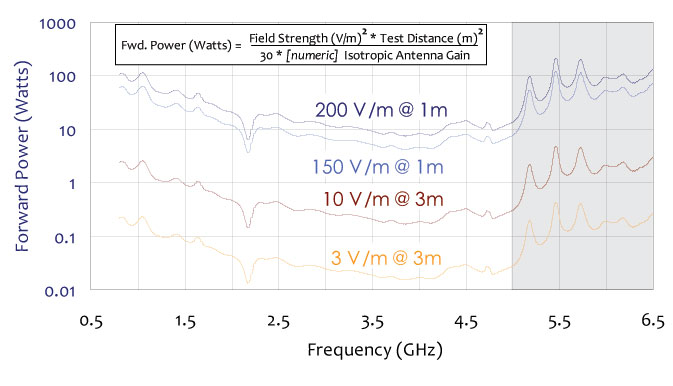
Using E ≈ √(30·P·G) / d at 1 m and 20 dBi gain:
• 10 V/m (IEC 61000-4-3 Level 3): ~0.03 W — a 5 W amp is enough with margin
• 30 V/m (industrial, residential wireless): ~0.3 W
• 100 V/m (automotive standard): ~3 W — a 25–50 W amp with headroom
• 200 V/m (automotive high-severity, MIL-STD-461 RS103): ~13 W — 100 W amp with margin
• 600 V/m (automotive component severe): ~120 W
• 1,670 V/m (maximum practical): 450 W (probe-compression-free ceiling)
Add 3–6 dB of amplifier headroom above the calculated value to cover VSWR, cable loss, modulation crest factor, and standard-mandated field uniformity requirements. Gain at 800 MHz is lower (10 dBi), so more power is needed at the low end.
10. What is antenna gain in dBi and why does it matter for immunity testing?
Gain (dBi) measures the antenna’s directivity relative to an ideal isotropic radiator. A 20 dBi antenna concentrates 100× the power density on its main axis compared with isotropic. In immunity testing this has three consequences: (1) smaller amplifier — gain and amplifier power both contribute equally (in dB) to field strength, so +10 dB of gain replaces a 10× amplifier upgrade; (2) reduced power dissipation in the chamber — lower stray fields and cooler setup; (3) better repeatability — a narrower main beam is less affected by chamber reflections. The AH-8055’s gain is specified and calibrated across frequency so your measurement software can correct for it in both transmit and receive modes.
11. How does directivity improve test reliability and efficiency?
Directivity focuses the generated RF energy onto the EUT (equipment under test) and away from chamber walls, reducing multi-path reflections that would otherwise cause field-uniformity ripple. This helps meet the ±0 to +6 dB uniformity window required by IEC 61000-4-3 and the 16-point/12-of-16 uniform field area specification. It also means the EUT sees the intended field level, while other sensitive equipment in or near the chamber sees lower levels — useful when testing networked systems where ancillary hardware must continue functioning normally during the exposure.
12. What are the setup and configuration requirements?
• Mounting: place on a non-conductive tripod (Com-Power AT-220 or equivalent) at the standard height (typically 1.5 m). Vertical and horizontal polarization mounts supported.
• Distance: 1 m or 3 m per the applicable standard, measured from the antenna aperture reference plane to the EUT.
• Cable: use low-loss 50 Ω coax (RG-214, LMR-400, or better) to minimize forward-power loss at the antenna’s upper frequencies.
• Chamber: semi-anechoic or fully-anechoic chamber with absorber covering direct and specular-reflection surfaces.
• Field probe: place a calibrated isotropic E-field probe at the EUT location to close-loop the test level.
• Load check: verify low VSWR (< 2:1 typical) before driving at full amplifier power to prevent reflected energy damaging the amplifier.
13. Why is antenna calibration critical and what does “NIST-traceable” mean?
Calibration produces an antenna factor (AF) or gain table across frequency that converts between receiver voltage and incident E-field (for receive) or amplifier output and generated E-field (for transmit). Without accurate calibration, you cannot prove the EUT was exposed to the required test level. NIST-traceable means the calibration equipment’s calibrations chain back through an unbroken sequence of comparisons to National Institute of Standards and Technology primary standards — the legal basis for compliance test reports. Com-Power calibrates every AH-8055 individually per ANSI C63.5 (site method) or SAE ARP958 (two-antenna method) with NIST traceability. ISO 17025 accredited calibration is available on request for labs whose accreditation bodies require it.
14. How does the AH-8055 improve lab efficiency and lower cost of ownership?
Four ways: (1) Smaller amplifier requirement — the AH-8055’s 20 dBi gain can replace a 2×-to-4×-larger amplifier investment, and high-power broadband amplifiers are typically the single most expensive item in an immunity test setup. (2) Reduced cooling load — less amplifier dissipation means simpler chamber thermal management. (3) Single antenna for both emissions and immunity — 800 MHz–5 GHz covers the most-tested band, reducing antenna-swap time during mixed test sequences. (4) Outdoor-rated construction — the corrosion-resistant coating supports occasional open-area test site use without a separate outdoor antenna.
15. What are the AH-8055’s key design advantages over lower-gain or narrower-band alternatives?
• Exceptional gain (10–20 dBi across 800 MHz–5 GHz) — the most critical spec for high-field work
• 450 W continuous power handling — supports the long dwell times common in automotive and military testing
• 1,670 V/m @ 1 m field capability — one of the highest in its class
• Usable to 6.5 GHz beyond the specified 5 GHz top — useful for 5G n78/n79 and Wi-Fi 6E pre-screening
• Low VSWR and well-controlled impedance — protects the amplifier and minimizes forward-power loss
• Robust aluminum/corrosion-resistant construction — survives production-lab and occasional outdoor use
• Individual NIST-traceable calibration included; ISO 17025 optional
• Both transmit and receive capable — one antenna serves immunity and emissions needs in the band
16. When should engineers select the AH-8055 over other Com-Power antennas?
Select the AH-8055 when any of the following is true:
• You are performing radiated RF immunity testing at field strengths ≥ 100 V/m in the 800 MHz–5 GHz band (automotive, aerospace, defense, or medical)
• You need to hit MIL-STD-461 RS103, ISO 11452-2, DO-160 Section 20, or IEC 61000-4-3 Level 4 without purchasing a larger amplifier
• Your test covers cellular LTE/5G sub-6 GHz, Wi-Fi 2.4/5 GHz, Bluetooth, or Zigbee immunity verification
• You are performing chamber characterization, shielding effectiveness, or site surveys in the 800 MHz–6.5 GHz range
• You need a single high-gain horn to replace both a log-periodic (narrower immunity band) and a lower-power horn
Choose a different antenna if your testing is centered on lower frequencies (use a biconical or log-periodic) or extends above 6.5 GHz (use AH-118 for 700 MHz–18 GHz, or mm-wave horns such as AH-826 or AH-840 for 18–40 GHz).
Application Notes (PDF)
- AN-107 — What is Antenna Factor?
- AN-106 — Use of Antenna Factor for EMC Measurements
- Selecting the Right EMI Antenna
- Considerations when Selecting an Antenna for RF Immunity Testing
- EMC Antenna Calibration Requirements, Methodologies, and Best Practices
- NIST Antenna Calibration Services — Com-Power Capabilities and Traceability
- Com-Power EMC Antenna Product Line — Complete Specifications
- Accounting for Ambient Noise
Interactive Tools
- Antenna Finder Wizard
- Com-Power Antenna & Field Strength Calculator
- Com-Power EMC Compliance Limits Calculator
- Com-Power Cable Loss & Attenuation Calculator
- Com-Power VSWR / Return Loss / Mismatch Loss Calculator
- Com-Power Free Space Path Loss & Link Budget Calculator
Industry Applications
- EMC Considerations for IoT and Smart Home Devices
- Automotive EMC Testing — ISO 11452 / CISPR 25
- 5G Equipment EMC Testing — New Challenges in EMC Compliance
- Medical Device EMC Compliance — IEC 60601-1-2 Essentials
- EV Charging Systems — EMC Requirements and Compliance
Blog Articles


Quote Request
Other EMC Test Equipment
- Absorbing Clamps
- Antenna Kits
- Antenna Masts - Automated and Manual
- Antennas
- Bulk Current Injection probes
- CDNs - Coupling Decoupling Network
- Comb Generators
- Conducted Immunity Test Systems
- Current Monitor Probes
- Current Probe Calibration Fixtures
- EM Clamps
- Feed Through Capacitor
- ISNs - Impedance Stabilization Network
- LISNs - Single Phase
- LISNs - TEMPEST
- LISNs - Three Phase
- Magnetic Field Generator
- Near Field Probes
- Power Amplifiers
- Pre-compliance Emissions Test Systems
- Preamplifiers
- Spectrum Analyzers
- Surge Generators
- System Controllers
- Transient Limiters
- Tripods For EMC
- Turntables