
LISN 20 Amps for CISPR 16 & ANSI C63.4
- ▸ Compact dual-conductor 20 A LISN with built-in transient limiter, 150 kHz to 30 MHz — the most affordable Com-Power CISPR 16-1-2 / ANSI C63.4 LISN, with both Line and Neutral 50 µH networks integrated in a single enclosure for fast bench-top setup.
- ▸ Universal multi-configuration EUT receptacle plus IEC C20 mains input — accepts almost any EUT power plug without adapters; the only 1x-series LISN with a built-in switchable transient limiter (10 dB attenuation) that protects the EMI receiver during initial scans.
- ▸ Air-core 50 µH inductors, 270 VAC / 380 VDC rating, 50 Ω N-type RF port — standard CISPR 16-1-2 V-network performance with insertion loss below 0.5 dB and isolation above 40 dB across 150 kHz to 30 MHz.
- ▸ FCC Part 15 / CISPR 32 / EN 55032 pre-compliance for desktop and consumer electronics — PCs, laptops, monitors, network equipment, A/V receivers, and small office equipment drawing up to 20 A on standard 120 / 230 VAC service.
- ▸ LED lighting and small SMPS qualification — LED drivers, fluorescent ballast electronics, low-power switching power supplies, and consumer adapters where the integrated transient limiter speeds initial debug measurements.
- ▸ Educational laboratories and EMC training programs — the entry-level LISN for university EMC instruction, in-house engineering training, and small consultancy practices building first-time CISPR 16-1-2 capability.
- ▸ Field-service and customer-site pre-compliance work — lighter and more portable than separately-housed pairs (LI-125C / LI-150C); the dual-housed design and built-in limiter make it the go-to for EMC consultants traveling to client facilities.
- ▸ NIST-traceable individual calibration with three-year warranty — impedance, phase, isolation, and insertion loss data supplied with each unit; ISO 17025 accredited calibration available on request; recommended LIT-153A or LIT-930A transient limiter accessory available separately for additional out-of-band protection beyond the integrated limiter.
Features
- ▸ Single-enclosure dual-conductor 1x Series LISN — both Line and Neutral networks in one chassis with front-panel TEST LEAD SELECTION switch; the inactive network's RF port is automatically internally terminated to 50Ω.
- ▸ 150 kHz to 30 MHz frequency range — covers the full CISPR Band B / commercial conducted emissions band for FCC Part 15, CISPR 22 / 32, EN 55022 / 55032 product certification testing.
- ▸ Fully compliant with CISPR 16-1-2 and ANSI C63.4 — the 50 Ω / 50 µH V-network is calibrated to both standards, supporting worldwide commercial product compliance testing.
- ▸ Built-in Transient Limiter with ON/OFF bypass switch — integral 10 dB attenuator plus low-pass and high-pass filter sections. ON: protects the EMI receiver from EUT power-up transients. OFF: complete bypass for raw LISN output during diagnostic work.
- ▸ No external transient limiter accessory needed — unlike other 1x Series LISNs, the LIN-120C does not require a separate LIT-153A or similar transient limiter, saving cost, cabling, and a calibration step.
- ▸ 20 A AC / 14 A DC current rating, 270 VAC / 380 VDC voltage rating — covers desktop computers, IT equipment, audio/video, LED drivers, small motors, test instruments, and other consumer/commercial products drawing up to 20 A.
- ▸ 50 µH air-core inductors — air-core construction prevents magnetic saturation at high currents, ensuring inductance and the defined LISN impedance remain stable across the entire load range.
- ▸ IEC 60320 C20 mains input + universal multi-configuration EUT receptacle — accepts AC plugs from most countries (Type A, B, C, G, I, etc.) without adapters; fastest setup of any Com-Power LISN for plug-in commercial products.
- ▸ 50 Ω N-type female RF connector — standard interface for direct connection to EMI receivers and spectrum analyzers; insertion loss < 0.5 dB and isolation > 40 dB across 150 kHz to 30 MHz.
- ▸ Unpainted mounting plate for low-impedance ground bond — metal-to-metal bonding to the test setup ground plane is essential for valid measurements and personnel safety; chassis ground terminal provided.
- ▸ Individually NIST-traceable calibrated — impedance, phase, isolation, and insertion loss data shipped with each unit, including both bypass and active transient-limiter configurations. ISO 17025 accredited calibration available on request.
- ▸ Three-year standard warranty — backed by manufacturer support.
Specifications
| Model | LIN-120C |
|---|---|
| Series | 1x Series — Single-enclosure with built-in Transient Limiter |
| Specification | CISPR 16-1-2 / ANSI C63.4 |
| Application | Power Line conducted emissions tests |
| Frequency Range | 150 kHz – 30 MHz |
| Inductors | 50 µH (air-core) |
| Current Rating | 20 Amperes AC, 14 Amperes DC |
| Voltage Rating | 270 VAC (Line to Ground), 380 VDC |
| Built-in Transient Limiter | Yes — 10 dB with ON/OFF bypass switch |
| RF Connector | 50 Ohms N-type (female) |
| Insertion Loss | < 0.5 dB (150 kHz – 30 MHz, with TL OFF) |
| Isolation | > 40 dB (150 kHz – 30 MHz) |
| Mains Connection | IEC 60320 C-20 |
| EUT Connection | Universal multi-configuration receptacle |
| Dimensions | 14 × 13 × 6.5 in (35.5 × 33 × 16.5 cm) |
| Weight | 10.5 lbs (4.76 kg) |
| Calibration | Individual, NIST-traceable; ISO 17025 accredited available on request |
| Warranty | Three-year standard warranty |
All values are typical, unless specified. All specifications are subject to change without notice.
🔍 Not Sure This Is The Right LISN?
Compare all 25 Com-Power LISN models side-by-side with our interactive selection tool. Filter by current, voltage, frequency, and standards to find your perfect match.
Compare All LISN Models →LIN-120C CISPR 16-1-2 / ANSI C63.4 Dual-Conductor LISN with Integral Transient Limiter FAQs
What is the LIN-120C and what makes it unique among Com-Power LISNs?
The LIN-120C is a dual-conductor, 50Ω, 50 μH Line Impedance Stabilization Network (LISN) rated at 20 A AC per line that uniquely includes an integral Transient Limiter with a 10 dB attenuator and an ON/OFF bypass switch built directly into the unit. Unlike any other Com-Power LISN, the LIN-120C does not require an external Transient Limiter accessory. Its combination of dual-conductor convenience, universal EUT receptacle, and integrated transient protection makes it the most self-contained single-instrument solution in the Com-Power LISN range for commercial conducted emissions testing per CISPR 16-1-2 and ANSI C63.4.
What standards does the LIN-120C comply with and what network type does it implement?
The LIN-120C is fully compliant with CISPR 16-1-2 and ANSI C63.4. It implements a 50Ω / 50 μH CISPR V-network for CISPR 16-1-2 testing and a 50 μH ANSI network for ANSI C63.4 testing, both covered by the individual calibration supplied with the unit.
What is the frequency range of the LIN-120C and how does it differ from the LI-220C?
The LIN-120C covers 150 kHz to 30 MHz — the standard commercial conducted emissions range. The LI-220C covers an extended 9 kHz to 30 MHz. Choose the LIN-120C when testing is limited to the 150 kHz to 30 MHz commercial range and the built-in Transient Limiter is desired. Choose the LI-220C when measurements must extend below 150 kHz (PLC devices, smart meters, EV chargers) or when the ANSI 250 μH network is required.
What is the integral Transient Limiter in the LIN-120C and how does the ON/OFF bypass switch work?
The built-in Transient Limiter protects the EMI receiver from damaging instantaneous voltage transients. It incorporates two 5 dB attenuation/impedance matching pads (combined 10 dB) plus low-pass and high-pass filter sections attenuating out-of-band emissions. The front-panel TRANSIENT LIMITER ON/OFF switch controls whether the circuit is active. ON: full 10 dB attenuation and filters are active, providing receiver protection. OFF: the Transient Limiter circuit including all attenuation and band-pass filters is completely bypassed, connecting the LISN RF port directly to the measurement output.
What is the current rating of the LIN-120C and what class of products does it support?
The LIN-120C is rated at 20 A AC RMS per line and 14 A DC. This covers desktop computers, monitors, audio/video equipment, network equipment, small-to-mid power supplies, LED drivers, small motor-driven appliances, and test equipment drawing up to 20 A at 120 V (2.4 kW) or 230 V (4.6 kW).
What is the voltage rating of the LIN-120C and what power systems does it support?
The LIN-120C is rated at 270 VAC RMS and 380 VDC line to ground. The mains input uses a standard IEC C20 receptacle. The EUT output uses a universal multi-configuration receptacle accommodating AC plugs from most countries (Type A, B, C, G, I, and others) without adapters.
How does the dual-conductor design of the LIN-120C work and how is Line / Neutral selection made?
The LIN-120C contains two independent LISN networks (Line/L1 and Neutral/L2) in a single chassis. A front-panel TEST LEAD SELECTION switch connects the RF measurement port to either network; the inactive network’s RF port is automatically internally terminated at 50 Ω. The operator switches between Line and Neutral by toggling the front-panel switch — no cable moves are required.
How does the LIN-120C achieve its defined impedance and why are air-core inductors used?
Each internal network contains a 50 μH air-core inductor in series with its power line conductor, combined with capacitor and resistor networks producing the defined 50 Ω CISPR impedance. Air-core inductors prevent saturation — a ferromagnetic core would saturate at elevated current, causing inductance to drop below 50 μH and invalidating the LISN impedance. Inductance remains constant at 50 μH at all currents up to the 20 A rating.
Why is the mounting plate of the LIN-120C left unpainted and what grounding is required?
The unpainted mounting plate enables a low-impedance metal-to-metal bond to the reference ground plane. LISN internal capacitors create leakage current paths between power line conductors and the chassis that must return to earth ground for valid measurements and personnel safety. The mounting plate must be bonded to the ground plane before any power connections are made.
What RF connector does the LIN-120C use and what is connected to the RF measurement port?
The LIN-120C uses a 50 Ω N-type female RF connector as the single external measurement port. When the Transient Limiter is ON, this port connects directly to the EMI receiver — no external Transient Limiter accessory is needed. When it is OFF, the port outputs the raw LISN RF signal and receiver protection is the operator’s responsibility.
What insertion loss and isolation does the LIN-120C provide and how does the Transient Limiter affect measurements?
With Transient Limiter OFF (bypass): insertion loss below 1 dB, isolation above 40 dB from 150 kHz to 30 MHz. With Transient Limiter ON: the 10 dB attenuation adds to the LISN insertion loss for a combined ~10.5–11 dB. When using the ON position for compliance measurements, raw EMI receiver readings must be corrected by adding 10 dB plus the LISN insertion loss from the individual calibration data to obtain the actual disturbance voltage at the LISN measurement port.
How is the LIN-120C individually calibrated and what calibration data is supplied?
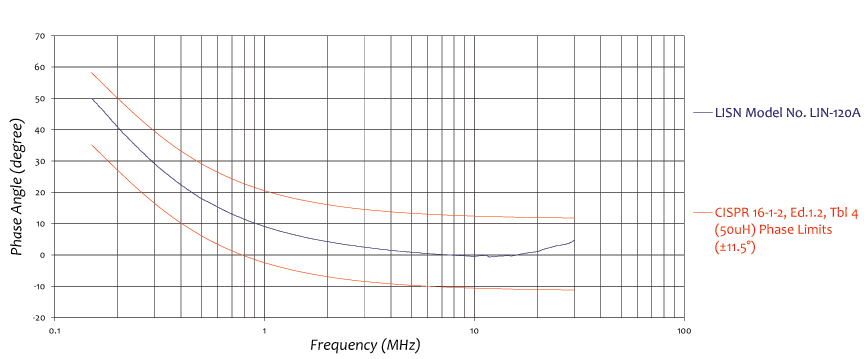
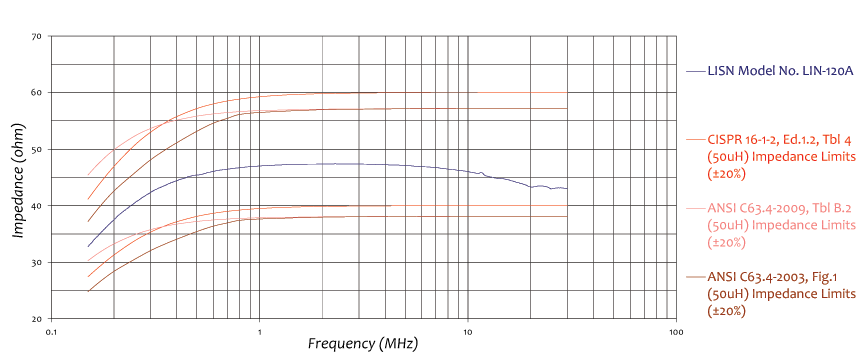
Every LIN-120C is individually calibrated per CISPR 16-1-2 and ANSI C63.4. Impedance, phase, isolation, and insertion loss data are supplied with a certificate of calibration. Calibration covers both the bypass (OFF) and active (ON) Transient Limiter configurations. ISO 17025 accredited calibration is also available upon request.
What is the warranty coverage for the LIN-120C?
The LIN-120C carries a three-year warranty from Com-Power Corporation. The LISN networks use entirely passive components; the Transient Limiter uses passive protection devices. Periodic recalibration on a one- or two-year interval is recommended to maintain traceability and confirm both internal networks and the integral Transient Limiter continue to meet specifications.
What are the physical dimensions and weight of the LIN-120C?
The LIN-120C measures 6.6 x 14.3 x 13 inches (16.8 x 36.3 x 33 cm) and weighs 10 lbs (4.5 kg). Its single-enclosure design with built-in Transient Limiter requires only one box, one mains cable, one EUT connection, and one coaxial cable to the EMI receiver — making it one of the fastest Com-Power LISNs to configure for a standard commercial conducted emissions test.
How does the LIN-120C compare to the LI-220C, and how should a laboratory choose between them?
Both are dual-conductor, 20 A AC, single-enclosure LISNs with universal EUT receptacles. Key differences: the LIN-120C covers 150 kHz–30 MHz with a built-in Transient Limiter (ON/OFF); the LI-220C covers 9 kHz–30 MHz, adds the ANSI 250 μH network, but requires an external Transient Limiter. Choose LIN-120C for standard 150 kHz–30 MHz testing with maximum setup convenience. Choose LI-220C for sub-150 kHz measurements or the ANSI 250 μH configuration.
How does the LIN-120C compare to the separately housed LI-125C and LI-150C pairs?
The LIN-120C (20 A, single enclosure, built-in Transient Limiter, universal receptacle) offers faster setup and greater compactness. The LI-125C (25 A) and LI-150C (50 A) pairs offer higher current ratings, individually calibrated units, and SUPERCON® shrouded sockets suited for high-current hardwired connections to equipment without a standard AC plug. Choose LIN-120C for plug-in products where speed and compactness are priorities; choose LI-125C/LI-150C pairs for hardwired equipment or products exceeding 20 A.
What types of equipment cannot be tested with the LIN-120C?
The LIN-120C is not suitable for: equipment exceeding 20 A AC or 14 A DC (use LI-125C, LI-150C, or LI-1100C); products requiring sub-150 kHz measurements (use LI-220C); DO-160 testing (use LI-325C or LI-350); MIL-STD-461 testing (use LI-400C or LI-4100); CISPR 25 automotive testing (use LI-550C). Two LIN-120C units can cover four conductors of a three-phase system; for dedicated three-phase programs the LI-3P series is purpose-built.
How can the LIN-120C be used in a three-phase power system configuration?
Two LIN-120C units cover a three-phase Wye system: Unit 1 handles Phase A (L1) and Phase B (L2); Unit 2 handles Phase C and Neutral. Each unit’s front-panel Test Lead Selection switch independently selects which network feeds its RF port. The integral Transient Limiter on each unit provides receiver protection during measurements on all four conductors. For laboratories regularly testing three-phase equipment, the LI-3P series provides a more integrated solution.
How is the LIN-120C used in a high-throughput commercial EMC test laboratory testing large volumes of consumer products?
In a high-throughput laboratory testing dozens of consumer products weekly for FCC and CE marking compliance, the LIN-120C minimizes per-product setup time. The universal EUT receptacle accepts any plug without adapter changes. The front-panel Line/Neutral switch eliminates cable moves. The built-in Transient Limiter removes the need to connect or recalibrate an external accessory. A technician transitions from one product to the next by simply swapping the EUT — significantly reducing per-product test time compared to setups requiring separate LISN pairs and external Transient Limiters.
How does an EMC engineer use the LIN-120C Transient Limiter bypass switch during diagnostic troubleshooting?
During troubleshooting, the ON/OFF switch provides diagnostic flexibility. With Transient Limiter ON, 10 dB attenuation and filters produce clean in-band measurements for pre-screening. With Transient Limiter switched OFF (bypass), the engineer observes the full unattenuated RF output including transient content. Comparing the spectrum with and without the Transient Limiter in circuit distinguishes genuine in-band conducted emissions from out-of-band transient artifacts that the filter sections would appropriately reject — a useful step when determining whether a spectral feature requires mitigation or is benign.
What is a real-world scenario for using the LIN-120C in an on-site conducted emissions assessment at a manufacturing facility?
An on-site conducted emissions assessment benefits greatly from the LIN-120C’s compact single-enclosure design and self-contained Transient Limiter. The entire LISN setup requires only the LIN-120C, a mains power cable, and a coaxial cable to a portable EMI receiver — no external Transient Limiter accessory to carry or connect. The engineer bonds the mounting plate to a portable ground reference, plugs the product into the universal receptacle, and begins scanning. The integral Transient Limiter protects the portable receiver from the industrial power environment’s transient content, which may be more severe than in a controlled laboratory. This self-sufficiency makes the LIN-120C ideal for field assessments, factory acceptance testing, and on-site pre-certification activities.
How is the LIN-120C used in DC power system conducted emissions testing?
The LIN-120C’s 380 VDC / 14 A DC rating supports testing of 24 VDC and 48 VDC industrial and telecom equipment, 380 VDC data center power distribution components, and battery-powered devices with DC-DC converters. The positive DC supply connects to L1 (Line input), the negative to L2 (Neutral input), and earth ground to the chassis terminal. The integral Transient Limiter with its ON/OFF switch is especially valuable in DC configurations because DC bus switching regulators can generate significant high-frequency transients on supply rails that would otherwise threaten the EMI receiver input.


Quote Request
Other EMC Test Equipment
- Absorbing Clamps
- Antenna Kits
- Antenna Masts - Automated and Manual
- Antennas
- Bulk Current Injection probes
- CDNs - Coupling Decoupling Network
- Comb Generators
- Conducted Immunity Test Systems
- Current Monitor Probes
- Current Probe Calibration Fixtures
- EM Clamps
- Feed Through Capacitor
- ISNs - Impedance Stabilization Network
- LISNs - Single Phase
- LISNs - TEMPEST
- LISNs - Three Phase
- Magnetic Field Generator
- Near Field Probes
- Power Amplifiers
- Pre-compliance Emissions Test Systems
- Preamplifiers
- Spectrum Analyzers
- Surge Generators
- System Controllers
- Transient Limiters
- Tripods For EMC
- Turntables