
LISN 100 Amps For MIL-STD 461
-
The LI-4100 Line Impedance Stabilization Network (LISN) is fully compliant with MIL-STD-461 requirements.
-
It is designed for CE102 conducted emissions tests on AC and DC power lines, covering 10 kHz to 10 MHz.
-
A 50 Ω N-type female RF connector ensures accurate EMI measurement output.
-
The LISN supports a 100-ampere current rating with forced air cooling, ideal for high-power EUTs.
-
Each unit is individually calibrated per MIL-STD-461, with ISO 17025-accredited calibration available, and comes with a three-year warranty.
-
This LISN is specifically intended for CE102 compliance testing under MIL-STD-461F/G, making it suitable for military, aerospace, and defense electronics EMC testing.
-
It can also be used in pre-compliance measurements (conducted emissions, 10 kHz–10 MHz) and CISPR-based commercial standards where LISNs are required.
-
Users can apply it for diagnostic and troubleshooting tasks, such as verifying power-line filter performance, locating noise sources, and evaluating EMI suppression techniques.
-
When used in multi-conductor setups, it supports three-phase conducted emissions testing (Wye or Delta) for equipment under MIL-STD-461 environments.
Features
- ▸ Highest-current 4x Series MIL-STD 461 CE102 LISN, 100 A AC with forced-air cooling — the flagship for full-compliance MIL-STD 461 CE102 testing of high-current military aircraft, ground vehicle, and shipboard equipment.
- ▸ 10 kHz to 10 MHz frequency range — matched precisely to the MIL-STD 461 CE102 test method's 10 kHz lower limit and 10 MHz upper limit for the LISN-based voltage measurement.
- ▸ Fully compliant with MIL-STD 461 — the 50 Ω / 50 µH impedance characteristic matches the MIL-STD 461 LISN circuit definition; calibrated per MIL-STD 461 with each unit.
- ▸ 100 A AC current rating with forced-air cooling — integrated cooling fans dissipate heat from the 50 µH air-core inductor and current paths during extended testing of 100 A loads.
- ▸ High voltage rating: 525 VAC / 600 VDC — supports 480 V industrial 3-phase systems, high-voltage DC bus configurations to 600 VDC, and high-voltage 50/60 Hz aircraft platforms.
- ▸ Multi-frequency AC voltage rating across three power frequencies — 525 VAC at 50/60 Hz (ground), 270 VAC at 400 Hz (aircraft), and 135 VAC at 800 Hz (high-speed generator buses); the only 4x Series LISN that supports all three military power frequencies.
- ▸ 50 µH air-core inductor — air-core construction prevents magnetic saturation across all load currents up to the 100 A rating, ensuring the LISN impedance remains stable.
- ▸ Superior Electric SUPERCON® shrouded sockets — safe shrouded design rated for 100 A connections; matching color-coded plugs included for high-current mains and EUT wiring.
- ▸ 50 Ω N-type female RF connector — standard interface for direct connection to MIL-STD-compliant EMI receivers and spectrum analyzers across the full 10 kHz to 10 MHz CE102 measurement band.
- ▸ 3-phase ready — a second LI-4100 pair extends the setup to 3-phase Wye or Delta high-current military and aerospace power systems.
- ▸ ISO 17025 accredited calibration available — individual MIL-STD 461 calibration is standard with each unit; ISO 17025 accredited calibration available on request for labs with formal accreditation requirements.
- ▸ Three-year standard warranty — backed by manufacturer support.
Specifications
| Model | LI-4100 |
|---|---|
| Series | 4x Series — MIL-STD 461 CE102 dedicated, single-conductor pair, with forced-air cooling |
| Specification | MIL-STD 461 (CE102) |
| Application | High-current MIL-STD 461 CE102 power line conducted emissions tests |
| Frequency Range | 10 kHz – 10 MHz |
| Inductors | 50 µH (air-core) |
| Current Rating | 100 Amperes AC (forced-air cooling) |
| Voltage Rating (AC) | 525 VAC (50/60 Hz); 270 VAC (400 Hz); 135 VAC (800 Hz) |
| Voltage Rating (DC) | 600 VDC |
| Cooling | Forced-air (integrated cooling fans) |
| RF Connector | 50 Ohms N-type (female) |
| Mains & EUT Connections | Superior Electric SUPERCON® shrouded sockets |
| Dimensions (each network) | 10 × 10 × 21 in (25.4 × 25.4 × 53.3 cm) |
| Weight (each network) | 17 lbs (7.7 kg) |
| Calibration | Individual, MIL-STD 461; ISO 17025 accredited available on request |
| Warranty | Three-year standard warranty |
All values are typical, unless specified. Ships as a pair of separately housed networks. All specifications subject to change without notice.
🔍 Not Sure This Is The Right LISN?
Compare all 25 Com-Power LISN models side-by-side with our interactive selection tool. Filter by current, voltage, frequency, and standards to find your perfect match.
Compare All LISN Models →LI-4100 MIL-STD-461 CE102 Single-Phase LISN FAQs
What is the LI-4100 and what type of testing is it designed for?
The LI-4100 is a single-conductor, 50Ω, 50 μH Line Impedance Stabilization Network (LISN) rated at 100 A AC with forced-air cooling, covering 10 kHz to 10 MHz, designed for CE102 power-line conducted emissions compliance testing per MIL-STD-461. It is the highest-current single-phase LISN in the Com-Power MIL-STD-461 CE102 range, intended for high-power military vehicle power conversion systems, large shipboard single-phase power management units, high-power airborne power conditioning equipment, and military facility infrastructure power systems requiring CE102 verification at up to 100 A.
What versions of MIL-STD-461 does the LI-4100 comply with and why is this important?
The LI-4100 is compliant with MIL-STD-461. The CE102 50 μH, 50 Ω LISN network specification has been consistent across MIL-STD-461D, E, F, and G revisions, making the LI-4100 applicable for CE102 testing under any of these active revisions. Defense acquisition programs span decades and equipment may need to satisfy CE102 under the revision in effect at the time of the original program contract. A laboratory with an LI-4100 can test 100 A class single-phase equipment under any current MIL-STD-461 revision without requiring a different LISN.
What is the frequency range of the LI-4100 and what CE102 measurement significance does 10 kHz to 10 MHz have?
The LI-4100 covers 10 kHz to 10 MHz — the complete CE102 frequency range defined by MIL-STD-461. For 100 A class equipment such as large power converters and high-power rectifiers switching at 2–20 kHz, the 10 kHz to 150 kHz sub-band captures dominant harmonic and switching noise components that fall entirely in this range. Testing must begin at 10 kHz to ensure CE102 compliance across the full required range.
What is the current rating of the LI-4100 and what class of military equipment does this address?
The LI-4100 is rated at 100 A AC continuous with forced-air cooling. This covers high-power single-phase military vehicle power conversion systems, large shipboard single-phase power management units, high-power airborne equipment on single-phase aircraft bus segments, military facility UPS systems, large military electronic warfare system prime power units, military data center power conditioning equipment, and any single-phase military equipment drawing up to 100 A requiring CE102 compliance.
What voltage ratings does the LI-4100 support and what military power architectures does this cover?
The LI-4100 supports 525 VAC at 50/60 Hz, 270 VAC at 400 Hz, 135 VAC at 800 Hz, and 600 VDC. The 525 VAC covers high-voltage single-phase military facility power. The 270 VAC 400 Hz covers standard military aircraft and shipboard single-phase bus voltage. The 135 VAC 800 Hz supports high-frequency military power used in certain naval and airborne applications. The 600 VDC covers high-voltage military DC bus systems.
Why does the LI-4100 use a 50 μH inductor and how does this differ from the 5 μH inductors used in DO-160 and CISPR 25 LISNs?
The 50 μH inductor is specified by MIL-STD-461 for CE102 testing. The 50 μH network produces an impedance characteristic approximating military platform power distribution wiring at CE102 measurement frequencies, providing the representative source impedance reference required for valid CE102 disturbance voltage measurements from 10 kHz to 10 MHz. The 5 μH network used in DO-160 and CISPR 25 LISNs (LI-325C, LI-350, LI-550C, LI-3100) has a different impedance profile and is designed for testing up to 400 MHz or 108 MHz. Using the wrong network type produces non-compliant measurements.
Why does the LI-4100 require forced-air cooling and how does the cooling system operate?
At 100 A, resistive losses generate substantial heat that passive convection cannot manage during extended CE102 test sequences. The LI-4100 includes internal forced-air cooling fans. Cooling fans must be activated before energizing the EUT and maintained throughout all CE102 testing. Operating at or near 100 A without cooling risks overheating the air-core inductor insulation, degrading inductance accuracy, and causing permanent damage to the unit.
The LI-4100 is sold as a pair of networks. Why is a pair required and how are they connected?
Single-phase AC and DC systems have two current-carrying conductors, and CE102 requires a LISN in series with each conductor simultaneously. One LI-4100 is installed in the Line conductor and one in the Neutral. CE102 measurements are performed one conductor at a time with the inactive RF port terminated at 50 Ω. For three-phase systems, a second LI-4100 pair covers the additional phase conductors, or the LI-3P-4100 three-phase LISN can be used.
What type of connectors does the LI-4100 use at the mains and EUT ports?
The LI-4100 uses Superior Electric SUPERCON® shrouded sockets at both mains and EUT ports. At 100 A, the shrouded design is essential — accidental contact with live conductors at this current level is life-threatening. Color-coded plugs for mains and EUT wiring are included, maintaining correct polarity and rated for the full 100 A current capacity.
Why is the mounting plate of the LI-4100 left unpainted and what grounding is required?
The unpainted mounting plate enables a low-impedance metal-to-metal bond to the MIL-STD-461 reference bonding plane. At 100 A, leakage currents through internal LISN capacitors are substantial and potentially life-threatening if the earth bond is absent. The mounting plate must be bonded to the bonding plane with a direct, verified metal-to-metal connection before any power source is connected. In facilities with painted bonding surfaces or unverified earth infrastructure, a dedicated low-impedance bonding conductor must be installed first.
What RF connector does the LI-4100 use and what should be connected to the RF measurement port?
The LI-4100 uses a 50 Ω N-type female RF connector. This connects via 50 Ω coaxial cable to an EMI receiver configured for a 10 kHz to 10 MHz CE102 sweep. The inactive LISN RF port must be terminated at 50 Ω. A Transient Limiter between the RF port and EMI receiver is recommended to protect the receiver from high-energy voltage transients generated by 100 A class military power equipment.
What insertion loss does the LI-4100 provide and how is it applied in CE102 data post-processing?
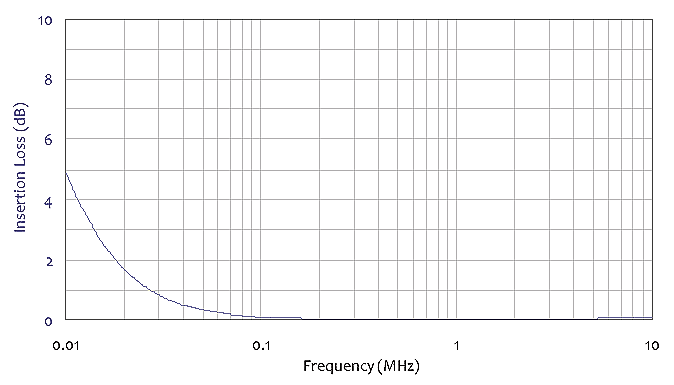
The LI-4100 provides insertion loss consistent with the 50 μH LISN network characteristic, decreasing from elevated values at 10 kHz to negligible levels above 1 MHz. The individual calibration data sheet supplied with each unit provides insertion loss values across the full 10 kHz to 10 MHz range. In CE102 post-processing, the insertion loss correction from calibration data must be added to raw EMI receiver readings at each frequency point to obtain actual disturbance voltage values, which are then compared against the applicable MIL-STD-461 CE102 limit line.
How is the LI-4100 individually calibrated and what calibration documentation is supplied?
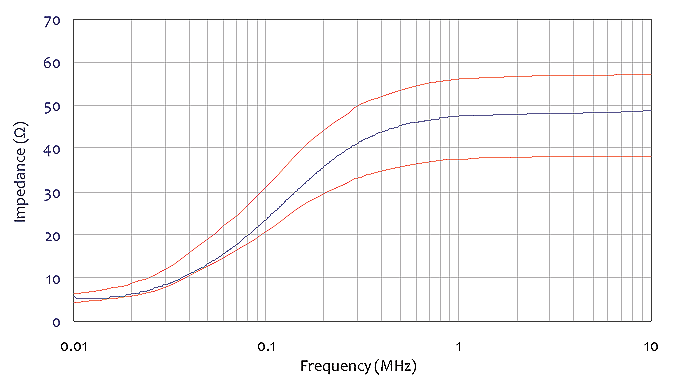
Every LI-4100 is individually calibrated per MIL-STD-461F. Impedance and insertion loss data across the full 10 kHz to 10 MHz range are supplied with a certificate of calibration. ISO 17025 accredited calibration is also available upon request, typically required by government-owned test laboratories, depot-level military test facilities, and defense prime contractors under quality management systems mandating traceable calibration.
What is the warranty coverage for the LI-4100?
The LI-4100 carries a three-year warranty from Com-Power Corporation. As a passive instrument without active components subject to wear, its service life is long under normal laboratory conditions. Periodic recalibration on a one- or two-year interval is recommended to maintain measurement traceability and confirm the unit continues to meet MIL-STD-461 impedance and insertion loss requirements.
What are the physical dimensions and weight of the LI-4100?
Each LI-4100 network measures 10 x 10 x 21.2 inches (25.4 x 25.4 x 53.8 cm) and weighs 17 lbs (7.7 kg). A complete single-phase CE102 installation requires floor or heavy bench space for both units on the MIL-STD-461 bonding plane, high-current wiring rated for 100 A at the applicable military power voltage, cooling fan power, and a coaxial cable from the active RF port to the EMI receiver.
How does the LI-4100 compare to the LI-400C and how should a laboratory choose between them?
The LI-4100 (100 A AC) and LI-400C (25 A AC) are the two Com-Power single-phase MIL-STD-461 CE102 LISNs with the 50 μH, 50 Ω network. Both cover 10 kHz to 10 MHz. The LI-400C suits single-phase military equipment up to 25 A; the LI-4100 is required when EUT current exceeds 25 A up to 100 A. The LI-4100 is larger, heavier, requires forced-air cooling, and supports higher voltage ratings: 525 VAC at 50/60 Hz and 600 VDC versus the LI-400C’s 380 VDC and 270 VAC at 50/60 Hz. Select the LI-400C for 25 A class equipment and the LI-4100 for 100 A class equipment.
How does the LI-4100 relate to the LI-3P-4100 three-phase LISN and when should each be used?
The LI-4100 is a single-conductor LISN used in pairs for single-phase and DC CE102 testing. The LI-3P-4100 is a four-conductor three-phase LISN for CE102 testing of three-phase equipment at 100 A per phase. When a military EUT has a single-phase or DC power input at 100 A, the LI-4100 pair is appropriate. When the EUT has a three-phase power input drawing up to 100 A per phase, the LI-3P-4100 is required. Platforms with both single-phase and three-phase equipment may need both the LI-4100 pair and the LI-3P-4100 in the same test facility.
How is the LI-4100 used when performing CE102 compliance testing on a high-power military vehicle single-phase power conditioning unit?
Military vehicle single-phase power conditioning units drawing up to 100 A at 120 V or 270 V single-phase are tested with the LI-4100 pair bonded to the MIL-STD-461 reference bonding plane. The vehicle power supply connects to the mains inputs using 100 A rated connectors. The EUT is operated at rated input current into a representative electronic load. Cooling fans are activated before the EUT is energized. CE102 sweeps from 10 kHz to 10 MHz on both Line and Neutral are performed with insertion loss corrections applied, and the corrected disturbance voltage values are compared against MIL-STD-461 CE102 limits.
What does a CE102 test program for a high-power military electronic warfare system power supply look like using the LI-4100?
High-power military EW system prime power supplies drawing up to 100 A from single-phase military facility or vehicle power are tested at a DoD-recognized EMC test facility with appropriate safety controls. The LI-4100 pair connects between the facility’s high-current single-phase supply and the EW system prime power input. CE102 sweeps from 10 kHz to 10 MHz are performed during the EW system’s highest-emissions operating mode — typically during transmit or high-power processing cycles. The LI-4100’s 100 A continuous rating with forced-air cooling allows the EW system to be tested at its full rated prime power draw for the entire CE102 test sequence.
How is the LI-4100 applied at a military test range for CE102 qualification of a large single-phase power supply for a ground-based directed energy system?
Large ground-based directed energy systems require single-phase prime power supplies drawing up to 100 A during energy storage charging cycles. At a military test range, the LI-4100 pair is permanently installed as the 100 A class single-phase CE102 LISN. The directed energy system prime power supply is operated through representative charge-sustain-discharge cycles, with CE102 sweeps performed during the charging phase which typically represents the worst-case emissions condition. The LI-4100’s forced-air cooling and 100 A continuous rating allow uninterrupted operation throughout a complete multi-cycle CE102 test sequence.
How does the LI-4100 support CE102 testing in a military System Integration Laboratory for a single-phase high-power subsystem?
In a military System Integration Laboratory (SIL), where multiple platform subsystems operate together before the actual platform is built, the LI-4100 is assigned to the highest-current single-phase subsystem — such as a large prime power conditioning unit or high-power radar transmitter power supply. CE102 measurements in the full integration context are more representative of the real platform electromagnetic environment than isolated benchtop testing. CE102 sweeps from 10 kHz to 10 MHz capture conducted disturbances under integrated operating conditions, producing compliance evidence that more accurately predicts in-platform CE102 performance.


Quote Request
Other EMC Test Equipment
- Absorbing Clamps
- Antenna Kits
- Antenna Masts - Automated and Manual
- Antennas
- Bulk Current Injection probes
- CDNs - Coupling Decoupling Network
- Comb Generators
- Conducted Immunity Test Systems
- Current Monitor Probes
- Current Probe Calibration Fixtures
- EM Clamps
- Feed Through Capacitor
- ISNs - Impedance Stabilization Network
- LISNs - Single Phase
- LISNs - TEMPEST
- LISNs - Three Phase
- Magnetic Field Generator
- Near Field Probes
- Power Amplifiers
- Pre-compliance Emissions Test Systems
- Preamplifiers
- Spectrum Analyzers
- Surge Generators
- System Controllers
- Transient Limiters
- Tripods For EMC
- Turntables