
AH-826 Standard Gain Horn Antenna
- Com-Power AH-826 is a broadband standard Gain Horn Antenna with an operating frequency range of 18 GHZ - 26.5 GHZ.
- Most EMI test standards require horn antennas for testing above 1 GHz.
- Because the AH-826 is linearly polarized, and can be used for transmitting and receiving, it is an excellent choice for both EMC radiated immunity and emissions testing.
- The AH-826 is tough enough to use daily in both indoor and outdoor laboratory environments.
- Corrosion-resistant, high-grade aluminum construction provides long-term protection.
- A standard three-year warranty provides extended protection for your investment.
- Weighing just 1.5 lbs., the AH-826 is easy to transport and set up in the test field.
- You could also buy a Com-Power tripod on which the antenna can be mounted.
- We deliver the unit calibrated as per ANSI C63.5, with full NIST traceability.
- ISO 17025 accredited calibrations are also available on request.
- Typical applications for the AH-826 include: EMI testing to FCC, CE, MIL-STD-461, RTCA DO-160 or other similar regulatory standards. Product immunity testing.
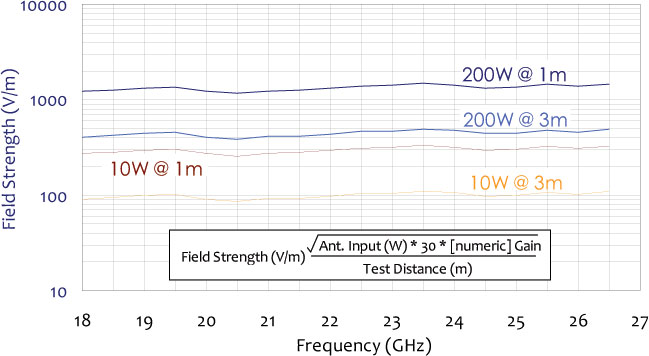
- When used as a transmitting antenna, it can produce radiated RF fields of more than 1,450 V/m @ 1 meter, using only 200 watts input power.
- Use the AH-826 as a substitution antenna for testing to ETSI and other standards. Site comparisons, surveying, field monitoring, and other general-purpose applications.
Features
- ▸ Full K-band 18 GHz to 26.5 GHz coverage in a single horn — no antenna swap across the band; covers 5G FR2 n257 lower portion and n258 (24 GHz), 24 GHz automotive short-range radar, Ka-band lower-edge satellite, and 18/23 GHz point-to-point microwave backhaul.
- ▸ Standard gain horn design with high stable gain (avg 24.7 dBi) — the precisely engineered standard-gain geometry produces predictable, repeatable gain across the band, making the AH-826 ideal for ERP/EIRP substitution measurements with tight uncertainty.
- ▸ Up to 200 W direct waveguide / 10 W coaxial — 200 W direct to the WR-42 waveguide flange supports radiated immunity at field strengths exceeding 1,450 V/m at 1 m; the included waveguide-to-coax adapter supports 10 W convenient coaxial operation for emissions and low-power immunity.
- ▸ Removable waveguide-to-coax adapter — choose coax convenience for everyday instrumentation or remove the adapter to drive the waveguide flange directly with a waveguide-output amplifier for maximum power and lowest insertion loss.
- ▸ 2.92 mm (K-type) coaxial connector — precision RF interface rated to 40 GHz, mechanically compatible with SMA but engineered for full performance through the entire K-band where standard SMA degrades.
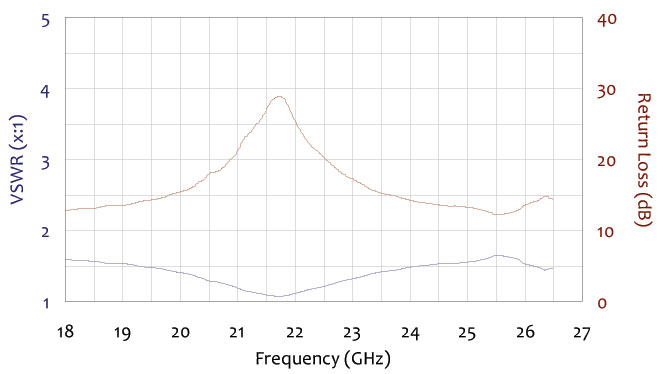
- ▸ Excellent VSWR (1.07–1.65, average 1.40:1) — tight impedance match across the band protects amplifiers from reflected energy and minimizes measurement error during emissions sweeps.
- ▸ Lightweight and compact — 1.5 lbs (0.7 kg), 5.9″ × 8.7″ × 12.1″ complete assembly — easy to mount and reposition during 5G/mmWave test campaigns.
- ▸ Standard 1/4″-20 mounting hole — located in the center of the antenna's base plate, mounts on the AT-812 Tripod or any compatible support.
- ▸ High-grade corrosion-resistant aluminum, painted finish — built for daily indoor and outdoor laboratory use, even under continuous extreme weather exposure.
- ▸ Transmit and receive capable — serves both as a receiving antenna for K-band emissions measurements and as a transmitting antenna for radiated immunity, eliminating antenna changes between test phases.
- ▸ ERP / EIRP substitution antenna — well-characterized standard gain makes the AH-826 a preferred reference for K-band substitution measurements per FCC/TCB and ETSI procedures.
- ▸ Regulatory compliance applications — suitable for FCC Part 15/30, CE, MIL-STD-461 RE103/RS103, RTCA DO-160, ETSI EN 303/EN 301 489, 3GPP TS 38.101-2, and CISPR 32.
- ▸ Individually calibrated, NIST-traceable — calibrated per ANSI C63.5; calibration certificate and antenna factor data ship with each unit; ISO 17025 accredited calibration available on request.
- ▸ Three-year standard warranty — backed by manufacturer support.
Specifications
| Product Name | Standard Gain Horn Antenna |
|---|---|
| Frequency Range | 18 GHz to 26.5 GHz |
| Polarization | Linear |
| Nominal Impedance | 50 Ω |
| Power Handling (CW) | 10 W with waveguide-to-coax adapter; 200 W direct waveguide |
| Connector | 2.92 mm (K-type, female) |
| Waveguide Flange | WR-42 |
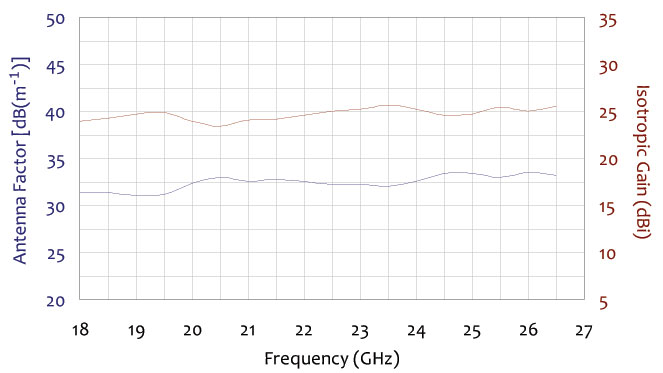
| Antenna Factor | 31.1 to 33.6 dB(m-1) [average: 32.4] |
| Isotropic Gain | 23.4 to 25.6 dBi [average: 24.7] |
| VSWR | 1.07 to 1.65 : 1 [average: 1.40] |
| Return Loss | 12.2 to 28.9 dB [average: 16.6] |
| Maximum Field Strength | >1,450 V/m at 1 m (with 200 W direct waveguide) |
| Radiated Field Strength | See typical field strength graph (10 W and 200 W input) |
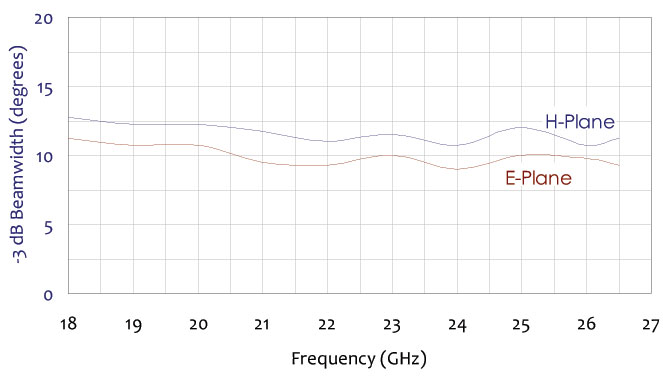
| -3 dB Beamwidth | See typical beamwidth graph (E-plane and H-plane) |
| Applicable Standards | FCC, CISPR, EN, ETSI, FAA, MIL-STD-461, RTCA DO-160, SAE |
| Calibration | Individually calibrated per ANSI C63.5, NIST traceable |
| Mounting | 1/4″-20 threaded hole (center of base plate) |
| Horn / Waveguide Dimensions | 3.4″ × 4.3″ × 9.6″ [8.6 × 10.9 × 24.5 cm] |
| Complete Assembly Dimensions | 5.9″ × 8.7″ × 12.1″ [15 × 22 × 30.8 cm] |
| Weight | 1.5 lbs [0.7 kg] |
All values are typical, unless specified. All specifications are subject to change without notice.

🔍 Not Sure Which Antenna You Need?
Compare all Com-Power antenna models side-by-side with our interactive selection tool. Filter by frequency range, antenna category, application, polarization, and power handling to find your perfect match.
Compare All Antenna Models →AH-826 Standard Gain Double Ridge Horn Antenna — Frequently Asked Questions
1. What is the Com-Power AH-826 and what is it primarily used for?
The AH-826 is a broadband standard gain double ridge waveguide horn antenna covering 18 GHz to 26.5 GHz — the full K-band range. It is a linearly polarized transmit/receive antenna designed for EMC emissions and immunity testing, effective radiated power (ERP) and effective isotropic radiated power (EIRP) measurements, and substitution-method testing. With at least 23 dBi gain across the band, it is well-suited for 5G FR2 n257/n258 bands, 24 GHz automotive short-range radar, Ka-band lower-edge satellite, and point-to-point microwave link verification.
2. What are the AH-826’s key electrical and mechanical specifications?
Frequency: 18 GHz – 26.5 GHz (WR-42 waveguide band). Gain: ≥ 23 dBi across the entire band. Power handling: 5 W CW at the coaxial terminals, up to 10 W with the waveguide-to-coax adapter, or up to 200 W direct to the WR-42 waveguide flange. Field capability: >1,450 V/m @ 1 m with 200 W direct-waveguide drive. VSWR: < 2:1 typical. Polarization: linear. Connector: 2.92 mm (K-type), SMA-compatible. Impedance: 50 Ω. Construction: lightweight corrosion-resistant aluminum. Horn size: 3.4″ × 4.3″ × 9.6″. Weight: 3 lbs (1.4 kg). Mounting: ¼″-20 threaded hole. Calibration: individual per ANSI C63.5 with NIST traceability; ISO 17025 available. 3-year standard warranty.
3. Why is the 18–26.5 GHz K-band range critical for modern EMC testing?
The K-band houses some of the most important wireless spectrum in current deployment. 5G NR FR2 uses the n257 (26.5–29.5 GHz — partially overlapping K-band) and n258 (24.25–27.5 GHz) bands. Automotive short-range radar (SRR) operates at 24 GHz for blind-spot detection, parking assist, and rear cross-traffic alert. Ka-band satellite downlinks start at 17.7 GHz. Point-to-point microwave backhaul uses 18 GHz and 23 GHz licensed bands. Without K-band coverage, compliance labs cannot test or certify any of these product categories — and modern EMC standards (CISPR 32, MIL-STD-461G, FCC Part 30) now require it.
4. Which EMC standards and applications use the AH-826’s frequency range?
• FCC Part 15 Subpart C/E (24 GHz SRR, U-NII devices, 5G FR2 intentional radiators)
• FCC Part 30 (Upper Microwave Flexible Use Service, 24 GHz band)
• CISPR 32 / EN 55032 (ITE and multimedia emissions to upper frequencies)
• CISPR 16-1-4 (site validation and SVSWR)
• MIL-STD-461G RE103 and RS103 (military EMI/EMS to 40 GHz — AH-826 covers the lower K-band portion)
• RTCA DO-160 Section 20/21 (airborne equipment radiated immunity/emissions)
• ETSI EN 303 645 / EN 301 489 series (European wireless compliance)
• 3GPP TS 38.101-2 (5G NR FR2 RF performance, n257/n258 bands)
• ITU-R F.758 / ITU-R SF.1395 (fixed-service radio relay specifications)
5. What real-world products and systems rely on AH-826 testing?
• 24 GHz automotive radar: blind-spot monitoring, rear cross-traffic alert, parking-assist sensors, short-range collision warning — the entire ADAS short-range radar ecosystem
• 5G NR FR2 (lower bands): n257 lower portion and n258 (24 GHz) base stations, small cells, customer-premises equipment, handsets
• Ka-band satellite downlink terminals: 17.7–21.2 GHz consumer and enterprise satellite dishes
• Point-to-point microwave links: 18/23 GHz licensed backhaul radios for cellular infrastructure, campus networks
• Military/defense: K-band SATCOM terminals, radar systems, electronic warfare receivers, ground-station equipment
• Industrial motion sensors: 24 GHz Doppler motion detectors used in automated doors, traffic-flow sensors, industrial safety interlocks
• Medical: mmWave imaging, radar-based vital-sign monitors
• Research: 5G/6G antenna characterization, mmWave component verification, academic RF labs
6. What is “standard gain” and why does it matter for substitution-method measurements?
A standard gain horn (SGH) is a precisely engineered pyramidal or conical waveguide horn whose gain is both high and predictably stable across its waveguide band. The AH-826’s ≥23 dBi gain is repeatable and well-characterized. This makes the AH-826 ideal for substitution-method ERP/EIRP measurements, where you compare an unknown transmitter’s radiated signal at a given location against the response of the calibrated horn driven with a known power at the same frequency. The stability of a standard gain design gives tight measurement uncertainty — typically ±0.5 dB or better at K-band — which is essential for regulatory compliance reports.
7. Why does the AH-826 include a waveguide-to-coax adapter, and when should I remove it?
At K-band frequencies, the native transmission line for low loss is WR-42 rectangular waveguide. The AH-826 is physically a WR-42 horn, but the included precision waveguide-to-coax adapter with a 2.92 mm (K-type) connector lets you drive the antenna with coaxial amplifiers, receivers, and signal sources. Use the coax adapter for emissions receive measurements and for immunity transmit up to 10 W — convenient for everyday instrumentation. Remove the adapter and drive the WR-42 flange directly when you need the full 200 W CW rating (up to >1,450 V/m at 1 m), or when your amplifier already has a WR-42 waveguide output. Direct waveguide coupling also has lower loss, giving cleaner reference data and higher achievable field strengths.
8. How does the AH-826 compare with other Com-Power horn antennas?
• vs. AH-118 (700 MHz–18 GHz, 300 W): AH-118 stops where AH-826 starts. Pair them for complete 700 MHz–26.5 GHz coverage with two antennas
• vs. AH-640 (26.5–40 GHz): adjacent bands; AH-826 + AH-640 together give complete 18–40 GHz coverage as two separate antennas
• vs. AH-840 (18–40 GHz): AH-840 combines AH-826 and AH-640 ranges into one antenna. AH-826 alone is the lower-cost choice if you only need the 18–26.5 GHz band
• vs. AH-8055 (800 MHz–5 GHz): different frequency class; no overlap. A complete compliance lab typically pairs AH-8055 (sub-6 GHz immunity) with AH-826 and AH-640 (K/Ka-band)
9. Should I choose the AH-826 or the AH-840?
Choose AH-826 when your testing is limited to the 18–26.5 GHz K-band — 24 GHz automotive radar, 5G n257/n258, K-band satellite, 18/23 GHz backhaul radio. The AH-826 is lower cost, lighter (3 lbs) than owning the AH-840, and its focused band-edge performance can be slightly better for pure K-band work. Choose AH-840 when you also need 26.5–40 GHz (Ka-band) coverage — complete 5G FR2 across all mmWave bands, Ka-band satellite, 28/39 GHz. Choose both AH-826 + AH-640 if you want separate optimized horns for each band, or if your budget allows higher-performance standalone options rather than the combined AH-840.
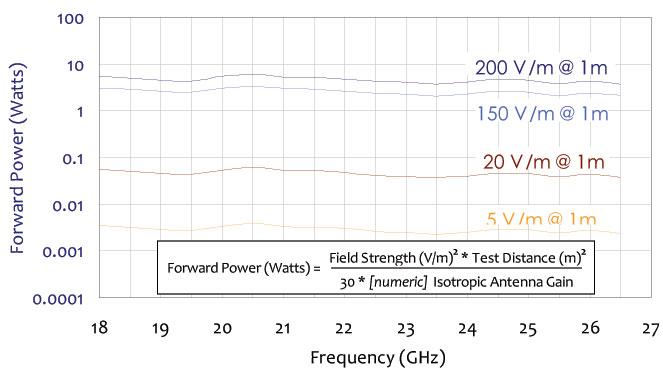
10. How much amplifier power do I need to hit common field strengths with the AH-826?
Using E ≈ √(30·P·G) / d at 1 m and 23 dBi gain:
• 10 V/m: ~0.02 W — any lab amp with margin
• 30 V/m: ~0.15 W
• 100 V/m: ~1.7 W — 10 W amp
• 200 V/m: ~6.7 W — 25–50 W amp
• 500 V/m: ~42 W — requires direct waveguide drive
• 1,450 V/m: 200 W direct waveguide (practical ceiling)
Stay within the 5 W coax / 10 W adapter / 200 W waveguide limits, and add 3–6 dB headroom for VSWR, cable loss, and modulation crest factor. K-band cable loss is significant — keep coax runs short or switch to direct WR-42 at the amplifier when pushing high powers.
11. What is the 2.92 mm K-type connector and why is it used for K-band?
The 2.92 mm connector (also called K-type, named for the K-band it was designed for) is a precision RF coaxial interface rated to 40 GHz. It is mechanically compatible with SMA (a 2.92 mm will mate with an SMA connector and vice versa), but only a 2.92 mm-to-2.92 mm mating achieves the full 40 GHz performance — SMA starts degrading above 18 GHz and is not recommended above 24 GHz. For the AH-826 in the 18–26.5 GHz band, always use 2.92 mm on both sides of every coaxial joint: at the antenna adapter, at the cable, and at the amplifier or receiver.
12. What setup and cable considerations matter most at 18–26.5 GHz?
• Cable loss is significant — typical low-loss coax loses 0.3–0.8 dB per foot at 26.5 GHz. Keep runs under 1 m; use phase-stable microwave cable
• Connector torque — torque 2.92 mm connectors to the specified 8 in-lb using a calibrated torque wrench
• Clean connectors before every mate — dust or damaged pins at K-band connectors cause measurement errors
• WR-42 flange alignment — when using direct waveguide, ensure flange pins align and torque evenly around the flange ring to prevent leakage
• Test distance — at K-band, the far-field boundary is typically < 30 cm; 1 m is standard for EMC
• Absorber validation — chamber absorbers should be rated for 40 GHz minimum; verify NSA compliance at the upper band limit
• Field probe: use a K-band-rated isotropic E-field probe to close-loop immunity levels
13. Why is calibration essential at K-band and what does NIST-traceable mean?
At K-band, small mechanical variations (flange flatness, connector wear, waveguide bends) produce larger measurement effects than at lower frequencies. Without accurate calibration, a 24 GHz emissions reading can be 2–4 dB off — enough to fail a passing product or pass a failing one. Com-Power calibrates every AH-826 individually per ANSI C63.5 with NIST traceability — a documented chain of measurements back to the U.S. National Institute of Standards and Technology primary standards. The calibration data gives antenna factor/gain vs. frequency, applied by your receiver automatically for accurate field strength or emissions readings. ISO 17025 accredited calibration is available on request when your lab accreditation scheme requires an externally audited certificate.
14. What applications beyond EMC testing does the AH-826 support?
• Antenna pattern measurement — rotate an antenna-under-test in an anechoic chamber while the AH-826 receives the swept signal; derive E- and H-plane radiation patterns
• ERP/EIRP substitution measurement — use AH-826 as the calibrated reference to derive absolute radiated power of K-band transmitters
• Site characterization — chamber field uniformity, reflection coefficient measurement, SVSWR at 18–26.5 GHz
• Surveillance / signal intelligence — directional K-band reception for detection and classification
• 5G component test — over-the-air (OTA) verification of K-band phased-array modules, RFIC characterization, packaged antenna testing
• Radar R&D — 24 GHz ISM-band radar transmitter and receiver characterization, Doppler module verification
• Research and education — mmWave instructional labs, thesis work, RF-design proofs-of-concept
15. What are the AH-826’s key design advantages?
• Full 18–26.5 GHz coverage in a single broadband horn — spans K-band without antenna swap
• High, stable gain (≥23 dBi) — among the best in its class for substitution measurements
• Two drive options: 5 W coax, 10 W with adapter, or 200 W direct waveguide — flexible for both emissions and high-field immunity
• Up to >1,450 V/m at 1 m with 200 W waveguide drive
• Precision 2.92 mm (K-type) connector — correct mmWave interface rated to 40 GHz
• WR-42 waveguide flange — industry-standard interface for 18–26.5 GHz high-power applications
• Lightweight (3 lbs) — easy to set up, position, and mount on standard ¼″-20 tripods
• Corrosion-resistant aluminum — daily lab use or outdoor site work
• Individual NIST-traceable calibration included; ISO 17025 available
• Both transmit and receive capable — emissions and immunity with the same antenna
• 3-year warranty — extended protection on the investment
16. When should engineers select the AH-826 over other Com-Power antennas?
Select the AH-826 when any of the following applies:
• Your tests include 5G NR FR2 n257 or n258 bands (24.25–27.5 GHz, 26.5–29.5 GHz lower portion)
• You test 24 GHz automotive short-range radar (blind-spot, parking-assist, ADAS modules)
• Your work includes Ka-band lower-edge satellite downlinks (17.7–21.2 GHz) or 18/23 GHz point-to-point microwave backhaul
• Your standard is FCC Part 30, FCC Part 15 Subpart C/E, CISPR 32, MIL-STD-461G, or DO-160 and you need K-band coverage
• You need EIRP/ERP substitution measurements at 18–26.5 GHz with a high-gain, stable reference antenna
• Your testing concentrates on K-band without requiring 26.5–40 GHz (where you’d need the AH-640 or combined AH-840)
Choose the AH-840 if you also need 26.5–40 GHz in the same antenna. Choose the AH-640 for Ka-band 26.5–40 GHz (5G 28/39 GHz, satellite Ka, 77 GHz radar harmonics). Choose the AH-118 for 1–18 GHz broadband coverage, or the AH-8055 for high-field 800 MHz–5 GHz immunity.
Application Notes (PDF)
- AN-107 — What is Antenna Factor?
- AN-106 — Use of Antenna Factor for EMC Measurements
- Selecting the Right EMI Antenna
- Considerations when Selecting an Antenna for RF Immunity Testing
- EMC Antenna Calibration Requirements, Methodologies, and Best Practices
- NIST Antenna Calibration Services — Com-Power Capabilities and Traceability
- Com-Power EMC Antenna Product Line — Complete Specifications
- Accounting for Ambient Noise
Interactive Tools
- Antenna Finder Wizard
- Com-Power Antenna & Field Strength Calculator
- Com-Power EMC Compliance Limits Calculator
- Com-Power Cable Loss & Attenuation Calculator
- Com-Power VSWR / Return Loss / Mismatch Loss Calculator
- Com-Power Free Space Path Loss & Link Budget Calculator
Industry Applications
- EMC Considerations for IoT and Smart Home Devices
- Automotive EMC Testing — ISO 11452 / CISPR 25
- 5G Equipment EMC Testing — New Challenges in EMC Compliance
- Medical Device EMC Compliance — IEC 60601-1-2 Essentials
- EV Charging Systems — EMC Requirements and Compliance
Blog Articles


Quote Request
Other EMC Test Equipment
- Absorbing Clamps
- Antenna Kits
- Antenna Masts - Automated and Manual
- Antennas
- Bulk Current Injection probes
- CDNs - Coupling Decoupling Network
- Comb Generators
- Conducted Immunity Test Systems
- Current Monitor Probes
- Current Probe Calibration Fixtures
- EM Clamps
- Feed Through Capacitor
- ISNs - Impedance Stabilization Network
- LISNs - Single Phase
- LISNs - TEMPEST
- LISNs - Three Phase
- Magnetic Field Generator
- Near Field Probes
- Power Amplifiers
- Pre-compliance Emissions Test Systems
- Preamplifiers
- Spectrum Analyzers
- Surge Generators
- System Controllers
- Transient Limiters
- Tripods For EMC
- Turntables