
Double Ridge Active Horn Antenna
The AHA-840 Active Horn Antenna operates from 18 GHz to 40 GHz for EMI and EMC testing.
- Covers 18 GHz to 40 GHz frequency band; suitable for modern high-frequency EMC test standards.
- It features a built-in low-noise preamplifier for enhanced signal sensitivity.
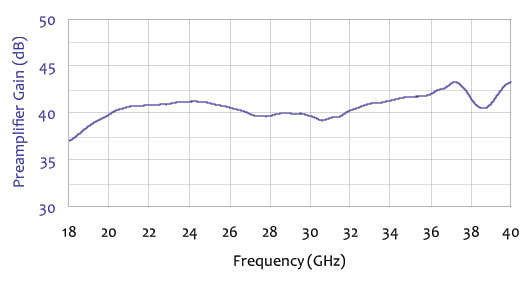
- High preamplifier gain of 37–43 dB; ensures enhanced signal reception across all test scenarios
- Low noise figure below 5 dB; maximizes signal-to-noise ratio in low-level signal environments
- The antenna includes a double ridged waveguide design with precise impedance matching.
- It is individually calibrated per ANSI C63.5 with NIST traceability.
- Full system calibration reduces measurement uncertainty.
- This antenna supports both radiated emissions and immunity testing.
- External connections allow filters and attenuators to be added.
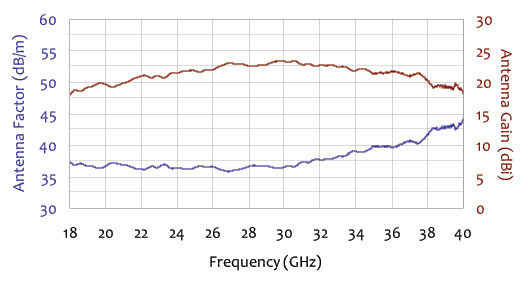
- The antenna factor remains flat across its broadband frequency range.
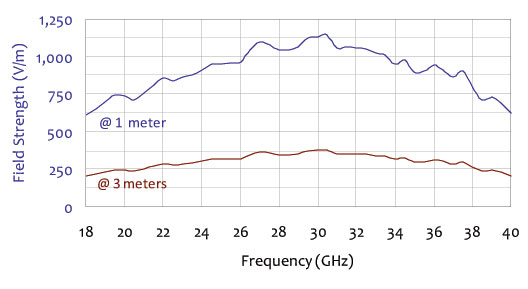
- It can generate up to 1100 V/m @ 1 meter with 200W input for immunity tests.
- Ideal for high-frequency EMC applications with flexible setup options.
- Lightweight and compact design; weighs only 1.5 lbs (0.68 kg), enabling portable and flexible deployment.
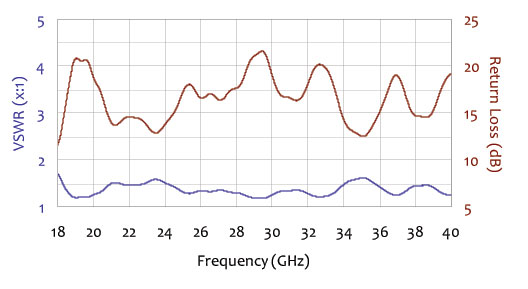
- Precision waveguide-to-coax adapter included; supports optimal VSWR (1.4:1 avg) for improved test integrity.
Features
- ▸ Millimeter-wave coverage — covers the full 18 GHz to 40 GHz band, addressing the increasingly critical mmWave region used in 5G, satellite, radar, and high-speed digital emissions testing.
- ▸ Tuned-as-a-set design — the double-ridged waveguide horn and waveguide-to-coaxial adapter are matched and tuned together as a single unit for optimum VSWR and impedance match.
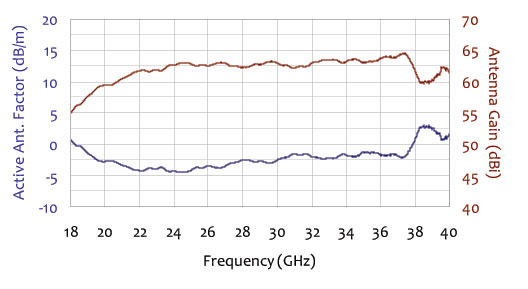
- ▸ Frequency-shaped preamplifier gain — preamp gain rises with frequency at nearly the same slope as the horn’s antenna factor, producing a flat active antenna factor across the entire band.
- ▸ External antenna-to-preamp connection — unique to this design, the link between antenna output and preamp input is an external short coaxial assembly, allowing insertion of attenuators, bandpass filters, or notch filters between them — not possible on competing integrated active horns.
- ▸ Wide dynamic range — preamp can be attenuated or fully bypassed to handle high-amplitude signals where saturation is the concern rather than sensitivity, giving the AHA-840 a measurement range broader than typical active horns.
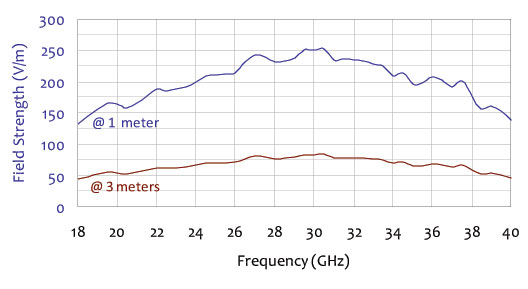
- ▸ High-field immunity capability — with the coaxial adapter removed and amplifier connected directly to the waveguide input, generates field strengths up to 1100 V/m @ 1 m with 200 W input; up to 250 V/m @ 1 m with 10 W using the standard coaxial input.
- ▸ Front-end placement of preamplifier — preamp is mounted at the antenna rather than at the receiver, amplifying weak signals before they suffer cable losses on the long run to the test equipment area.
- ▸ Precision K-type (2.92 mm) connectors — high-frequency connectors rated for full mmWave performance through 40 GHz with low loss and excellent repeatability.
- ▸ Compact and lightweight — weighs only 1.5 lbs (0.68 kg), making it easier to mount on tripods, masts, and positioners than larger broadband horns.
- ▸ Custom-built durable assembly — integrated horn, adapter, and preamplifier in a single rugged housing built for repeated lab and field deployment.
- ▸ Calibrated as a complete system — antenna, preamplifier, and connecting cable are calibrated together as a single unit at 3 meters per ANSI C63.5, accounting for inter-component mismatch and reducing measurement uncertainty beyond what individual component calibration provides.
- ▸ NIST-traceable calibration included — calibration data and certificate ship with every unit; ISO 17025 accredited calibration available on request.
- ▸ Dual emissions and immunity role — one antenna serves both radiated emissions measurements and radiated immunity testing, simplifying mmWave test setups.
Specifications
| Product Name | Active Horn Antenna |
|---|---|
| Frequency Range | 18 GHz to 40 GHz |
| Polarization | Linear |
| VSWR (Antenna Port) | 1.4 : 1 (average) |
| POUT @ 1 dB Compression | > 10 dBm |
| POUT @ Third Order Intercept | 17 dBm |
| Noise Figure | < 5 dB (@ 25 °C) |
| Preamplifier Gain | 37 to 43 dB (frequency-dependent — see graph) |
| Connector Types | 50 Ω [2.92 mm] “K-type” female (all RF connections) |
| Field Strength (waveguide direct, 200 W) | Up to 1100 V/m @ 1 m (waveguide-to-coaxial adapter removed) |
| Field Strength (2.92 mm input, 10 W) | Up to 250 V/m @ 1 m (with adapter in place) |
| AC Adapter Output (preamp power) | 6 VDC (unregulated), 500 mA |
| Calibration | Individually calibrated at 3 m per ANSI C63.5, NIST traceable |
| Dimensions (L × W × H) | 10.2" × 8.5" × 5.9" [26 × 21.7 × 15 cm] |
| Weight | 1.5 lbs [0.68 kg] |
All values are typical, unless specified. All specifications are subject to change without notice.
🔍 Not Sure Which Antenna You Need?
Compare all Com-Power antenna models side-by-side with our interactive selection tool. Filter by frequency range, antenna category, application, polarization, and power handling to find your perfect match.
Compare All Antenna Models →AHA-840 Active Horn Antenna – Frequently Asked Questions
1. What is the AHA-840 active horn antenna and what is it designed to do?
The AHA-840 active horn antenna is a broadband double-ridge waveguide horn antenna designed for high-frequency EMI and EMC testing from 18 GHz to 40 GHz. It combines the directional characteristics of a horn antenna with a built-in low-noise preamplifier, allowing it to function as a sensitive receiving antenna for radiated emissions while also supporting radiated immunity work. According to the product information, it is suitable for FCC, CISPR, EN, ETSI, FAA, MIL-STD, and automotive EMC applications, which makes it a strong option for labs working on mmWave, radar, aerospace, and advanced wireless products.
2. What frequency range does the AHA-840 cover, and why is 18 GHz to 40 GHz important?
The AHA-840 covers 18 GHz to 40 GHz, a range that is important for modern mmWave EMC testing, 5G FR2-related evaluations, 24 GHz automotive radar, high-frequency digital harmonics, and other microwave or Ka-band-adjacent applications. As products continue moving into higher operating frequencies, EMC test labs need antennas that can characterize emissions and immunity in bands far above traditional 1 GHz to 18 GHz work. An antenna that reaches 40 GHz allows engineers to investigate whether a product is radiating unintended energy or remains immune to high-frequency exposure in an increasingly crowded RF environment.
3. What makes the AHA-840 an active horn antenna rather than a passive horn antenna?
The AHA-840 is considered an active horn antenna because it includes a built-in low-noise preamplifier with approximately 37 dB to 43 dB gain. A passive horn antenna relies only on its inherent antenna behavior and typically requires external amplification for weak-signal measurements. By contrast, an active horn amplifies the received signal close to the antenna, which improves effective system sensitivity and helps offset cable and connector losses at very high frequencies. This is especially valuable in the 18 GHz to 40 GHz region, where path loss and cable attenuation become increasingly important in measurement uncertainty and system noise performance.
4. What is the advantage of the built-in low-noise preamplifier in the AHA-840?
The built-in preamplifier improves the antenna’s usefulness as a high-frequency radiated emissions antenna by increasing low-level signal strength before the signal travels through the rest of the RF chain. The page lists a 37 to 43 dB preamplifier gain and a noise figure below 6 dB, both of which are important in microwave measurements. High gain helps raise weak signals above the receiver noise floor, while the low noise figure limits the amount of additional noise contributed by the active stage. In practical terms, this means the antenna can be used more effectively for weak mmWave emissions, chamber diagnostics, and advanced product troubleshooting where sensitivity matters.
5. Can the AHA-840 be used for both radiated emissions and radiated immunity testing?
Yes. The product page states that the AHA-840 supports both radiated emissions and immunity testing. That dual-role capability is valuable because laboratories often want one antenna platform that can support both receive-mode measurements and high-field transmit setups. For emissions work, the active preamplifier improves sensitivity. For immunity work, the antenna is specified to generate up to 1100 V/m at 1 meter with 200 W input, which makes it useful in demanding high-frequency field generation applications. This versatility helps reduce equipment changes and can simplify chamber workflow.
6. How strong of a field can the AHA-840 generate, and why is that significant?
The AHA-840 can generate up to 1100 V/m at 1 meter with 200 W input. That is a significant field-strength capability for an antenna in the 18 GHz to 40 GHz range because high-frequency immunity testing often requires strong, stable fields over a controlled area. Field generation at mmWave frequencies can be challenging due to cable losses, amplifier performance limits, and chamber behavior. An antenna that can produce this level of field strength gives test engineers more headroom for demanding immunity profiles, development stress testing, and specialized aerospace, defense, or automotive test plans.
7. What type of horn design does the AHA-840 use, and why is a double-ridge waveguide horn beneficial?
The AHA-840 uses a double-ridge waveguide horn design. Double-ridge horn antennas are widely used in broadband EMC work because they provide useful directional performance over a wider frequency range than many simpler horn geometries. In this case, that design helps the antenna cover 18 GHz to 40 GHz while maintaining performance that supports emissions measurement and immunity generation. A broadband horn reduces the need to change antennas during long sweeps or multi-standard test programs, which improves test efficiency and repeatability in high-frequency labs.
8. What does the low antenna factor and flat antenna factor response mean in practical EMC testing?
The product page highlights a flat antenna factor response and low antenna factor characteristics. In practical EMC testing, a flatter antenna factor means the conversion between received voltage and field strength varies less dramatically across frequency. That helps simplify measurement corrections, improves consistency across broadband sweeps, and reduces the risk of highly frequency-dependent behavior masking important emissions. For engineers performing high-frequency scans, a flatter response often makes data interpretation easier and helps create a cleaner, more stable measurement chain, especially when combined with individual calibration data.
9. What are the key electrical specifications of the AHA-840 that engineers should pay attention to?
Several specifications on the page are especially important. These include the 18 GHz to 40 GHz frequency range, 37 to 43 dB preamplifier gain, noise figure below 6 dB, active antenna gain greater than 55 dBi, P(out) at 1 dB compression greater than 10 dBm, and an average 1.4:1 VSWR at the antenna port. Together, these values describe how the antenna behaves in both receive and transmit mode, how well it is matched, how much amplification it provides, and how robustly it can support high-frequency measurement and field-generation tasks. These are the types of parameters that determine whether an antenna fits a given chamber, amplifier chain, or compliance workflow.
10. What connector does the AHA-840 use, and why is the 2.92 mm K-type connector important?
The AHA-840 uses 50 ohm 2.92 mm K-type female connectors for all RF connections. At frequencies up to 40 GHz, connector quality becomes much more critical than it is at lower EMC bands. Precision connectors help maintain match quality, minimize reflections, reduce uncertainty, and preserve signal integrity throughout the RF path. The use of a 2.92 mm connector is appropriate for mmWave and upper microwave EMC work because it supports reliable mechanical and electrical performance in a frequency range where ordinary lower-frequency connectors may become limiting.
11. What is the purpose of the preamp bypass function on the AHA-840?
The product page notes that the AHA-840 includes a preamp bypass. This is useful because it gives the user flexibility when dealing with strong signals, specialized setups, or external measurement chains. In some situations, the built-in active stage is helpful because it boosts weak signals. In other situations, such as when signals are already strong or when external amplification, attenuation, or calibration architecture is preferred, bypassing the preamp can improve control over the RF chain. This makes the antenna more versatile than a fixed active-only design and supports a wider variety of laboratory workflows.
12. Why does the AHA-840 include an external port for filters and attenuators?
The external connection for filters and attenuators gives engineers more flexibility in configuring the measurement chain. At very high frequencies, external filtering can be useful for rejecting unwanted out-of-band content, protecting downstream equipment, or tailoring the system to a particular standard or test environment. External attenuators can help manage signal levels, improve impedance behavior, or protect sensitive active circuitry. This kind of configurable RF access is valuable in high-end EMC labs because it lets the user adapt the antenna to different measurements rather than forcing one fixed operating mode.
13. What standards and industries is the AHA-840 suited for?
According to the page, the AHA-840 is suitable for FCC, CISPR, EN, ETSI, FAA, MIL-STD, and automotive EMC work. That means it can serve commercial electronics, aerospace, defense, transportation, advanced communications, and automotive radar-related test programs. Because of its high-frequency range, it is especially relevant for products that operate in or radiate into mmWave bands, including advanced wireless systems, satellite-adjacent platforms, automotive sensing, and other modern RF-dense environments. This broad applicability makes it a strong fit for test labs that support multiple industries rather than a single standard family.
14. How is the AHA-840 calibrated, and why does ANSI C63.5 with NIST traceability matter?
The AHA-840 is individually calibrated per ANSI C63.5 with NIST traceability. Individual calibration is especially important for high-frequency antennas because small variations in geometry, connector behavior, and RF assembly can affect performance. NIST traceability provides confidence that the calibration chain links back to recognized national measurement standards. For EMC labs, this supports data credibility, quality-system compliance, and repeatability across time and different test facilities. The page also notes that full system calibration helps reduce measurement uncertainty, which is a critical point in upper microwave EMC testing where uncertainty can accumulate quickly.
15. How does the AHA-840 compare with the AHA-118?
The main difference is frequency coverage. The AHA-118 serves the lower high-frequency range around 700 MHz to 18 GHz, while the AHA-840 covers 18 GHz to 40 GHz. That means the AHA-840 is the better choice for mmWave EMC testing, high-frequency radar-related work, and applications above the traditional 18 GHz upper limit of many standard horn test setups. The AHA-840 also emphasizes features like a preamp bypass, 2.92 mm K-type connector, and 1100 V/m at 1 meter with 200 W input, all of which reflect its focus on upper microwave performance. In short, the AHA-118 is better for lower broadband microwave EMC work, while the AHA-840 is aimed at the next tier above it.
16. Is the AHA-840 suitable for 5G FR2, automotive radar, and other mmWave product evaluations?
Yes. The page’s SEO and product description clearly position the AHA-840 for mmWave EMC applications, including 5G FR2-style frequency regions, 24 GHz automotive radar, Ka-band-related work, and other very high frequency product environments. In EMC terms, that means the antenna is well suited for evaluating whether these products emit unintended RF energy or maintain performance under high-frequency exposure. As more products move into higher bands, antennas in this class become essential rather than optional for advanced compliance and engineering labs.
17. What are the physical size and weight advantages of the AHA-840 in lab use?
The AHA-840 has compact dimensions of approximately 10.2 x 8.5 x 5.9 inches and weighs only about 1.5 lbs (0.68 kg). For a high-frequency active horn, this is a useful mechanical advantage because it makes the antenna easier to mount, easier to position on masts or stands, and easier to integrate into portable or reconfigurable test setups. Lighter antenna assemblies can also reduce mechanical loading on positioning systems and make chamber alignment quicker and more repeatable for engineers performing frequent test changes.
18. Why would a lab choose the AHA-840 instead of using a passive mmWave horn plus separate accessories?
A lab may choose the AHA-840 because it combines several valuable capabilities into one platform: broad 18 GHz to 40 GHz coverage, built-in low-noise gain, preamp bypass flexibility, external filter/attenuator access, flat antenna factor response, and strong radiated immunity field generation. Instead of building a more complex RF chain with a passive horn, separate preamplifier, added transitions, and more connection points, the AHA-840 gives the user a more integrated path. That can reduce setup time, reduce cable-related loss and uncertainty, and create a cleaner, more repeatable test environment for advanced EMC work.
Application Notes (PDF)
- Reducing Scepticism in Emissions Measurements (Active Horn Antennas)
- AN-107 — What is Antenna Factor?
- AN-106 — Use of Antenna Factor for EMC Measurements
- Selecting the Right EMI Antenna
- EMC Antenna Calibration Requirements, Methodologies, and Best Practices
- NIST Antenna Calibration Services — Com-Power Capabilities and Traceability
- Com-Power EMC Antenna Product Line — Complete Specifications
- Accounting for Ambient Noise
Interactive Tools
- Antenna Finder Wizard
- Com-Power Antenna & Field Strength Calculator
- Com-Power EMC Compliance Limits Calculator
- Com-Power Cable Loss & Attenuation Calculator
- Com-Power RF Power and Level Converter
Industry Applications
- 5G Equipment EMC Testing — New Challenges in EMC Compliance
- Aerospace and Defense EMC Testing — MIL-STD-461 Requirements
- Automotive EMC Testing — ISO 11452 / CISPR 25
Blog Articles


Quote Request
Other EMC Test Equipment
- Absorbing Clamps
- Antenna Kits
- Antenna Masts - Automated and Manual
- Antennas
- Bulk Current Injection probes
- CDNs - Coupling Decoupling Network
- Comb Generators
- Conducted Immunity Test Systems
- Current Monitor Probes
- Current Probe Calibration Fixtures
- EM Clamps
- Feed Through Capacitor
- ISNs - Impedance Stabilization Network
- LISNs - Single Phase
- LISNs - TEMPEST
- LISNs - Three Phase
- Magnetic Field Generator
- Near Field Probes
- Power Amplifiers
- Pre-compliance Emissions Test Systems
- Preamplifiers
- Spectrum Analyzers
- Surge Generators
- System Controllers
- Transient Limiters
- Tripods For EMC
- Turntables