
AB-900A Biconical Antenna
AB-900A / ABF-900A Biconical Antenna — Key Highlights
- ▸ Broadband 25 MHz to 300 MHz Coverage: A linearly polarized biconical dipole antenna designed for the full lower-VHF EMC band, supporting both radiated emissions measurements and radiated immunity testing required by FCC, CISPR, EN, ETSI, MIL-STD-461, RTCA DO-160, and SAE Automotive standards.
- ▸ Choice of Fixed or Flexible Elements: Order the AB-900A with rigid, fixed powder-coated aluminum elements for permanent installation in chambers and OATS, or the ABF-900A with high-quality polished-aluminum flexible (collapsible) elements for portable EMC labs, multi-site contract testing, and field surveys — same calibrated electrical performance, different mechanical configuration.
- ▸ Gamma-Match Element Design: An integrated gamma-match rod connects the element’s center rod to one of the outer elements at the inside edge of the 90° bend, eliminating the response “dip” common to most biconical antennas and producing a noticeably smoother frequency response across the operating band.
- ▸ CISPR 16-1-4 Compliant Symmetry & Cross-Polarization: Antenna balance is held to better than ±1 dB and cross-polarization rejection exceeds 20 dB, meeting the symmetry and polarization-discrimination requirements of CISPR 16-1-4 and ANSI C63.5 to minimize uncertainty in compliance measurements.
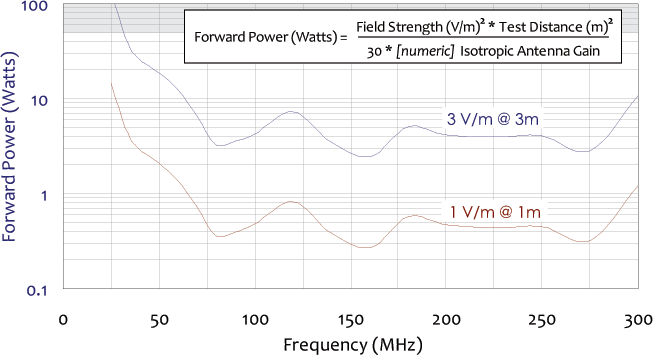
- ▸ 50 W Transmit & Receive Capability: Both versions handle up to 50 W continuous input power, allowing the same antenna to function as a receive antenna for emissions measurements and as a transmit antenna for radiated immunity testing per IEC 61000-4-3, automotive ISO 11452, and military RS103 setups when driven by an RF power amplifier.
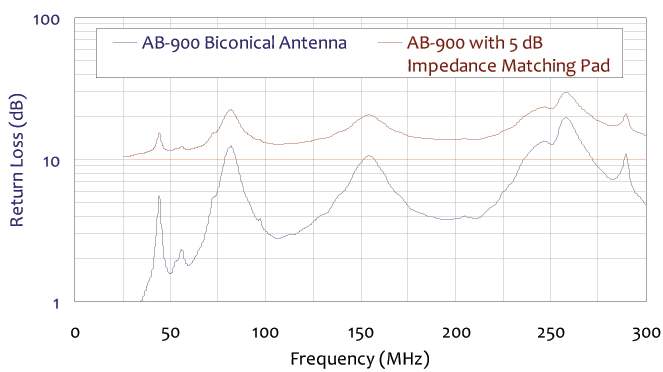
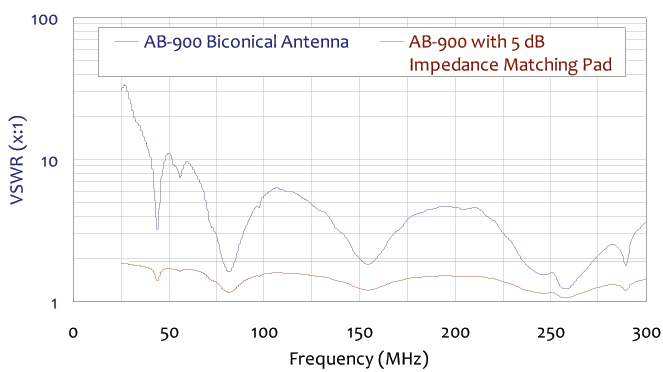
- ▸ Optional 5 dB Impedance-Matching Pad: With the factory-fitted 5 dB matching pad, average VSWR drops from 7.3:1 (unmatched) to 1.39:1, easily satisfying the minimum 10 dB return-loss requirement of CISPR 16-1-4 without adding an external attenuator.
- ▸ ANSI C63.5 NSA-Ready Geometry: Physical dimensions conform to Figure G.1 of ANSI C63.5, so a matched pair can be used for Normalized Site Attenuation (NSA) calibration of OATS and semi-anechoic chambers using published Geometry Specific Correction Factors — avoiding costly Standard Antenna Calibration Site procedures.
- ▸ Robust 50 Ω N-Type Interface: Standard 50 ohm nominal impedance with a Type-N female RF connector provides reliable signal transfer to EMI receivers, spectrum analyzers, signal generators, and RF amplifiers used in compliance and engineering setups.
- ▸ Tripod & Mast Mounting Ready: Lightweight 5 lb / 2.3 kg construction mounts cleanly on the Com-Power AT-812 Antenna Tripod and AM-400 Antenna Mast; the ATHP-812 Antenna Pipe Holder clamps around the feed tube and threads onto any standard 1/4"-20 mounting point.
- ▸ Individually Calibrated, NIST-Traceable, 3-Year Warranty: Each unit is individually calibrated per ANSI C63.5 or SAE ARP958 with NIST-traceable data and a certificate of calibration; ISO 17025 accredited calibration is available on request. Backed by Com-Power’s standard three-year manufacturer warranty.
Features
- ▸ Standard 25 MHz to 300 MHz EMC band — covers the lower-VHF emissions and immunity range required by FCC, CISPR, EN, ETSI, MIL-STD-461, RTCA DO-160, and SAE Automotive standards.
- ▸ Gamma-match element design — integrated gamma-match rod connects the element’s center rod to one of the outer elements at the inside edge of the 90° bend, eliminating the response “dip” common to most biconical antennas and producing a smoother frequency response.
- ▸ High cross-polarization rejection — better than 20 dB cross-polarization rejection per CISPR 16-1-4, minimizing measurement uncertainty caused by orthogonal field components.
- ▸ Tight balance/symmetry per CISPR 16-1-4 — antenna symmetry held to better than ±1 dB, complying with the balance requirements of ANSI C63.5 and CISPR 16-1-4.
- ▸ Choice of fixed or flexible elements — standard AB-900A ships with fixed powder-coated aluminum elements for permanent lab installation; the ABF-900A option supplies flexible (collapsible) polished-aluminum elements for portable use, easier transport, and compact storage.
- ▸ Transmit and receive capability — functions as a receiving antenna for emissions measurements and as a transmitting antenna for radiated immunity testing with up to 50 W input power.
- ▸ 5 dB impedance-matching pad option — with the optional matching pad, average VSWR drops dramatically (1.39:1 vs. 7.3:1 unmatched), helping satisfy CISPR 16-1-4 return-loss requirements.
- ▸ ANSI C63.5 numerical-correction-compatible geometry — physical dimensions conform to Figure G.1 of ANSI C63.5, allowing a pair to be used for NSA calibration of OATS and semi-anechoic chambers using the published Geometry Specific Correction Factors, avoiding expensive Standard Antenna Calibration Site procedures.
- ▸ Powder-coated aluminum elements — corrosion-resistant aluminum with a powder-coated finish for durability in lab and field deployments.
- ▸ Tripod and mast mounting — works with the Com-Power AT-812 Antenna Tripod and AM-400 Antenna Mast; the ATHP-812 Antenna Pipe Holder clamps securely around the feed tube and mounts to any 1/4"-20 thread.
- ▸ General-purpose RF utility — useful for shielding effectiveness testing, site comparisons, field monitoring, and site surveys beyond formal compliance work.
- ▸ Individually calibrated, NIST-traceable — calibrated per ANSI C63.5 or SAE ARP958; calibration data and certificate ship with each unit; ISO 17025 accredited calibration available on request.
- ▸ Three-year standard warranty — backed by manufacturer support.
Antenna Ordering Options
| Order Code | Option Description |
|---|---|
| AB-900A | Fixed [standard] Elements |
| ABF-900A | Flexible (Collapsible) Elements |
| AB-900A-B | Balun ONLY [no elements] |
| AB-900A-A5 | Fixed Elements with 5 dB Attenuator |
| ABF-900A-A5 | Flexible (Collapsible) Elements with 5 dB Attenuator |
| AB-900A-B-A5 | Balun ONLY with 5 dB Attenuator |
Antenna Accessories
| Item Description | Part No. |
|---|---|
| Additional Set of Fixed Elements | AELE-BF |
| Additional Set of Flexible (Collapsible) Elements | AELE-BC |
| Mounting Adapter for Tripod | ATA-22MR |
| Mounting Adapter for Antenna Mast | AMA-22MR |
Specifications
| Product Name | Biconical Antenna |
|---|---|
| Frequency Range | 25 MHz to 300 MHz |
| Polarization | Linear |
| Cross-Polarization | > 20 dB rejection |
| Antenna Symmetry (balance) | < ±1 dB |
| Nominal Impedance | 50 Ω |
| Power Handling | 50 Watts (continuous) |
| Connector | N-type (female) |
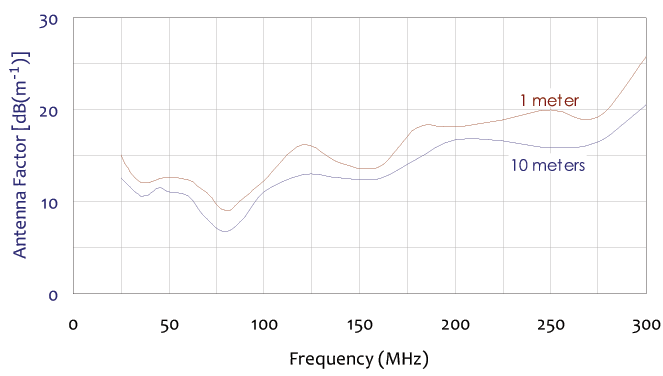
| Antenna Factor | 6 to 19 dB(m-1) [average: 13.8] @ 10 m |
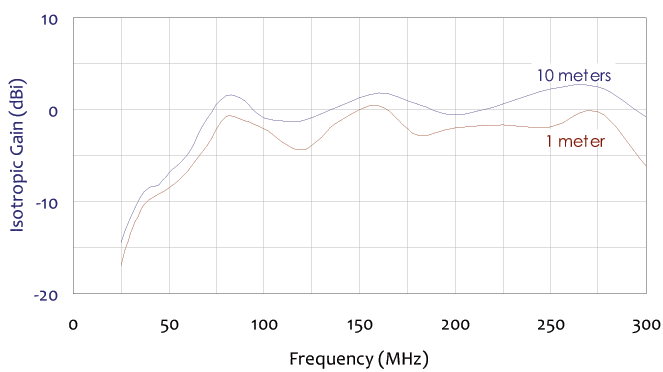
| Isotropic Gain | -19 to 3 dBi [average: -0.8] @ 10 m |
| VSWR (without matching pad) | 1.2 to 104 : 1 [average: 7.3] |
| VSWR (with 5 dB matching pad) | 1.12 to 1.86 : 1 [average: 1.39] |
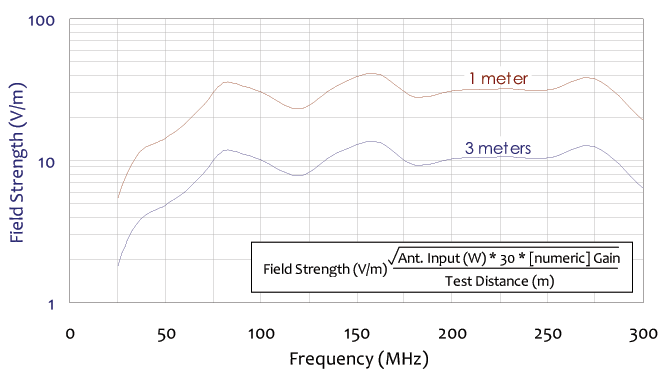
| Maximum Radiated Field | See typical field strength graph (with 50 W input power) |
| Applicable Standards | FCC, CISPR, EN, ETSI, FAA, MIL-STD-461, Automotive, and similar |
| Calibration | Individually calibrated per ANSI C63.5 or SAE ARP958, NIST traceable |
| Dimensions (L × W × H) | 51.5" × 20.2" × 27.2" [130.8 × 51.3 × 69.1 cm] |
| Weight | 5 lbs [2.3 kg] |
All values are typical, unless specified. All specifications are subject to change without notice.
🔍 Not Sure Which Antenna You Need?
Compare all Com-Power antenna models side-by-side with our interactive selection tool. Filter by frequency range, antenna category, application, polarization, and power handling to find your perfect match.
Compare All Antenna Models →AB-900A Biconical Antenna – Technical FAQs
1. What is the AB-900A biconical antenna and where is it used in EMC testing?
The AB-900A is a broadband biconical antenna covering 25 MHz to 300 MHz, used for radiated emissions and immunity testing. In real EMC labs, it is commonly used to test automotive electronics, industrial controllers, cable harnesses, and communication systems where emissions in the VHF band are critical.
2. What is the difference between AB-900A and AB-300M?
Both operate in the same frequency range, but the AB-900A emphasizes collapsible element design for portability and ease of transport, while AB-300M offers more configuration flexibility. Functionally, both serve similar roles in emissions and immunity testing.
3. When should you use a biconical antenna instead of a log periodic antenna?
Use a biconical antenna below ~300 MHz where broadband low-frequency coverage is required. Log periodic antennas are preferred above this range due to higher gain and smaller size.
4. What real-world problems can this antenna help identify?
It helps detect emissions from: - Long cable radiation - Switching power supplies - Ground loops - PCB layout issues These are common failure points in EMC compliance.
5. What standards require this type of antenna?
The AB-900A is used in FCC, CISPR, EN, MIL-STD-461, and DO-160 testing. It is also used in chamber validation and NSA testing.
6. Can the AB-900A be used for immunity testing?
Yes, it supports transmit mode up to 50W and is used with amplifiers to generate RF fields for immunity testing.
7. What industries use this antenna?
Automotive, aerospace, defense, industrial electronics, and consumer electronics manufacturers commonly use this antenna.
8. What are real-world immunity use cases?
Used to test ECUs, avionics systems, and industrial equipment to ensure they operate correctly under RF exposure.
9. How does it compare to a horn antenna?
Horn antennas operate at higher frequencies (above ~700 MHz), while biconical antennas are ideal for lower frequencies.
10. Why is linear polarization important?
It allows controlled measurement of emissions in specific orientations, which is required by EMC standards.
11. What is the benefit of collapsible elements?
They make the antenna portable and easy to store, which is useful for field testing and mobile labs.
12. What is antenna factor and why does it matter?
Antenna factor converts measured voltage into field strength. Accurate calibration ensures compliance measurements are valid.
13. Can this antenna be used for pre-compliance testing?
Yes, engineers use it early in development to identify EMI issues before certification testing.
14. What test setups commonly use this antenna?
Used in: - Semi-anechoic chambers - Open area test sites - EMC pre-compliance labs
15. How does impedance matching affect results?
Proper matching reduces reflections and improves measurement accuracy.
16. How does this compare to monopole antennas?
Monopoles are used below 30 MHz for E-field, while biconical antennas are used above that range.
17. Why choose AB-900A?
It provides broadband coverage, compliance with major standards, portability, and reliable measurement performance.
Application Notes (PDF)
- AN-107 — What is Antenna Factor?
- AN-106 — Use of Antenna Factor for EMC Measurements
- Selecting the Right EMI Antenna
- Considerations when Selecting an Antenna for RF Immunity Testing
- EMC Antenna Calibration Requirements, Methodologies, and Best Practices
- NIST Antenna Calibration Services — Com-Power Capabilities and Traceability
- Com-Power EMC Antenna Product Line — Complete Specifications
- Accounting for Ambient Noise
Interactive Tools
- Antenna Finder Wizard
- Com-Power Antenna & Field Strength Calculator
- Com-Power EMC Compliance Limits Calculator
- Com-Power Cable Loss & Attenuation Calculator
- Com-Power VSWR / Return Loss / Mismatch Loss Calculator
- Com-Power Free Space Path Loss & Link Budget Calculator
Industry Applications
- EMC Considerations for IoT and Smart Home Devices
- Automotive EMC Testing — ISO 11452 / CISPR 25
- 5G Equipment EMC Testing — New Challenges in EMC Compliance
- Medical Device EMC Compliance — IEC 60601-1-2 Essentials
- EV Charging Systems — EMC Requirements and Compliance
Blog Articles


Quote Request
Other EMC Test Equipment
- Absorbing Clamps
- Antenna Kits
- Antenna Masts - Automated and Manual
- Antennas
- Bulk Current Injection probes
- CDNs - Coupling Decoupling Network
- Comb Generators
- Conducted Immunity Test Systems
- Current Monitor Probes
- Current Probe Calibration Fixtures
- EM Clamps
- Feed Through Capacitor
- ISNs - Impedance Stabilization Network
- LISNs - Single Phase
- LISNs - TEMPEST
- LISNs - Three Phase
- Magnetic Field Generator
- Near Field Probes
- Power Amplifiers
- Pre-compliance Emissions Test Systems
- Preamplifiers
- Spectrum Analyzers
- Surge Generators
- System Controllers
- Transient Limiters
- Tripods For EMC
- Turntables