
FM High Power Log Periodic Antenna
- The ALFM-80120 is a linearly polarized Log Periodic Dipole Array (LPDA) Antenna, operating over the frequency range of 80 MHz to 120 MHz.
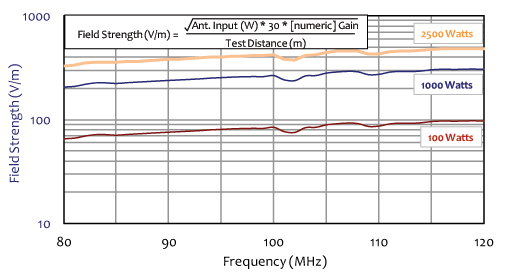
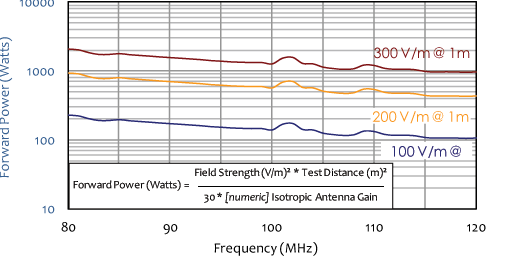
- The ALFM-80120 Power Log Periodic Antenna is part of our custom designed antennas specifically geared for use as a high power transmitting antenna to establish radiated RF fields for immunity tests, and is capable of handling power levels up to 2500 Watts (CW).
- Every antenna is calibrated individually in accordance with SAE ARP 958 with NIST traceability. The certificate and calibration data are provided.
- Additionally, ISO 17025-accredited calibration is available upon request.
Features
- ▸ FM-band high-power immunity coverage — covers the full FM broadcast band (88 MHz to 108 MHz, extendible to 80–120 MHz), the band where automotive, broadcast, and avionics immunity testing requires the highest forward power for a given field strength.
- ▸ Exceptional 2500 W CW power handling — rated for up to 2500 Watts continuous wave, far exceeding the 50–500 W ratings typical of higher-frequency LPDAs; sized to the field strength demands of low-VHF immunity testing.
- ▸ 7-16 DIN female connector — high-power coaxial connector chosen specifically to handle continuous kilowatt-level RF safely, where standard N-type connectors approach their thermal limits.
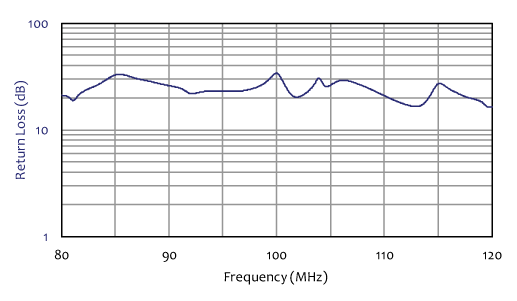
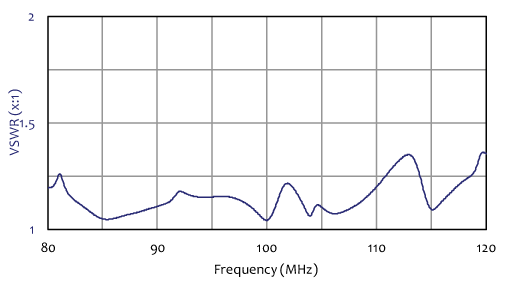
- ▸ Low VSWR across the FM band — better than 1.25:1 across 88–108 MHz (1.3:1 from 80–88 MHz, 1.45:1 from 108–120 MHz), protecting expensive RF amplifiers from reflected power during high-power immunity testing.
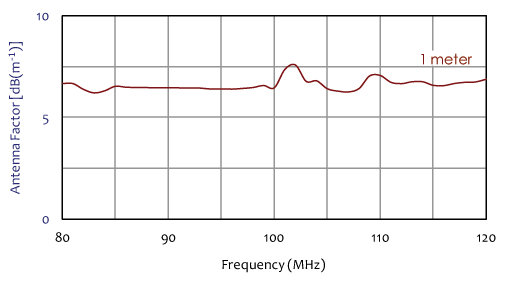
- ▸ Low antenna factor — 6 to 8 dB(m-1) at 1 m distance, allowing efficient field generation without requiring excessive amplifier power overhead.
- ▸ Center-pivoting polarization mount — integrated 1/4"-20 threaded center pivoting joint allows fast switching between horizontal and vertical polarization for two-axis immunity testing.
- ▸ Custom-designed for high-power EMC labs — this is a purpose-built specialist antenna for facilities running kilowatt-class amplifiers in the FM band, not a general-purpose product adapted for high power.
- ▸ Disassemblable element design — ten pairs of log elements ship separately and assemble onto the feeder tubes per the supplied diagram, simplifying transport and storage of an antenna with an 82" element span.
- ▸ Calibrated per SAE ARP 958 — calibration to the SAE ARP 958 procedure with NIST traceability makes this antenna directly applicable to automotive and aerospace immunity test programs that reference this standard.
- ▸ Application-specific sweet spot — optimized for automotive FM immunity testing (SAE J551, ISO 11452-2), broadcast equipment immunity verification, and avionics FM band susceptibility per RTCA DO-160.
- ▸ Individually calibrated, NIST-traceable — calibration certificate and data ship with each unit; ISO 17025 accredited calibration available on request.
- ▸ Three-year standard warranty — backed by manufacturer support.
Specifications
| Model | ALFM-80120 |
|---|---|
| Frequency Range | 88 MHz to 108 MHz (extendible to 80 MHz to 120 MHz) |
| Polarization | Linear |
| Nominal Impedance | 50 Ω |
| Power Handling | 2500 Watts (CW), maximum |
| Connector | 7-16 DIN female |
| Antenna Factor | 6 to 8 dB(m-1) (@ 1 m distance) |
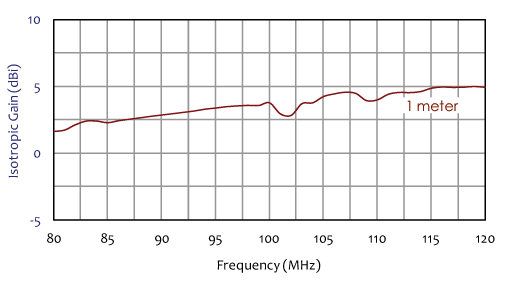
| Isotropic Gain | 1.5 to 5 dBi (@ 1 m distance) |
| VSWR (80 to 88 MHz) | < 1.3 : 1 |
| VSWR (88 to 108 MHz) | < 1.25 : 1 |
| VSWR (108 to 120 MHz) | < 1.45 : 1 |
| Mounting | 1/4"-20 threaded center pivoting joint (horizontal and vertical polarization) |
| Calibration | Individually calibrated per SAE ARP 958, NIST traceable |
| Dimensions (H × W × D, fully assembled) | 7.5" × 81.9" × 82.7" [19 × 208 × 210 cm] |
| Weight | 13.5 lbs [6.1 kg] |
All values are typical, unless specified. All specifications are subject to change without notice.
ALFM-80120 FM High Power Log Periodic Antenna – Frequently Asked Questions
1. What is the ALFM-80120 FM high power log periodic antenna and what is it specifically designed for?
The ALFM-80120 is a high-power linearly polarized log periodic dipole array antenna designed for the FM broadcast band, covering 88 MHz to 108 MHz with practical usability from about 80 MHz to 120 MHz. Unlike general broadband log periodic antennas, this model is intentionally focused on the FM band and is built to support high-power transmitting applications for radiated immunity testing as well as selected receiving applications. Its key engineering purpose is to generate stable, repeatable RF fields in the FM region where automotive, aerospace, broadcast, and communication-related equipment must demonstrate immunity to strong external radio-frequency environments.
2. Why is a dedicated FM-band antenna useful when broadband antennas already exist?
A dedicated FM-band antenna is useful because frequency focus improves efficiency, power handling, and field generation performance in the exact band of interest. A broadband antenna may cover the FM band, but it is usually designed as a compromise across a much wider spectrum. In contrast, the ALFM-80120 concentrates its design on the FM range, which allows it to handle very high power and provide better suitability for intense radiated immunity work in that band. In real EMC programs, that matters because automotive receivers, infotainment modules, avionics systems, and other sensitive products may need to be evaluated specifically against FM-band interference, not merely against a general broadband RF source.
3. What kinds of real-world products and systems are most likely to be tested with the ALFM-80120?
This antenna is particularly relevant for products exposed to or affected by strong FM-band fields, including automotive infotainment systems, in-vehicle radios, control modules with connected harnesses, avionics subsystems, broadcast-related electronics, communication equipment, and receiver-based systems. In real qualification work, engineers may need to verify that a vehicle radio does not malfunction in the presence of strong FM fields, or that a safety-related controller does not suffer upset when exposed to nearby broadcast-band energy. The ALFM-80120 is suited to that kind of focused, application-driven EMC work where FM-band susceptibility is a serious engineering concern rather than just a theoretical requirement.
4. Why does 2500 W continuous power handling matter so much for this antenna?
The 2500-watt continuous-wave power rating is one of the defining technical characteristics of the ALFM-80120. High power handling matters because radiated immunity testing often requires the creation of substantial field strength at realistic test distances, and lower-power antennas may be unable to do that efficiently in the FM band. At these frequencies, achieving strong, controlled fields can demand serious transmit capability. A high-power antenna reduces the risk of antenna overheating, instability, or mismatch-related limitations when driven by large amplifiers. In practical terms, it gives engineers and lab managers more headroom to reach required field levels with better confidence and less concern that the antenna itself becomes the weak point in the test chain.
5. Which EMC and related standards make an antenna like the ALFM-80120 relevant?
Based on the provided page information, the ALFM-80120 is relevant to standards and programs such as SAE J551, ISO 11452-2, RTCA DO-160, SAE ARP 958, and other automotive, avionics, and broadcast-oriented immunity frameworks where FM-band performance is important. The significance of this is that it places the antenna within sectors where targeted narrowband or band-specific immunity evaluation is often more important than general broadband scanning alone. For buyers, that means this antenna is not just another LPDA; it is a specialized tool for serious FM-band EMC work.
6. How does the ALFM-80120 compare with a general-purpose high-power log periodic antenna?
A general-purpose high-power log periodic antenna is intended to cover a wider frequency range and therefore must balance design tradeoffs across that wider band. The ALFM-80120, however, is optimized for the FM band, which means it can deliver better practical suitability for that region in terms of power use, efficiency, and intended test purpose. In real test planning, a broader antenna may be the right choice when multiple bands must be covered in one sweep. But when FM-band immunity is a key requirement and especially when high transmit power is needed, the ALFM-80120 becomes the better technical choice because it is purpose-built for that environment.
7. Is the ALFM-80120 mainly a transmit antenna, or can it also be used in receive mode?
The ALFM-80120 is primarily positioned as a high-power transmitting antenna for establishing radiated RF fields, which is its most important role. However, it can also be used in receive-oriented measurement situations where FM-band antenna behavior is needed. In practice, though, its strongest value proposition is on the transmit side. Buyers and lab users should think of it mainly as an FM-band immunity antenna rather than as a general-purpose emissions antenna. That distinction helps avoid underusing or misapplying the product in workflows where a lighter, wider-band receive antenna may actually be the more appropriate tool.
8. Why are FM-band immunity tests especially important in automotive EMC?
Automotive systems operate in environments filled with strong broadcast signals, and many vehicles contain multiple electronics platforms that can be affected directly or indirectly by those signals. Modules such as infotainment systems, tuners, control units, body electronics, harness-connected devices, and embedded communication systems may all be vulnerable to radiated disturbances if not properly designed. FM-band testing is important because it addresses a real external environment that vehicles encounter in everyday operation. Using an antenna like the ALFM-80120 helps automotive EMC teams reproduce those field conditions more effectively in the lab so that product behavior can be observed under controlled, repeatable exposure.
9. How is the ALFM-80120 relevant to avionics and aerospace EMC work?
In aerospace and avionics programs, equipment may need to demonstrate tolerance to strong radio-frequency environments across defined bands, including the FM region. Systems installed in aircraft or evaluated for aerospace applications can be sensitive to RF coupling, control disruption, or receiver interference if immunity margins are weak. A specialized FM antenna such as the ALFM-80120 helps engineers perform focused testing in that band when qualification requirements or engineering concerns point to FM-related susceptibility. In these sectors, repeatability, field stability, and documentation matter greatly, so using a purpose-built antenna with traceable calibration is particularly valuable.
10. What do the stated antenna factor, gain, and VSWR characteristics tell an engineer?
The published antenna factor, gain, and VSWR characteristics give engineers insight into how efficiently the antenna radiates and how predictable its performance is across the intended operating band. Gain helps indicate how strongly energy is concentrated in the forward direction, antenna factor supports field-related measurement interpretation, and VSWR reflects how well the antenna is matched to the source over frequency. In transmit applications, low VSWR is especially important because it helps minimize reflected power and makes amplifier-to-antenna operation more efficient and more controlled. In simple terms, these specifications tell the lab whether the antenna is likely to behave stably and effectively when generating high FM-band fields.
11. Why is the 7-16 DIN connector important on this antenna?
The use of a 7-16 DIN female connector is meaningful because this connector family is well suited to higher RF power applications. It offers strong mechanical robustness and practical suitability in installations where substantial power transfer is required. In real immunity labs, connector choice matters because weak or inappropriate connector systems can become a thermal, reliability, or mismatch problem when high-power amplifiers are involved. The presence of a 7-16 DIN interface is a strong signal that the antenna is meant for serious transmit-side EMC work rather than light general-purpose RF observation.
12. How important is individual SAE ARP 958 calibration with NIST traceability for this product?
It is very important because a specialized high-power immunity antenna must still be a measurement-grade tool, not just a radiator. The stated individual calibration per SAE ARP 958 with NIST traceability gives users confidence that the antenna’s behavior has been documented in a traceable way. This supports field uniformity work, documentation, repeatability, and quality assurance in regulated environments. For customers in automotive and aerospace sectors, calibration is often not optional from a workflow standpoint. It helps ensure the antenna is accepted as part of a disciplined test chain and not treated as an undefined RF source.
13. When is the ALFM-80120 a better choice than trying to use a broadband immunity antenna for the FM band?
The ALFM-80120 is a better choice when the test program has a serious FM-band requirement, especially where high field strength, sustained transmit power, and repeatable band-focused performance matter more than broad frequency coverage. If a lab only occasionally touches the FM region and does not need strong field generation there, a general broadband antenna might be sufficient. But if the FM band is a key part of the product’s environment or a recurring qualification requirement, the dedicated FM antenna is the better engineering choice because it is optimized for exactly that challenge.
14. What practical setup and safety considerations matter most when using this antenna?
Because this is a high-power FM transmit antenna, setup discipline is very important. Engineers must consider amplifier compatibility, connector and cable ratings, spacing, mounting stability, grounding practices, and safe exposure conditions around the test area. High-power immunity testing is not just about connecting an antenna and turning on an amplifier. Mechanical stability, repeatable antenna location, adequate power chain design, and careful control of the environment all matter. In real labs, consistent setup practice directly affects not only safety but also the repeatability and validity of the resulting test data.
15. What kind of EMC lab should invest in the ALFM-80120?
The ALFM-80120 is best suited for labs that perform repeated FM-band immunity work in sectors such as automotive, avionics, broadcast-related equipment, and specialized RF susceptibility evaluation. It is especially appropriate where strong FM-band field generation is not just an occasional need but a recurring part of qualification or design validation. A lab that only performs broad generic EMC testing may not need such a specialized antenna. But a lab that regularly faces FM-band requirements will benefit from having a product designed specifically for that band rather than trying to force a broader antenna to do a more specialized job.
16. Why is the ALFM-80120 more than just a niche antenna and instead a strategic tool for the right application?
For the right application, the ALFM-80120 is strategic because it solves a very specific and technically demanding EMC problem: reliable high-power FM-band field generation. That is not a minor niche when entire product classes must survive in environments where broadcast-band RF is part of the real operating world. By combining band focus, high power handling, appropriate connector design, and traceable calibration, the antenna gives engineers a tool that is both application-specific and professionally measurement-oriented. For organizations that work in FM-sensitive immunity environments, that makes it a highly meaningful long-term asset rather than a narrow specialty accessory.
Application Notes (PDF)
- AN-107 — What is Antenna Factor?
- AN-106 — Use of Antenna Factor for EMC Measurements
- Selecting the Right EMI Antenna
- Considerations when Selecting an Antenna for RF Immunity Testing
- EMC Antenna Calibration Requirements, Methodologies, and Best Practices
- NIST Antenna Calibration Services — Com-Power Capabilities and Traceability
- Com-Power EMC Antenna Product Line — Complete Specifications
- Accounting for Ambient Noise
Interactive Tools
- Antenna Finder Wizard
- Com-Power Antenna & Field Strength Calculator
- Com-Power EMC Compliance Limits Calculator
- Com-Power Cable Loss & Attenuation Calculator
- Com-Power VSWR / Return Loss / Mismatch Loss Calculator
- Com-Power Free Space Path Loss & Link Budget Calculator
Industry Applications
- EMC Considerations for IoT and Smart Home Devices
- Automotive EMC Testing — ISO 11452 / CISPR 25
- 5G Equipment EMC Testing — New Challenges in EMC Compliance
- Medical Device EMC Compliance — IEC 60601-1-2 Essentials
- EV Charging Systems — EMC Requirements and Compliance
Blog Articles


Quote Request
Other EMC Test Equipment
- Absorbing Clamps
- Antenna Kits
- Antenna Masts - Automated and Manual
- Antennas
- Bulk Current Injection probes
- CDNs - Coupling Decoupling Network
- Comb Generators
- Conducted Immunity Test Systems
- Current Monitor Probes
- Current Probe Calibration Fixtures
- EM Clamps
- Feed Through Capacitor
- ISNs - Impedance Stabilization Network
- LISNs - Single Phase
- LISNs - TEMPEST
- LISNs - Three Phase
- Magnetic Field Generator
- Near Field Probes
- Power Amplifiers
- Pre-compliance Emissions Test Systems
- Preamplifiers
- Spectrum Analyzers
- Surge Generators
- System Controllers
- Transient Limiters
- Tripods For EMC
- Turntables